I used to pause video interviews of professional investors and squint at the books on their shelves. Not because I thought the same titles would make me rich, but because the bookshelves of serious investors tell you something that curated lists don’t: what people actually return to, re-read, and keep within arm’s reach when they’re making real decisions with real money.
This guide is built on that principle. Rather than starting with the most popular titles or the most famous authors, it starts with what professional investors — fund managers, wealth advisors, and practitioners at serious firms — actually recommend when asked. Then it adds the titles that belong on every serious investor’s shelf regardless of strategy, plus the books that are universally recommended but consistently overhyped.
The CFA Institute’s survey of what successful investors read is one of the most honest primary sources available on this question. Several recommendations in this guide draw directly from that research.
Table of Contents
- Investing books that professionals actually recommend
- Investing books that belong on every serious investor’s shelf
- Underrated investing books that rarely appear on lists
- Investing books that are overhyped relative to their actual value
- How to build your investing library in the right order
- Why most “investing books” lists miss the point
- FAQ: Investing books
Investing books that professionals actually recommend
These recommendations come from named professionals at serious firms — not anonymous internet polls, not affiliate-driven editorial calendars. When the same titles come up repeatedly across different professionals with different strategies, that convergence is meaningful.

Thinking, Fast and Slow — recommended by Barry Ritholtz (Ritholtz Wealth Management)
Barry Ritholtz, founder of Ritholtz Wealth Management and one of the most widely-read financial commentators in the US, says Daniel Kahneman’s Thinking, Fast and Slow is the first book he recommends to anyone who asks for an investing book. His reasoning: “You realize your brain is part of the problem.”
This recommendation from an experienced practitioner is more useful than it sounds. Most investors assume that better investing comes from better information or smarter analysis. Ritholtz — and Kahneman’s decades of Nobel Prize-winning research — argue that the primary obstacle is cognitive bias: overconfidence, loss aversion, anchoring, the availability heuristic. These biases operate below conscious awareness and affect even experienced professionals. Understanding them is prerequisite knowledge for any strategy to work consistently.
The Essays of Warren Buffett — recommended by multiple professionals
Multiple investment professionals cite Lawrence Cunningham’s compilation of Buffett’s shareholder letters as essential reading. The key advantage over reading the letters individually: Cunningham organizes them thematically rather than chronologically, so readers can follow Buffett’s thinking on corporate governance, capital allocation, accounting, and investment philosophy as coherent bodies of thought rather than as annual snapshots.
What makes this more useful than most Buffett books: the words are Buffett’s own, written when real money was at stake, not reconstructed or summarized by a biographer. The gap between what investors say and what they do is large. Buffett’s letters show what he actually did, in real time, with real consequences.
Adaptive Markets — recommended by Bernard Horn (Polaris Capital Management)
Bernard Horn, founder of Polaris Capital Management, recommends Andrew Lo’s Adaptive Markets. Lo is a professor at MIT Sloan School of Management who argues that the efficient market hypothesis — the theoretical foundation of passive investing — is incomplete. Markets are efficient sometimes, but they adapt to changing conditions in ways that create temporary inefficiencies. His framework reconciles the passive investing evidence (which shows most active managers underperform) with the existence of genuine alpha (which some managers consistently generate).
Horn’s reasoning: “The conditions and the environment that you are investing in are constantly changing and becoming more sophisticated over time.” Adaptive Markets is the intellectual framework for thinking about markets as complex adaptive systems rather than static mechanisms. More challenging than most books on this list, but richly rewarding for investors who want a deeper theoretical foundation.
Innumeracy — recommended by David Abrams (Abrams Capital)
David Abrams, founder of Abrams Capital, recommends John Allen Paulos’ Innumeracy: Mathematical Illiteracy and Its Consequences. His description: “People don’t understand how numbers work.” This is not a finance book. It’s a book about probability, statistics, and the systematic errors that result from quantitative illiteracy.
For investors, the relevance is direct: understanding base rates, regression to the mean, conditional probability, and the law of large numbers prevents a category of errors that no amount of fundamental research can fix. The investor who doesn’t understand that a coin that has come up heads ten times in a row is no more likely to come up tails next time will systematically misread financial data. Short, witty, and more useful than it sounds.
Investing books that belong on every serious investor’s shelf
These titles represent the foundational canon — not because they are the most popular, but because they address the most fundamental questions in investing with the greatest rigor and durability.
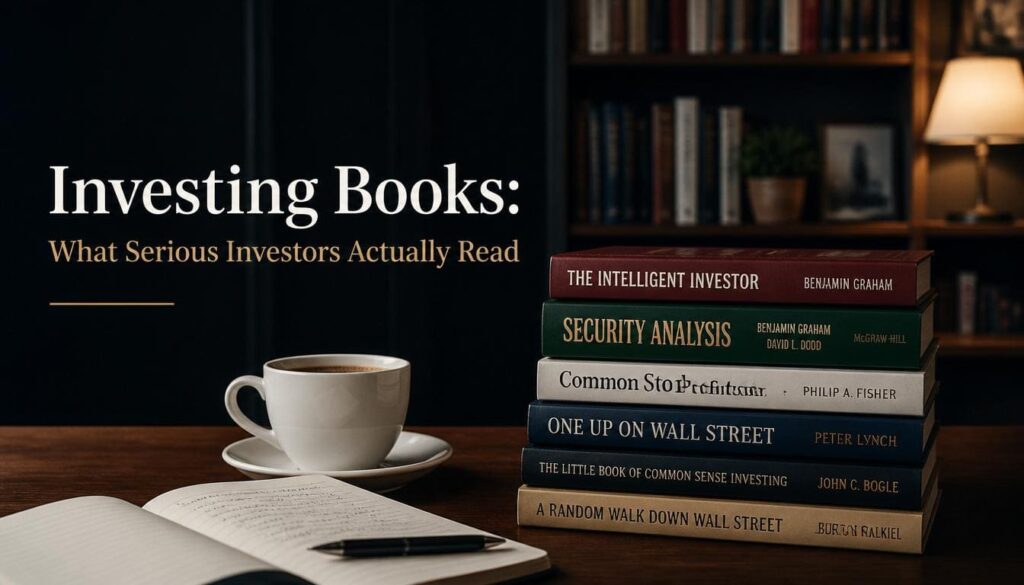
The Intelligent Investor by Benjamin Graham (Jason Zweig edition)
The foundational text of value investing. Graham’s concepts — intrinsic value, margin of safety, Mr. Market — remain the intellectual backbone of fundamental analysis. The Zweig revised edition is the only version worth reading; his updated commentary translates Graham’s 1949 professional text into accessible modern context. Essential, but not first — readers who aren’t ready for it will abandon it and conclude that investing is too complicated. Build foundation first with Collins or Bogle, then return to Graham.
The Psychology of Money by Morgan Housel
The most impactful investing book of the last decade. Housel’s argument — that financial success depends more on behavior than intelligence or technical knowledge — is supported throughout by precise, memorable stories. The chapter “Tails, You Win” alone is worth the price of the book: it explains why staying in the market through inevitable downturns is more valuable than finding better investments. Mandatory reading at every level. Re-read every few years as your experience grows.
A Random Walk Down Wall Street by Burton Malkiel
The most comprehensive empirical case for passive index investing. Malkiel examines every major active strategy and shows why each consistently fails to beat a diversified index after costs over long periods. Now in its 13th edition with sections on ETFs, cryptocurrency, and factor investing. Read this when you want to understand the theoretical and empirical foundation for why passive works, not just that it does.
Common Stocks and Uncommon Profits by Philip Fisher
The qualitative complement to Graham’s quantitative framework. Fisher focuses on evaluating management quality, competitive moat depth, and long-term growth potential — dimensions of business analysis that financial statements don’t capture. Warren Buffett has described his investment philosophy as “85% Graham, 15% Fisher.” Reading both explains how he actually evaluates businesses. Written in 1958, its insights on qualitative research remain as applicable today as when published.
The Most Important Thing by Howard Marks
Marks co-founded Oaktree Capital and is famous for client memos that Buffett reads as soon as they arrive. This book distills his most important investing concepts: second-level thinking, risk as the probability of permanent loss rather than volatility, market cycles, and the role of luck and skill in investment outcomes. His treatment of risk alone makes this book essential. Read after a few years of real investing experience — the concepts are clear but the wisdom lands differently once you’ve lived through a correction.
Underrated investing books that rarely appear on lists
These titles deserve far more attention than they receive. They don’t appear on most lists because they’re harder to summarize, less well-known, or generate less affiliate revenue. That scarcity of attention is precisely why they’re worth flagging.
The Missing Billionaires by Victor Haghani & James White (2023)
One of the most genuinely useful investing books published in years, and almost entirely absent from mainstream recommendation lists. Haghani — a founding partner of Long-Term Capital Management — asks why financial markets have created so much wealth yet so few billionaires persist across generations. The answer is systematic position sizing errors: most people consistently bet either too much or too little relative to their actual edge. The practical framework for correcting this — using expected utility theory — is more directly applicable to individual investment decisions than most of what appears on bestseller lists. The Economist named it one of the best finance books of 2023.
Just Keep Buying by Nick Maggiulli (2022)
Maggiulli is the Chief Operating Officer at Ritholtz Wealth Management and one of the best data-driven finance writers working today. His book takes conventional personal finance wisdom and runs it through actual data. His finding that lump-sum investing beats dollar-cost averaging two-thirds of the time — even though DCA feels safer — is the kind of counterintuitive, evidence-supported insight that changes real behavior. His analysis of when to pay off debt versus invest is the most honest treatment of this question available. Underrated because it was published without the marketing apparatus of a major publisher.
The Simple Path to Wealth by JL Collins (2016)
This book does not appear on most professional lists because it is almost insultingly simple: own a total market index fund, keep costs minimal, stay invested. Professionals recommend complex strategies; Collins recommends doing almost nothing. The irony is that his approach consistently outperforms most professional strategies over 10-year periods. For individual investors building long-term wealth, this is the most practically useful book on this entire list. Its absence from professional recommendation surveys reflects professional incentives, not investment reality.
Investing books that are overhyped relative to their actual value
Honest curation requires this section. These books appear on every list. Some contain value. All are overhyped relative to what they actually deliver.
Rich Dad Poor Dad — one useful idea, 300 pages of vagueness
Robert Kiyosaki’s book contains one genuine insight: assets put money in your pocket, liabilities take it out. That idea is worth about twenty pages. The remaining pages offer vague investing advice, a “rich dad” character widely believed to be fictional, and consistent upselling toward Kiyosaki’s own seminars. His specific investment recommendations — leveraged real estate, avoiding mutual funds — are presented without the risk disclosures those strategies require. The mindset shift it offers is available more accurately in Housel’s Psychology of Money.
The Snowball (Buffett biography) — better as inspiration than instruction
Alice Schroeder’s biography of Buffett is well-researched and genuinely illuminating about his character and approach. What it is not is an instruction manual. Understanding that Buffett reads annual reports for hours every day, identifies exceptional businesses with durable competitive advantages, and holds them for decades is not a replicable strategy for most individual investors — because most individual investors don’t have Buffett’s analytical infrastructure, time, or psychological constitution. Reading about his life is inspiring. Applying his method requires capabilities this book won’t give you.
Market Wizards by Jack Schwager — inspiring but un-actionable
Schwager’s interview collection is genuinely fascinating. The traders he profiles are remarkable. The problem: their approaches are so varied, and their edge so specific to their individual circumstances, background, and psychological profiles, that reading about their strategies provides limited actionable guidance for most investors. The book teaches you that exceptional traders exist and share certain character traits. It doesn’t teach you to replicate those traits. Valuable for inspiration and pattern recognition. Overrated as a practical guide.
How to build your investing library in the right order
The order in which you read investing books matters almost as much as which books you choose. Here is the sequence that produces the most durable understanding.
| Stage | Read | Why this order |
|---|---|---|
| Foundation | JL Collins → Morgan Housel | Build the strategy first, then the mindset to follow it |
| Theory | Malkiel → Bogle | Understand why the simple approach works before questioning it |
| Portfolio | Bernstein → Maggiulli | Asset allocation theory, then data-driven implementation |
| Cognition | Kahneman → Marks | Bias awareness first, then sophisticated risk frameworks |
| Fundamentals | Graham → Fisher | Valuation framework first, then qualitative judgment |
| Professional depth | Haghani/White → Lo → Buffett letters | Position sizing, adaptive markets, primary sources |
If you’re still building the investing foundation underneath all of this reading, start with our practical guides: how to start investing, how to invest with confidence, and the best high-yield investments in 2026.

Why most “investing books” lists miss the point
InvestmentNews: technically solid, audience too narrow
InvestmentNews’ investing books guide is better than most — it includes Fisher and Bogle alongside Graham and covers a reasonable range. The weakness is audience scope: it’s written primarily for financial advisors seeking to improve their professional knowledge, not for individual investors making decisions about their own portfolios. The books it recommends are good. The framing is wrong for most readers who land on it.
Morningstar: conflict of interest, beginner-only scope
Morningstar’s list remains limited to seven beginner titles and continues to include a book authored by Morningstar’s own Director of Personal Finance without disclosing the employment relationship. An intermediate or advanced investor gets nothing useful from this list.
Wall Street Prep: emoji-heavy, finance-bro tone, zero honest critique
Wall Street Prep’s value investing book list describes The Intelligent Investor with fire emojis and calls it “the GOAT of investing books.” It describes books as “hot takes” and promises readers they’ll “literally be reading Buffett’s mind.” This is content written to perform on social media, not to help someone make a reading decision. No limitations are mentioned for any book. No skip recommendations are made. Every title is uniformly excellent. That is not curation.
Gumroad pirated PDFs: still ranking, still wrong
A Gumroad page selling unauthorized PDF copies of seven copyrighted investing books for $1 continues to appear in search results for this keyword. Beyond the ethical and legal problems, the pack includes Rich Dad Poor Dad as a core investing title. It does not include Collins, Bernstein, Housel, or Maggiulli — four of the most practically useful books for individual investors. Buy the books. They cost less than one bad trade.
More reading from InvestClarify
- Best investing books: the definitive ranked list by level
- Best investment books: 15 picks organized by goal
- Best investing books 2026: new releases and updated rankings
- How to start investing: the complete beginner’s guide
- Early retirement through dividend investing
FAQ: Investing books
Disclaimer: This article is for educational and informational purposes only. It does not constitute financial advice. Investing involves risk, including the potential loss of principal. Always consult a qualified financial advisor before making investment decisions.