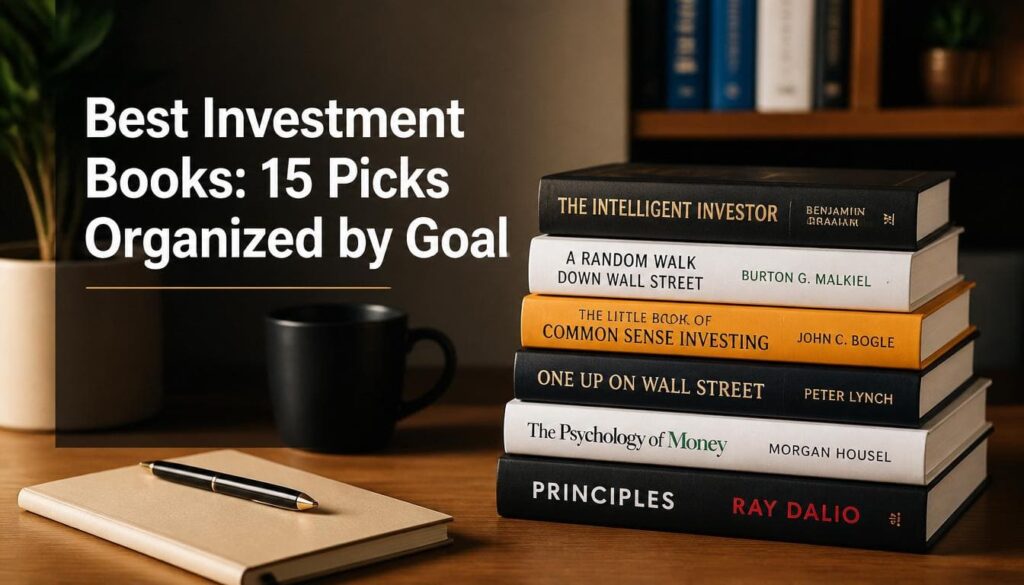
Most investment book lists are organized the wrong way. They rank by popularity, by how many Goodreads votes a book received, or simply by how famous the author is. None of those criteria answer the question you’re actually asking: which investment book should I read to achieve what I’m specifically trying to do?
This list organizes the best investment books by investment goal. Whether you want to build long-term passive wealth, understand how to evaluate individual companies, manage risk more rigorously, or think about market cycles and macro conditions — each section starts with the book that most directly addresses that objective. Read what fits your goal. Skip what doesn’t.
Table of Contents
- Goal: build long-term passive wealth
- Goal: understand value and evaluate individual companies
- Goal: find exceptional growth companies early
- Goal: understand and manage risk better
- Goal: understand why investors fail and how to avoid it
- Goal: understand market cycles and macro investing
- What other “best investment books” lists get wrong
- FAQ: Best investment books

Goal: build long-term passive wealth
These are the best investment books for investors who want to build wealth steadily over decades with minimal ongoing effort. The passive approach — low-cost index funds, consistent contributions, staying invested through downturns — has the strongest empirical track record of any investment strategy available to individual investors.
1. The Simple Path to Wealth by JL Collins
The most direct, practical, and complete guide to passive wealth building available. Collins distills decades of personal finance wisdom into a single actionable framework: own a total market index fund, keep costs minimal, stay the course. Written as letters to his daughter, it assumes no prior knowledge and wastes no words. If you implement its advice, you are already executing a strategy that outperforms most professional fund managers over any 10-year period.
The honest critique: US-focused, equity-heavy, and doesn’t address international diversification or bond allocation until late in the book. Adapt the specific fund recommendations if you’re outside the US.
2. The Little Book of Common Sense Investing by John C. Bogle
Bogle founded Vanguard and the first index mutual fund available to individual investors. His argument is pure arithmetic: in aggregate, all investors receive the market return before costs and below-market returns after costs. The only way to guarantee your fair share is to minimize costs. This isn’t philosophy — it’s math, and it’s been validated by every major long-term study of active vs. passive fund performance. Short, clear, and morally passionate.
3. A Random Walk Down Wall Street by Burton Malkiel
The most evidence-based intellectual case for passive investing available in book form. Malkiel systematically examines every major active strategy — technical analysis, fundamental analysis, growth investing, factor tilts — and shows why each consistently fails to beat a diversified index fund after costs over long periods. Now in its 13th edition with sections updated for ETFs, crypto, and factor investing. Essential if you want to understand why passive works, not just that it does.
4. The Four Pillars of Investing by William Bernstein
The most rigorous guide to portfolio construction for individual investors. Bernstein covers the theory, history, psychology, and business of investing, then synthesizes them into practical guidance on asset allocation across US stocks, international stocks, bonds, and REITs. His chapters on rebalancing and the role of bonds at different life stages are the clearest available. Best read after Collins or Bogle, when you’re ready to move beyond a single-fund portfolio.
Goal: understand value and evaluate individual companies
These investment books are for investors who want to move beyond index funds and learn how to evaluate whether a specific company’s stock represents good value. This is harder than passive investing and requires genuine time commitment — but these books give you the conceptual foundation to do it rigorously.
5. The Intelligent Investor by Benjamin Graham (Jason Zweig revised edition)
The foundational text of value investing. Graham introduces intrinsic value, margin of safety, and the Mr. Market metaphor — concepts that remain the intellectual backbone of serious fundamental analysis. Warren Buffett called it “by far the best book about investing ever written.” That endorsement is accurate — for investors who are ready for it. Read only the Jason Zweig revised edition; Zweig’s updated commentary contextualizes Graham’s 1949 text for modern markets and makes it navigable.
The honest critique: it assumes comfort with financial statements and market mechanics. Not a starting point for beginners — a destination for investors who already have the foundations.
6. Common Stocks and Uncommon Profits by Philip Fisher
The qualitative complement to Graham’s quantitative framework. Fisher focuses on what financial statements can’t capture: management quality, competitive moat depth, research and development culture, long-term growth potential. His “scuttlebutt” method — building investment insight through conversations with customers, suppliers, competitors, and employees — was revolutionary in 1958 and remains effective today. Buffett has described his philosophy as “85% Graham, 15% Fisher.” Reading both explains how he actually thinks about businesses.
7. Security Analysis by Graham & Dodd
The professional text that preceded The Intelligent Investor. More technical, more comprehensive, and less accessible — this is the book that institutional analysts and serious fundamental investors study. It covers financial statement analysis, bond valuation, preferred stock, and common stock evaluation in exhaustive detail. Not a casual read; a professional reference. Most individual investors are better served by The Intelligent Investor. Read this only if you intend to analyze securities with professional-level rigor.
Goal: find exceptional growth companies early
Growth investing focuses on identifying companies with exceptional long-term earnings potential and holding them through volatility. It requires genuine time commitment, strong conviction, and the ability to distinguish durable competitive advantages from temporary momentum.
8. One Up on Wall Street by Peter Lynch
Lynch managed the Fidelity Magellan Fund from 1977 to 1990, generating a 29.2% average annual return — one of the best track records in mutual fund history. His book explains how individual investors can identify exceptional companies before institutional investors catch on — by using everyday observation of products, services, and industries they actually understand. His taxonomy of stocks (stalwarts, fast growers, cyclicals, turnarounds, asset plays) remains one of the most useful frameworks in growth investing. Readable, funny, and practical.
The honest critique: Lynch’s approach requires significant research time and genuine interest in business. If you don’t enjoy reading annual reports and thinking about competitive dynamics, this strategy will feel like work. It is work.
9. 100 Baggers: Stocks That Return 100-to-1 by Christopher Mayer
Mayer studied every stock that returned 100x its purchase price from 1962 to 2014 and identified the common characteristics. The findings are counterintuitive in some ways: you don’t need to find companies before they’re well-known — you need to find companies with durable competitive advantages and hold them long enough for compounding to produce extraordinary returns. The book is a masterclass in patience as an investment strategy. Most investors sell their best positions far too early. This book explains why — and how to stop.
10. The Outsiders by William Thorndike
A study of eight unconventional CEOs who generated extraordinary long-term returns for shareholders by making disciplined capital allocation decisions rather than pursuing growth for its own sake. Thorndike’s book teaches investors how to evaluate management quality through the lens of capital allocation — a dimension of company analysis that most books ignore entirely. Warren Buffett called it “an outstanding book.” It changes how you think about what makes a great CEO, and therefore what makes a great investment.
Goal: understand and manage investment risk better
Risk is the most misunderstood concept in investing. Most investors define it as volatility — how much a portfolio fluctuates. The better definition is the probability of permanent loss of capital. These investment books address risk from multiple angles.
11. The Missing Billionaires by Victor Haghani & James White (2023)
One of the best investment books published in the last decade, and almost entirely overlooked by mainstream lists. Haghani — a founding partner of Long-Term Capital Management — asks why financial markets have created so much wealth yet so few billionaires persist across generations. The answer, he and White argue, is that people consistently bet either too much or too little relative to their actual edge and financial position. The book introduces expected utility theory as a practical framework for sizing investment decisions correctly. According to research from the Kauffman Foundation, sizing errors are among the most consistent destroyers of investment returns — and this is the book that addresses that problem most rigorously. The Economist named it one of the best finance books of 2023.
12. Against the Gods: The Remarkable Story of Risk by Peter Bernstein
The definitive history of how humanity learned to understand, measure, and manage risk. Bernstein traces the development of probability theory, statistics, and modern risk management from ancient civilizations through the twentieth century. For investors, the historical perspective is invaluable: understanding where the tools of risk measurement came from helps you understand their limitations as well as their power. A narrative history, not a how-to guide — but one of the most intellectually enriching books in the finance canon.
Goal: understand why investors fail and how to avoid it
13. The Psychology of Money by Morgan Housel
The most accessible and impactful behavioral finance book written in the last twenty years. Housel’s central argument — that financial success is determined more by behavior than by intelligence or technical knowledge — is supported by compelling stories and research throughout its nineteen chapters. The chapter “Tails, You Win” alone, explaining why staying invested matters more than finding the best stocks, is worth the price of the book. Mandatory reading for every investor at every level. Re-read it every few years as your experience grows.
14. Thinking, Fast and Slow by Daniel Kahneman
The Nobel Prize-winning foundation for everything we know about behavioral finance. Kahneman’s research on cognitive bias — overconfidence, loss aversion, anchoring, the availability heuristic — explains why even intelligent, informed investors make systematically bad decisions. Reading this book doesn’t eliminate these biases (nothing does, according to the research), but it makes you aware of them as they happen — which is the beginning of better decision-making.
Goal: understand market cycles and macro investing
15. Mastering the Market Cycle by Howard Marks
Marks co-founded Oaktree Capital and is known for client memos that Buffett reads as soon as they arrive. This book gives investors a practical framework for understanding where we are in a market cycle and positioning their portfolios accordingly. Marks is explicit that nobody can time markets precisely — but that doesn’t mean all points in a cycle are equal. Recognizing when markets are priced for greed vs. fear allows investors to tilt risk exposure in ways that improve long-term outcomes without requiring perfect prediction.
For investors who want more of Marks’ thinking, his companion book The Most Important Thing covers his broader investment philosophy — including his concept of second-level thinking, which is the most useful framework for developing genuine investment insight.

Quick reference: best investment books by goal
| Goal | Start with | Then read |
|---|---|---|
| Long-term passive wealth | JL Collins | Bogle → Malkiel → Bernstein |
| Value / company evaluation | Graham (Zweig edition) | Fisher → Graham & Dodd (reference) |
| Growth investing | Peter Lynch | Mayer → Thorndike |
| Risk management | The Missing Billionaires | Against the Gods |
| Behavioral understanding | Housel | Kahneman |
| Macro and cycles | Mastering the Market Cycle | The Most Important Thing (Marks) |
What other “best investment books” lists get wrong
Goodreads: 128 books, zero editorial judgment
The top result for “best investment books” is a Goodreads list with 128 titles voted on by 248 users. This is the investment book equivalent of asking a crowd to design an airplane. Crowd voting surfaces popular books, not useful ones. It produces a list heavily weighted toward well-known titles rather than books that are most useful for specific investment goals. There is no reading order, no organization by objective, no honest assessment of any book’s limitations. It’s a popularity contest, not a curated reading guide.
InvestmentNews: recommends Graham for beginners
InvestmentNews’ guide asks “What is the best book to learn to invest?” and answers: The Intelligent Investor by Benjamin Graham. This is precisely wrong for most readers. Graham’s book was written in 1949 for professional investors and assumes familiarity with financial statements, corporate accounting, and market mechanics that most beginners don’t have. Placing it first guarantees most readers will abandon it before Chapter 3 and conclude that investing is too complicated for them. The right first book is Collins or Bogle. Graham comes later.
Morningstar: self-promotion without disclosure
Morningstar’s list includes a book by Morningstar’s own Director of Personal Finance without disclosing the conflict of interest. Beyond this, their list is restricted to beginners and organized by familiarity of title rather than by investment objective. An experienced investor gets no useful signal from it.
The universal problem: organization by popularity, not utility
Every major “best investment books” list organizes books by some combination of sales figures, social votes, and name recognition. None organizes by investment goal — the most useful organizational principle for a reader who already knows what they’re trying to achieve. A long-term passive investor and an active value investor need completely different books. Giving them the same list helps neither. At InvestClarify, we start with your goal, not with whoever sold the most copies.
Go deeper with InvestClarify
- Best investing books: the definitive ranked list by level
- Best investing books 2026: new releases and updated rankings
- How to start investing: the complete beginner’s guide
- Best high-yield investments: ranked by risk and return
- How to invest with confidence: mindset and strategy
FAQ: Best investment books
Disclaimer: This article is for educational and informational purposes only. It does not constitute financial advice. Investing involves risk, including the potential loss of principal. Always consult a qualified financial advisor before making investment decisions specific to your situation.