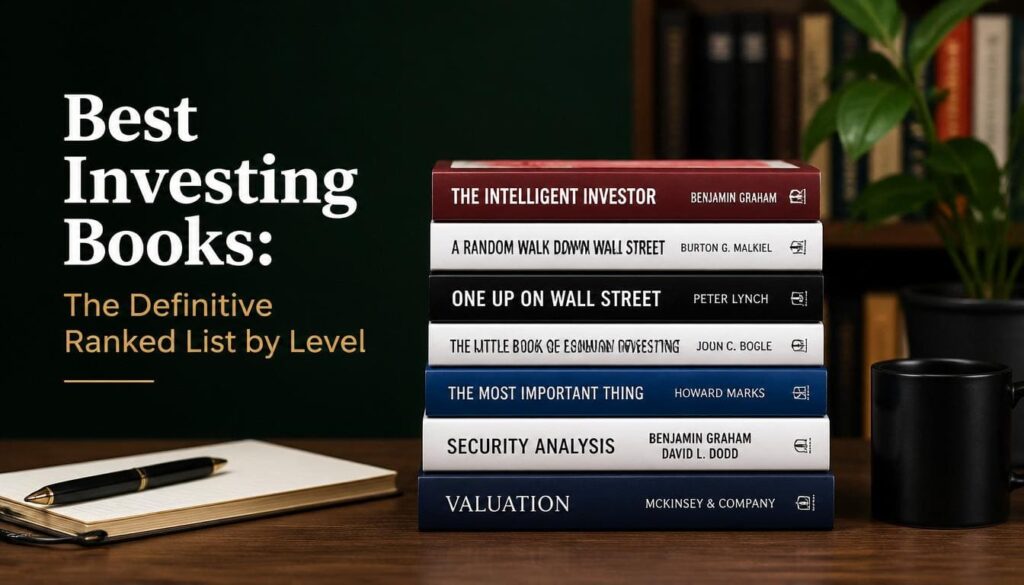
Every list of the best investing books has the same problem. It’s written for beginners only, while calling itself definitive. Or it recommends books the author has a financial interest in promoting — Morningstar’s list includes a book written by Morningstar’s own director of personal finance. Or it mixes budgeting guides, business memoirs, and get-rich-quick books with actual investing content and calls the whole thing “best investing books.”
This list is different in three ways. First, it covers every level — from absolute beginner to experienced investor — in clearly separated sections. Second, every recommendation includes an honest critique of that book’s limitations, not just its strengths. Third, there is a section telling you which famous books to skip and why. Nobody else does this, because every listing is a potential affiliate click. We don’t operate that way.
Table of Contents
- How to use this list
- Best investing books for complete beginners
- Best investing books for intermediate investors
- Best investing books for mindset and behavior
- Best investing books for advanced investors
- Famous investing books you can safely skip
- What other “best investing books” lists get wrong
- FAQ: Best investing books
How to use this list of the best investing books
Reading the wrong investing book at the wrong stage is worse than not reading at all. It either bores you out of the habit entirely, or worse, teaches you concepts you don’t have the context to apply correctly.
The structure here is simple. Start at your level. Read books in the order they appear within each section. Move to the next section when the books in your current section feel intuitive rather than challenging. There is no rush — understanding one book deeply is more valuable than skimming ten.
| Level | You’re here if… | Start with |
|---|---|---|
| Complete beginner | You’ve never invested, or feel lost when reading financial content | JL Collins |
| Intermediate | You invest regularly but want to deepen your understanding of markets and portfolio theory | Malkiel or Bernstein |
| Mindset | You have a strategy but struggle to follow it consistently | Housel or Kahneman |
| Advanced | You’re comfortable with portfolio theory and want deeper analytical frameworks | Graham or Fisher |

Best investing books for complete beginners
1. The Simple Path to Wealth by JL Collins — the best first investing book
Best for: Anyone who has never invested before and wants a complete, actionable framework fast.
JL Collins originally wrote this as a series of letters to his daughter when she showed no interest in finance. That context explains everything about what makes it work: it assumes zero prior knowledge, wastes no words, and gives you a complete strategy you can implement the same week you finish reading. Own a low-cost total market index fund like VTSAX or VTI, keep your savings rate high, stay the course through downturns, and let time do the heavy lifting.
What separates Collins from other beginner books is that he doesn’t just tell you what to do — he explains why it works with enough depth that you actually believe it. His chapter on why stock market declines are not disasters but buying opportunities is one of the best pieces of investor education written in any format.
The honest critique: it’s US-centric, focused almost entirely on equities, and doesn’t address bond allocation seriously until late in the book. International readers will need to adapt the specific fund recommendations.
Verdict: Read this first, regardless of your age or income. If you finish it and implement its advice, you’re already ahead of the vast majority of retail investors. Everything else on this list is refinement.
2. I Will Teach You to Be Rich by Ramit Sethi — the system builder
Best for: Young professionals (20s–30s) who need to build their complete financial infrastructure from scratch, not just pick investments.
Sethi’s book does something the other beginner investing books don’t: it tells you exactly how to set up the system around your investments. Which bank accounts to open. How to automate your savings. How to handle the 401(k) vs Roth IRA decision. How to invest your first dollars without overthinking it. The six-week program format makes it the most immediately actionable book on this list.
The honest critique: the investing advice is solid but thin. Sethi correctly directs you toward index funds and low-cost brokerages, but doesn’t go deep on portfolio theory or long-term strategy. Use it to build the system, then read Collins or Malkiel for the investing philosophy.
Verdict: Essential for readers who haven’t set up their financial accounts yet. If your infrastructure is already in place, skip it and go straight to Collins.
3. The Little Book of Common Sense Investing by John C. Bogle — from the founder of index funds
Best for: Beginners who want the definitive, concise argument for index fund investing from the person who invented it.
Jack Bogle created Vanguard and the first index mutual fund available to individual investors. His central argument is irrefutable arithmetic: in aggregate, all investors receive the market return before costs. After costs, they receive below-market returns. The only way to guarantee your fair share of market returns is to minimize costs through index funds. This isn’t a philosophy — it’s math. According to the SPIVA report from S&P Dow Jones Indices, over any 15-year period, more than 90% of actively managed US equity funds underperform their benchmark index. Bogle predicted this decades before the data confirmed it.
Short (under 300 pages), clearly written, and morally passionate, this is one of the most important investing books ever published.
Verdict: Read alongside Collins or immediately after. Together they form the most complete beginner case for passive investing available in book form.
Best investing books for intermediate investors
These books are for investors who have the basics in place and are ready to understand markets more deeply — how they work, how to build a durable portfolio, and how to think about asset allocation over decades.
4. A Random Walk Down Wall Street by Burton Malkiel — the intellectual case for passive investing
Best for: Investors who want to understand why passive index investing works — the theoretical and empirical foundation, not just the practical argument.
Malkiel’s core argument — that stock prices follow a “random walk” and cannot be consistently predicted — is one of the most well-supported ideas in all of finance. He walks through every major active investment strategy — technical analysis, fundamental analysis, growth investing, momentum trading — and shows systematically why each one fails to beat a diversified index fund over long periods once costs are accounted for.
Now in its 13th edition, Malkiel has updated the book to address ETFs, factor investing, cryptocurrency, and the 2022–2024 market environment. His treatment of each new asset class or strategy is consistent: show the evidence, not the marketing.
The honest critique: denser than Collins or Bogle. Some sections on efficient market theory get academic. Skip them if they slow you down and focus on the practical investment chapters.
Verdict: Essential. Read it once and you’ll never pay an active management fee again.
5. The Four Pillars of Investing by William Bernstein — the portfolio builder
Best for: Investors who are ready to move beyond “just buy one index fund” and think seriously about asset allocation, diversification, and portfolio construction.
Bernstein is a neurologist who became one of the most respected voices in investment theory — a combination that shows in how he approaches evidence. His four pillars are the theory of investing, the history of investing, the psychology of investing, and the business of investing. Together they give you a complete framework for building a portfolio that survives market downturns, inflation, and your own behavioral tendencies.
His asset allocation chapters are the best available anywhere. He explains how combining different asset classes — US stocks, international stocks, bonds, REITs — reduces portfolio risk while maintaining returns. His treatment of rebalancing and the role of bonds at different life stages is clear, evidence-based, and immediately applicable.
The honest critique: the most demanding read on the beginner and intermediate sections of this list. Read Collins first to build intuition, then return to Bernstein for the theory that supports it.
Verdict: The best book on portfolio construction for individual investors. Non-negotiable once you’re ready to think beyond a single-fund portfolio.
6. Just Keep Buying by Nick Maggiulli — the data-driven modern approach
Best for: Investors who want a rigorous, data-first approach to common financial questions — when to invest, how much to save, whether to pay off debt or invest, how to handle windfalls.
Maggiulli is the Chief Operating Officer at Ritholtz Wealth Management and one of the best data-driven finance writers working today. His blog Of Dollars and Data has built a large following for exactly the same reason his book works: he takes the conventional wisdom of personal finance and runs it through actual data to find out what’s true.
His finding that lump-sum investing beats dollar-cost averaging two-thirds of the time — even though DCA feels safer — is the kind of counterintuitive, evidence-supported insight that changes how you make decisions. So is his analysis of when it actually makes sense to pay off debt versus invest, and why most advice on this question ignores the real tradeoffs.
The honest critique: it’s strongest on the savings and accumulation questions and less detailed on portfolio construction. Read Bernstein alongside it for the allocation side.
Verdict: One of the best modern investing books published in the last five years. Read it after Collins and Bogle.
Best investing books for mindset and behavior
7. The Psychology of Money by Morgan Housel — the essential mindset book
Best for: Any investor at any level who wants to understand why intelligent people consistently make bad financial decisions — and how to avoid doing the same.
Morgan Housel is the best financial writer working today. His ability to turn behavioral finance research into clear, human stories is genuinely rare. The Psychology of Money argues that financial success is less about intelligence and technical knowledge than about behavior: patience, humility, avoiding catastrophic mistakes, and understanding your own relationship with money and risk.
The chapter “Tails, You Win” — explaining that a small number of events drive the majority of investment returns, and that your job is simply to stay in the game long enough for those events to happen — is worth the price of the book alone. Read alongside any tactical book on this list.
The honest critique: it’s a mindset book, not a strategy book. It won’t tell you what to buy. Read it alongside Collins or Malkiel.
Verdict: Mandatory reading for every investor at every level. Read it now, then re-read it every few years as your experience grows.
8. Thinking, Fast and Slow by Daniel Kahneman — the behavioral science foundation
Best for: Investors who want to understand the cognitive biases that cause even intelligent people to make systematically bad financial decisions.
Kahneman is a Nobel Prize-winning psychologist whose research is the intellectual foundation for everything we know about behavioral finance. His book explains the two systems of thinking — fast and intuitive versus slow and deliberate — and shows how the fast system produces predictable errors in financial judgment. Overconfidence, loss aversion, anchoring, narrative bias — each explained with compelling research. Once you’ve read Kahneman, you start noticing these errors in your own thinking in real time.
The honest critique: long and academic in places. The section on prospect theory is dense. Skip to the chapters most directly relevant to financial decision-making if you find the psychological research sections slow going.
Verdict: Read at any stage. The self-awareness it produces compounds over time like interest.
Best investing books for advanced investors
9. The Intelligent Investor by Benjamin Graham (Jason Zweig edition) — the value investing foundation
Best for: Investors who want to understand how to evaluate individual stocks and think rigorously about intrinsic value.
Graham’s masterwork introduces the concepts that define value investing: intrinsic value, margin of safety, Mr. Market, and the distinction between investment and speculation. Warren Buffett called it “by far the best book about investing ever written.” That endorsement has made it the most-recommended investing book in history — which also means it sits at number one on lists written by people who haven’t read it.
The honest critique: it is genuinely difficult. Written in 1949 for a professional audience, it assumes knowledge of financial statements and market mechanics that most readers don’t have. The Jason Zweig revised edition (read only this edition) makes it more accessible, but it’s still a demanding read. Beginners who start here will be lost. This book belongs at step 9, not step 1.
Verdict: Essential — but not first. Read it when you’re ready to analyze individual companies, not when you’re building your first index portfolio.
10. Common Stocks and Uncommon Profits by Philip Fisher — the qualitative framework
Best for: Investors who want to evaluate the qualitative dimensions of a business that financial statements alone cannot capture.
Where Graham focuses on what the numbers say, Fisher focuses on what numbers can’t capture: the quality of management, the depth of competitive advantage, the culture of innovation, the long-term growth potential. His “scuttlebutt” method — researching companies by talking to customers, suppliers, competitors, and employees — was revolutionary in 1958 and remains one of the most effective approaches to company research today. Warren Buffett has described his philosophy as “85% Graham and 15% Fisher.” Reading both explains how Buffett actually thinks.
Verdict: Read alongside or after Graham. Complementary, not redundant.
11. The Most Important Thing by Howard Marks — second-level thinking
Best for: Experienced investors who want more sophisticated frameworks for thinking about risk, value, and market cycles.
Howard Marks co-founded Oaktree Capital and is famous for his client memos, which Buffett reads as soon as they arrive. This book’s central idea — that successful investing requires “second-level thinking” (thinking about what others are thinking, and why the consensus is wrong) — is one of the most useful frameworks in investment literature. His treatment of risk as the probability of permanent loss rather than volatility is the best available anywhere.
Verdict: Read after a few years of real investing experience. The concepts are clear but the wisdom lands differently once you’ve lived through a significant market correction.
12. One Up on Wall Street by Peter Lynch — growth investing made human
Best for: Investors who want to understand how to identify exceptional individual companies using everyday observation and common sense.
Peter Lynch managed the Fidelity Magellan Fund from 1977 to 1990, generating a 29.2% average annual return — one of the best track records in mutual fund history. His book explains how: by investing in companies he understood, whose products he used, and whose fundamentals were strong but overlooked by Wall Street. His framework for categorizing stocks — stalwarts, fast growers, cyclicals, turnarounds, asset plays — remains one of the most useful organizational tools in growth investing.
The honest critique: Lynch’s approach requires significant research time. It is not passive. If you don’t want to analyze individual companies, this book will inspire you but you won’t be able to apply it.
Verdict: Read after Malkiel. Lynch and Malkiel represent opposing philosophies — active stock picking vs. passive indexing. Reading both gives you the intellectual tools to make an informed choice about which approach fits your temperament.

Famous investing books you can safely skip
This section exists because no other list includes it. Honest curation means telling you what not to read.
Rich Dad Poor Dad — skip
Robert Kiyosaki’s book has sold over 32 million copies and contains exactly one genuinely useful idea: assets put money in your pocket; liabilities take money out. That mental model is worth about 20 pages. The remaining 300 pages contain vague investing advice, a “rich dad” character widely believed by investigators to be fictional, and consistent upselling toward Kiyosaki’s own seminars and courses. His specific investing recommendations — real estate leverage, business building, avoiding mutual funds — are presented without the risk disclosures those strategies require. The version of the “rich dad” mindset you actually want is available more accurately in Housel’s Psychology of Money. Skip the original.
Think and Grow Rich — not an investing book
Napoleon Hill’s 1937 motivational classic appears on investing book lists because it mentions wealth. It is a self-help book about the power of positive thinking, written during the Great Depression, based on interviews whose accuracy has never been independently verified. Multiple biographers have raised serious questions about whether Hill met many of the people he claimed to have interviewed. Not an investing book. If you want mindset books grounded in actual evidence, read Kahneman or Housel instead.
The Total Money Makeover — useful but wrong category
Dave Ramsey’s book is genuinely excellent for its intended purpose: getting out of debt and building an emergency fund. It is not an investing book. His investing advice — specifically recommending actively managed mutual funds capable of returning 12% annually and dismissing index funds — contradicts decades of academic research and has been criticized publicly by prominent economists. Read it for the debt framework if you need it. Do not follow its investment guidance.
What other “best investing books” lists get wrong
Morningstar: recommends their own author
Morningstar’s list of best investing books includes Morningstar’s 30-Minute Money Solutions by Christine Benz, who is Morningstar’s own Director of Personal Finance. The conflict of interest is not disclosed anywhere on the page. The book may be genuinely useful — but placing it on a “best investing books” list without disclosing the author’s employment relationship is an editorial integrity problem. Additionally, Morningstar’s list covers beginners only, despite being titled as a general best-of guide.
U.S. News: beginner-only list with no honest critique
U.S. News’ “best investing books” list covers 11 books, all aimed at beginners. An experienced investor searching for what to read next gets no useful signal from this list. More importantly, not one of the 11 descriptions includes a single limitation or critique. Every book is described in unqualified positive terms. That is not editorial curation — it is catalog copy. Honest recommendations require acknowledging that every book has weaknesses.
Yahoo Finance: personal finance dressed as investing
Yahoo Finance’s list mixes genuine investing books with personal finance guides, budgeting books, and one book about commercial real estate investing. These are all valuable genres — but they are not the same genre. A reader who came for investing books and finds budgeting advice has been misdirected. The blurring of categories exists because a longer list captures more affiliate clicks across more search queries.
Gumroad/unauthorized PDFs — don’t use these
Several results for “best investing books” link to sites selling unauthorized PDF bundles of copyrighted books for $1. These are piracy operations. Beyond the obvious ethical and legal issues, the PDFs are often incomplete, improperly formatted, or outdated editions. Buy the books. They cost less than one bad trade.
Put the reading into practice
Books build the foundation. These InvestClarify guides help you implement what you’ve learned:
- How to start investing: the complete beginner’s guide
- Best investing books 2026: new releases and updated rankings
- Best high-yield investments: ranked by risk and return
- How to invest with confidence: mindset and strategy
- Early retirement through dividend investing
FAQ: Best investing books
Disclaimer: This article is for educational and informational purposes only. It does not constitute financial advice. Investing involves risk, including the potential loss of principal. Always consult a qualified financial advisor before making investment decisions.