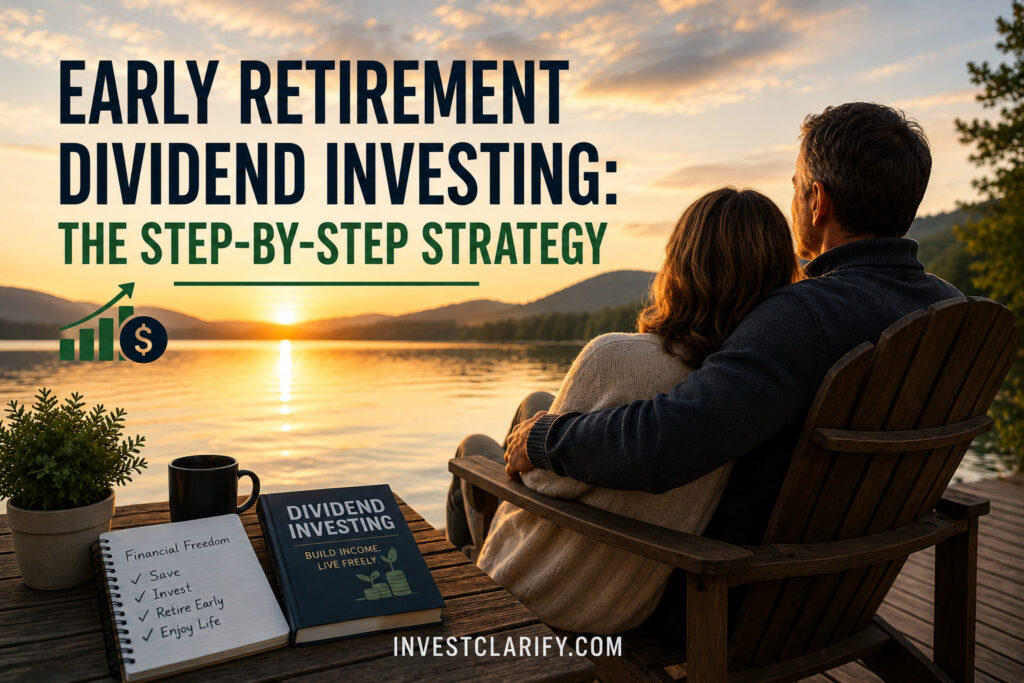
Early retirement dividend investing is one of the most important topics for US investors in 2026. Millions of Americans dream of leaving the workforce before the traditional retirement age of 65, but few understand how to build a reliable income stream that makes it possible. This comprehensive guide reveals the exact strategy you need to achieve financial independence through dividend-paying stocks.
According to recent data from the Federal Reserve, the average American has just $65,000 saved for retirement by age 55, which is nowhere near enough to retire comfortably. However, investors who focus on building dividend portfolios often achieve financial independence decades earlier by creating passive income streams that cover their living expenses. The power of compounding dividends combined with strategic reinvestment can transform modest monthly contributions into a retirement income machine that pays you for life.
What Is Early Retirement Dividend Investing?
Early retirement dividend investing is a wealth-building strategy that focuses on purchasing shares of companies that regularly pay dividends to their shareholders, with the specific goal of generating enough passive income to retire before the traditional retirement age. Unlike growth investing where profits come primarily from selling appreciated assets, dividend investing creates a stream of cash payments that can fund your lifestyle without depleting your principal. This approach allows investors to potentially retire in their 40s or 50s rather than working into their 60s or beyond.
For example, if you build a portfolio worth $1 million that yields an average of 4% in annual dividends, you would receive $40,000 per year in passive income without selling a single share. Companies like Johnson & Johnson, Procter & Gamble, and Coca-Cola have paid increasing dividends for over 50 consecutive years, providing reliable income streams that grow faster than inflation. The beauty of this strategy is that your dividend checks arrive whether the stock market is up, down, or sideways, giving you financial stability that pure growth investing cannot match.
Why Early Retirement Dividend Investing Matters for US Investors in 2026
The landscape for early retirement dividend investing has never been more favorable, with over 3,000 US companies currently paying dividends and many offering yields between 3-6%. Interest rates have stabilized after years of volatility, making dividend stocks an attractive alternative to bonds and savings accounts that often fail to keep pace with inflation. Furthermore, qualified dividends receive preferential tax treatment with rates of 0%, 15%, or 20% depending on your income level, which is significantly lower than ordinary income tax rates that can exceed 37%.
- Passive Income Generation: Dividend stocks pay you regular cash distributions quarterly or monthly, creating predictable income streams that can replace your salary and fund early retirement without requiring you to work.
- Inflation Protection: Quality dividend-paying companies typically increase their payouts annually, with Dividend Aristocrats averaging 3-5% annual dividend growth that helps your income keep pace with or exceed rising living costs.
- Tax Advantages: Qualified dividends are taxed at long-term capital gains rates rather than ordinary income rates, and strategic withdrawal planning can minimize or even eliminate taxes for early retirees in lower tax brackets.
- Portfolio Stability: Dividend-paying companies tend to be mature, profitable businesses with lower volatility than growth stocks, providing more stable returns that help you sleep better at night during market turbulence.
How to Get Started with Early Retirement Dividend Investing: Step-by-Step
Building a successful early retirement dividend investing portfolio requires a systematic approach that balances yield, growth, safety, and diversification across multiple sectors and companies.
- Step 1: Calculate Your Retirement Income Needs: Determine your annual living expenses and multiply by 25 to find your target portfolio size using the 4% rule as a baseline. For example, if you need $50,000 per year, you would aim for a $1.25 million portfolio that yields 4% in dividends, though you can adjust this based on your specific yield targets and risk tolerance.
- Step 2: Open a Tax-Advantaged Brokerage Account: Choose a low-cost broker like Fidelity, Charles Schwab, or Vanguard that offers commission-free trading and consider using both taxable brokerage accounts and Roth IRAs to maximize tax efficiency. Taxable accounts offer more flexibility for early retirement since you can access funds before age 59½ without penalties, while Roth IRAs provide tax-free growth and withdrawals in retirement.
- Step 3: Build a Diversified Dividend Portfolio: Allocate your investments across 25-40 individual dividend stocks or use low-cost dividend ETFs like SCHD, VYM, or DGRO to achieve instant diversification. Focus on Dividend Aristocrats and Dividend Kings that have raised dividends for 25+ and 50+ consecutive years respectively, and maintain exposure across all major sectors including consumer staples, healthcare, financials, utilities, and technology.
- Step 4: Reinvest Dividends During Accumulation Phase: Enroll in dividend reinvestment plans (DRIPs) to automatically purchase additional shares with your dividend payments, harnessing the power of compound growth to accelerate your portfolio’s expansion. Once you reach your target portfolio size and are ready to retire early, switch from reinvesting to collecting the cash dividends to fund your living expenses.
- Step 5: Monitor and Rebalance Quarterly: Review your holdings every three months to ensure no single position exceeds 5% of your portfolio and that sector allocations remain balanced. Replace any companies that cut dividends or show deteriorating fundamentals with stronger alternatives, and gradually shift toward higher-yielding positions as you approach your early retirement date.
- Step 6: Create a Sustainable Withdrawal Strategy: Plan to live on dividends alone during market downturns and consider harvesting some capital gains during bull markets to supplement income or build cash reserves. Maintain 1-2 years of living expenses in a high-yield savings account as a buffer to avoid selling stocks during temporary market declines.
Early Retirement Dividend Investing: Common Mistakes to Avoid
Many beginners make critical errors when implementing early retirement dividend investing strategies that can derail their financial independence goals and leave them working far longer than necessary.
- Mistake 1: Chasing Extremely High Yields: Dividends above 7-8% often signal financial distress or unsustainable payout ratios rather than attractive opportunities. Companies with yields in the 10-15% range frequently cut their dividends, causing both income reduction and severe capital losses that can set your retirement plans back years.
- Mistake 2: Lacking Sector Diversification: Concentrating too heavily in high-yielding sectors like utilities, REITs, or energy exposes you to sector-specific risks that can devastate your portfolio. The 2020 energy sector collapse and dividend cuts from companies like ExxonMobil and Occidental Petroleum demonstrated how quickly concentrated portfolios can lose both value and income.
- Mistake 3: Ignoring Dividend Growth: Focusing exclusively on current yield while disregarding dividend growth rates leaves you vulnerable to inflation eroding your purchasing power over 30-40 year retirements. A stock yielding 3% that grows dividends 8% annually will produce more income within a decade than a 6% yielder with no growth, making growth rate analysis essential for long-term success.
- Mistake 4: Failing to Account for Taxes: Not understanding the difference between qualified and non-qualified dividends or holding income-producing assets in the wrong account types can cost you thousands in unnecessary taxes. REITs and MLPs generate ordinary income rather than qualified dividends, making them better suited for tax-advantaged accounts like IRAs when possible.
- Mistake 5: Underestimating Required Portfolio Size: Many aspiring early retirees calculate their needs based on current expenses without factoring in healthcare costs before Medicare eligibility, inflation over multi-decade retirements, or maintaining an emergency fund. Healthcare alone can cost $15,000-20,000 annually for a couple in their 50s purchasing private insurance, significantly increasing the portfolio size needed for sustainable early retirement.
Successful dividend investors study the fundamentals including payout ratios below 75%, consistent earnings growth, strong balance sheets with manageable debt, and competitive advantages that protect market share. They understand that sustainable wealth building requires patience, discipline, and focusing on quality companies rather than chasing the highest yields or trying to time the market.
For more information, visit Investopedia or the official SEC website.
Frequently Asked Questions About Early Retirement Dividend Investing
What is early retirement dividend investing and how does it work?
Early retirement dividend investing is a strategy where you build a portfolio of dividend-paying stocks that generate enough passive income to cover your living expenses, allowing you to retire before the traditional age of 65. You purchase shares of established companies that distribute a portion of their profits to shareholders quarterly, and as your portfolio grows through contributions and dividend reinvestment, your income stream increases until it can sustain your lifestyle. The key is accumulating enough dividend-paying assets that the annual income they produce equals or exceeds your annual spending needs.
Is early retirement dividend investing a good option for beginners?
Yes, dividend investing is actually one of the most beginner-friendly strategies because it focuses on established, profitable companies with proven business models rather than speculative growth stocks. The regular cash payments provide tangible feedback on your investment progress and help instill disciplined saving habits. However, beginners should start with diversified dividend ETFs before selecting individual stocks, and they must commit to consistent investing over 15-25 years to accumulate sufficient assets for early retirement.
How much money do I need to start with early retirement dividend investing?
You can begin early retirement dividend investing with as little as $100 through fractional shares and low-cost ETFs, though your ultimate target depends on your lifestyle expenses. Using the 4% rule as a guideline, you would need approximately $1 million to generate $40,000 in annual dividend income, or $1.5 million for $60,000 annually. Most successful early retirees invest 30-50% of their income for 15-20 years, combining aggressive saving rates with dividend growth and reinvestment to reach their goals.
What are the risks of early retirement dividend investing?
The primary risks include dividend cuts during recessions, concentration in specific sectors, inflation eroding purchasing power, and sequence of returns risk if you retire right before a major market decline. Unlike traditional retirees who have pension income or Social Security as a safety net, early retirees rely entirely on their portfolios and may need to return to work if their income proves insufficient. Healthcare costs, unexpected expenses, and living longer than anticipated can also strain portfolios, making it essential to build in safety margins and maintain flexible spending during down markets.
How long does it take to achieve early retirement through dividend investing?
The timeline depends on your saving rate, starting capital, investment returns, and income needs, but most investors require 15-25 years of consistent investing to achieve early retirement dividend investing goals. Someone saving 50% of a $100,000 household income and earning 8% annual returns could potentially retire in 15-17 years, while someone saving 20% might need 30+ years. Starting earlier provides more time for compounding to work its magic, and increasing your savings rate has a more dramatic impact than chasing higher returns.
Should I focus on high dividend yields or dividend growth?
The optimal approach balances both current yield and future dividend growth based on how close you are to early retirement. Investors with 20+ years until retirement should emphasize dividend growth stocks yielding 2-3% that increase payouts 8-12% annually, as the compounding growth will produce superior income over time. Those within 5-10 years of retirement can shift toward higher current yields of 3-5% with moderate growth rates of 4-6%, providing more immediate income while still maintaining purchasing power.
Conclusion: Is Early Retirement Dividend Investing Right for You?
Early retirement dividend investing offers a proven pathway to financial independence for disciplined investors willing to save consistently, invest in quality companies, and maintain a long-term perspective through market cycles. This strategy has enabled thousands of Americans to leave the workforce in their 40s and 50s by building portfolios that generate reliable passive income streams. While it requires significant upfront saving and patience, the freedom to control your time and pursue your passions decades before traditional retirement age makes the sacrifice worthwhile for many investors.
The key to success with early retirement dividend investing lies in starting as early as possible, maximizing your savings rate, diversifying across sectors and companies, and focusing on sustainable dividends rather than chasing unsustainably high yields. Whether you are just beginning your career or already have a decade of investing experience, implementing these strategies today puts you on the path toward financial independence. Remember that every dividend payment brings you one step closer to the day when your investment income permanently exceeds your expenses.
If you are ready to take the next step with early retirement dividend investing, start your investment journey today and build the financial future you deserve.