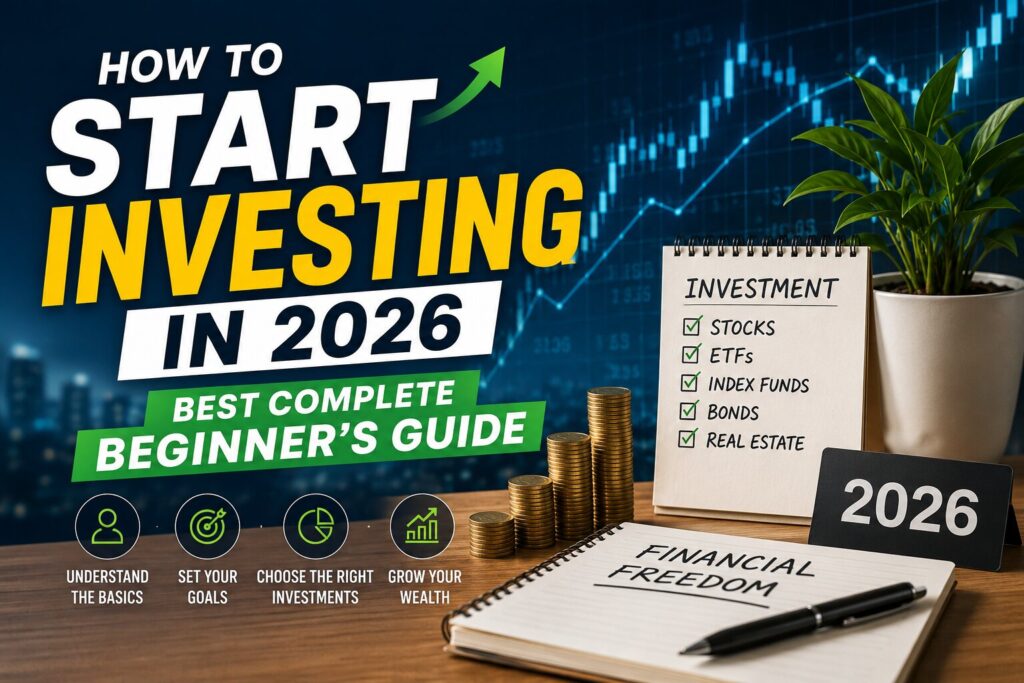
I remember the first time I tried to figure out how to start investing. I opened three browser tabs, read half an article about P/E ratios, watched a YouTube video that assumed I already knew what a brokerage was, and closed everything 20 minutes later more confused than when I started.
If that sounds familiar, this guide is for you.
Here’s what I’m going to do differently: explain investing the way I wish someone had explained it to me — in plain English, in a logical order, without assuming you already know anything. By the time you finish reading, you’ll know exactly how to start investing today.
Why Start Investing Now: The Power of Time
Here’s an uncomfortable truth: keeping money in a regular savings account is quietly losing you money. Most traditional savings accounts pay around 0.5% interest or less. Meanwhile, inflation erodes purchasing power by 2–3% per year. That gap adds up fast.
If you invest $500 a month starting at age 25 and earn a 7% average annual return — roughly the inflation-adjusted historical average of the S&P 500 — you’ll have around $1.2 million by age 65. Wait until 35, and you end up with about $590,000. Less than half, despite only missing 10 years.
That’s the power of compounding. Time is quite literally money. According to Investopedia’s guide to compound interest, even small amounts invested consistently early on can grow to life-changing sums — making the timing of your first investment one of the most important financial decisions you’ll ever make.
Starting in 2026 is also easier than ever. Fractional shares let you buy into any ETF with as little as $1. Commission-free trading is standard. Top brokerages cost nothing to open. The only thing standing between you and your first investment is getting started.

Before You Start Investing: 3 Steps to Get Right First
These three steps separate investors who build real wealth from those who panic-sell during the first market dip because they needed cash.
1. Build a real emergency fund
An emergency fund is 3 to 6 months of living expenses in a high-yield savings account — liquid, accessible, boring. Not in the market. Without one, the next time your car breaks down, you’ll be forced to sell your investments at a loss. High-yield savings accounts in 2026 are paying 4–5% APY, which is a decent return for money that needs to stay safe.
2. Pay off high-interest debt first
Carrying credit card debt at 22% APR? Paying that off is a guaranteed 22% return. No investment reliably beats that. Clear any debt above 7–8% before putting money in the market. Lower-rate debt like student loans or a mortgage is different — investing in parallel usually makes more sense there.
3. Define your goal and timeline
Why are you investing? This single question shapes every decision that follows.
- Retirement in 30+ years? Go heavy on stocks — you can handle short-term volatility.
- House down payment in 3 years? Keep that money out of the stock market entirely.
- Passive income stream? Dividends and REITs become part of your plan.
How to Start Investing: The Main Asset Types Explained
You don’t need to understand every financial product. Here are the ones that actually matter when learning how to start investing.
Stocks
A stock is a fractional ownership stake in a company. Buy a share of Apple, and you own a tiny slice of Apple — its assets, earnings, and future growth. If the company does well, the stock rises. If it doesn’t, it falls. Picking individual stocks is genuinely hard — professional fund managers fail to beat a simple market index most years.
ETFs — the best starting point for beginners
An ETF is a bundle of investments — stocks, bonds, or both — you can buy like a single stock. An S&P 500 ETF gives you exposure to 500 of America’s largest companies with one purchase. ETFs are low-cost, instantly diversified, and require almost no management. The best ones charge under 0.03% per year — that’s $3 annually on a $10,000 investment.
Index funds
Index funds work like ETFs but are bought and sold once a day at closing prices. The principle is the same: track a market index passively instead of trying to beat it. Over 10+ year periods, index funds outperform the majority of actively managed funds. Lower fees, lower stress, better results.
Bonds
Buying a bond means lending money to a government or corporation in exchange for regular interest payments. Bonds are more stable than stocks but offer lower long-term returns. For investors under 40, bonds typically represent a small slice of the portfolio — maybe 10–20%. That share grows as you age and get closer to needing the money.
REITs
REITs let you invest in real estate without buying property. By law they must distribute at least 90% of taxable income to shareholders, making them reliable dividend payers. Our full guide on how to get started in real estate investing covers REITs in detail.
Quick comparison of investment types
| Type | Risk | Avg. annual return | Best for |
|---|---|---|---|
| S&P 500 ETF | Medium | ~10% nominal / ~7% real | Long-term wealth |
| Total market index fund | Medium | ~9–10% | Broad passive growth |
| Government bonds | Low | 3–5% | Stability |
| Individual stocks | High | Variable | Experienced investors |
| REITs | Medium | 8–12% | Dividend income |
| High-yield savings | Very low | 4–5% (2026) | Emergency fund |
How to Start Investing: Choosing the Right Account
Where you invest matters almost as much as what you invest in. Tax-advantaged accounts can be worth tens of thousands of dollars over a lifetime.
401(k) — start here if your employer matches
A 401(k) is a retirement account offered through your employer. Contributions come out pre-tax, reducing your taxable income today. The killer feature: employer matching. If your company matches 50% of contributions up to 6% of salary, that’s a guaranteed 50% return on that money before the market does anything. Always contribute enough to get the full match — it’s free money. The 2026 contribution limit is $23,500 ($31,000 if you’re 50 or older).
Roth IRA — the smart choice for most beginners
A Roth IRA is funded with after-tax dollars. All growth inside the account is completely tax-free — forever. When you withdraw in retirement, you owe nothing to the IRS. For most people in their 20s and 30s, the Roth IRA is the single best investment account available. The 2026 limit is $7,000 per year ($8,000 if 50+). Income limits apply — check IRS eligibility if your income is high.
Taxable brokerage — after you’ve maxed everything else
No contribution limits, no withdrawal restrictions, no special tax advantages. You’ll pay capital gains tax on profits when you sell. Use this account after maxing tax-advantaged options, or for goals you might need money for before retirement age. Priority order: 401(k) match → Roth IRA → more 401(k) → taxable brokerage.
How to Start Investing Step by Step: Your First Trade
Step 1: Choose a brokerage
Fidelity, Vanguard, or Charles Schwab are the best choices for beginners in 2026. All are commission-free, reputable, and beginner-friendly. Fidelity offers zero-expense-ratio index funds exclusive to their platform.
Step 2: Open and fund the account
Open a Roth IRA on the brokerage’s website. It takes 15 minutes. You’ll need your Social Security number and bank account details. Link your bank and transfer money in. Settlement takes 1–3 business days.
Step 3: Choose your first ETF
Keep it simple. Any of these three is an excellent first investment:
- VTI — Vanguard Total Stock Market ETF (0.03% expense ratio)
- FZROX — Fidelity ZERO Total Market Index Fund (0.00%)
- SCHB — Schwab U.S. Broad Market ETF (0.03%)
Step 4: Place the order and automate
Search the ticker, click Buy, enter a dollar amount, and confirm. Use a market order. Then immediately set up automatic monthly contributions — even $50 or $100. This single habit will do more for your long-term wealth than any stock pick ever will.

Best Investing Strategies for Beginners in 2026
Dollar-cost averaging: stop trying to time the market
Dollar-cost averaging (DCA) means investing a fixed amount on a regular schedule regardless of market conditions. When prices are high, you buy fewer shares. When prices are low, you buy more. It works because you stop thinking about it. Our guide on investing in a down market shows exactly how DCA plays out during volatile periods.
The three-fund portfolio: simple and proven
Three funds. One rebalancing per year. Consistently beats the majority of actively managed strategies over 10+ years: a US total market ETF (growth), an international ETF (diversification), and a US bond ETF (stability). Subtract your age from 110 to get your stock percentage. At 30: 80% stocks, 20% bonds.
Dividend investing: building passive income
Some investors focus on stocks and ETFs that pay regular dividends — cash distributions from company profits. This creates income without selling assets, especially appealing for early retirement planning. Read the full breakdown: early retirement through dividend investing.
5 Costly Beginner Investing Mistakes to Avoid
1. Waiting for the perfect moment
There is no perfect moment. Research is clear: investing immediately — even consistently at market peaks — outperforms waiting for a dip over long periods. Start now. Optimize later.
2. Panic-selling during corrections
Corrections happen every 1–2 years. Bear markets every few years. Both feel alarming and both have been followed by full recoveries. Investors who get hurt are those who sell during the drop and miss the recovery. The right response is almost always: do nothing.
3. Paying too much in fees
A 1% annual fee vs. 0.03% on $100,000 over 30 years can cost you over $150,000 in foregone growth. Always check the expense ratio. For index ETFs, anything above 0.20% needs justification.
4. Skipping tax-advantaged accounts
Investing in a taxable brokerage while your Roth IRA sits empty is like refusing free money. Always fill tax-advantaged accounts before going taxable.
5. Overcomplicating the portfolio
Forty stocks and twelve ETFs don’t make you a better investor. They make you a busier one. Keep it simple enough that you actually stick to it — consistency beats complexity every time.
How Much Money Do You Need to Start Investing?
The standard financial planning target is 15% of gross income per year for retirement. Start with whatever you can manage consistently without stress — even $25 a month builds the habit. Increase incrementally with every raise or paid-off debt. A $100/month investor who stays the course for 30 years will likely outperform a $500/month investor who stops after 3 years.
Have a lump sum? Our guide on how to invest $10,000 breaks down the best options by goal and risk level. New grad? The debt-free college graduate investing guide is built for your exact situation. Want to build confidence first? Read how to invest with confidence.
What Other Guides Get Wrong About How to Start Investing
I spent time reading the most popular beginner investing guides currently ranking on Google. Some are genuinely useful. But all of them have gaps — things they skip, oversimplify, or get wrong. Here’s an honest breakdown, and what we do differently at InvestClarify.
Ramsey Solutions: good foundation, but pushes you toward paid advisors
Dave Ramsey’s guide is structured and beginner-friendly. The Baby Steps framework is genuinely helpful for people who are new to personal finance entirely. But there’s a problem: the guide consistently steers readers toward Ramsey’s “SmartVestor Pros” — a paid network of financial advisors who pay Ramsey to be listed. For a beginner investor following a simple three-fund or index fund strategy, this advice is unnecessary and potentially expensive. A commission-based advisor adds a layer of cost that will compound against you for decades. For most beginners, a good book and a low-cost brokerage are all you need.
The guide also avoids any mention of specific ETF tickers or concrete expense ratios. It’s deliberately vague on the “what to actually buy” part — the exact question beginners are asking. We name the funds. We give the numbers.
WalletGrower: good content buried under monetization
WalletGrower’s investing guide has solid information and covers the right topics. The problem is the experience of reading it. The article is interrupted by banners promoting cash-back games, paid surveys, and affiliate platform comparisons. There are popup offers to “start earning before you finish reading.” For a beginner who came looking for calm, clear investing education, this is the opposite of that.
The platform comparison section — ranking Webull, Acorns, and Robinhood alongside Fidelity and Schwab — is where the affiliate revenue motive becomes most visible. Robinhood has well-documented issues around gamified design, payment for order flow, and trading outages during volatile markets. A guide truly written for beginners wouldn’t give it equal billing with Fidelity.
Prof. Stacy (The Money Teacher): thorough but lacks actionable specifics
Prof. Stacy’s guide is well-written and genuinely educational in tone. The emphasis on understanding what investing actually is before diving into accounts is a good approach. The problem is that the guide stays at 30,000 feet for too long. It explains concepts carefully but rarely gives you something to do next.
After reading it, you understand what a brokerage account is and why an emergency fund matters. But you don’t know which brokerage to open, which ETF to buy on day one, or what a realistic first month looks like. Good theory. Not enough practice.
The Land Geek: generic content, wrong audience
The Land Geek’s beginner investing guide reads like AI-generated content written for a general financial audience without a specific reader in mind. The advice is technically correct but generic to the point of being unhelpful. It recommends “stocks, bonds, mutual funds, and REITs” without explaining which one a complete beginner should actually start with, in what proportion, or through which account.
There’s also a mismatch between the site’s core audience (land investing and real estate) and the beginner stock market content. The result is a guide that feels like it exists for SEO traffic rather than to genuinely help someone take their first investing step.
What we do differently at InvestClarify
We don’t sell advisor referrals. We don’t earn commissions for recommending specific brokerages or platforms. We don’t fill guides with surveys and cashback offers.
What we do: name specific ETFs (VTI, FZROX, SCHB), give real numbers (expense ratios, contribution limits, return averages), explain the exact steps in order, and answer the questions beginners are too embarrassed to ask. Every guide on this site is written to help you take a real action today — not to keep you reading indefinitely or funnel you toward a paid product.
| Guide | What they do well | Key weakness |
|---|---|---|
| Ramsey Solutions | Clear structure, baby steps framework | Pushes paid advisor network, avoids specific fund recommendations |
| WalletGrower | Good coverage of platforms and accounts | Heavy monetization, promotes gamified apps like Robinhood |
| Prof. Stacy | Calm, educational tone, good on concepts | Too abstract — no specific ETFs, tickers, or first-step actions |
| The Land Geek | Covers basic terminology | Generic, no audience focus, unclear on what to actually buy first |
| InvestClarify | Specific tickers, real numbers, no affiliate bias | No paid advisor network (that’s intentional) |
FAQ: How to Start Investing — Beginner Questions Answered
Keep Learning About Investing
This guide gives you the foundation. Here’s where to go deeper:
- How to invest with confidence: mindset and strategy
- Best high-yield investments in 2026: ranked by risk and return
- 15 best investing books in 2026
- Best investing podcasts in 2026
- Early retirement through dividend investing
Disclaimer: This article is for educational and informational purposes only. It does not constitute financial advice. Investing involves risk, including the potential loss of principal. Always consult a qualified financial advisor before making investment decisions.