You want to learn how to invest — but you don’t know where to start. You’ve heard names like Warren Buffett, Benjamin Graham, and Morgan Housel thrown around, but with hundreds of investing books on the market, you have no idea which ones are actually worth your time in 2026.
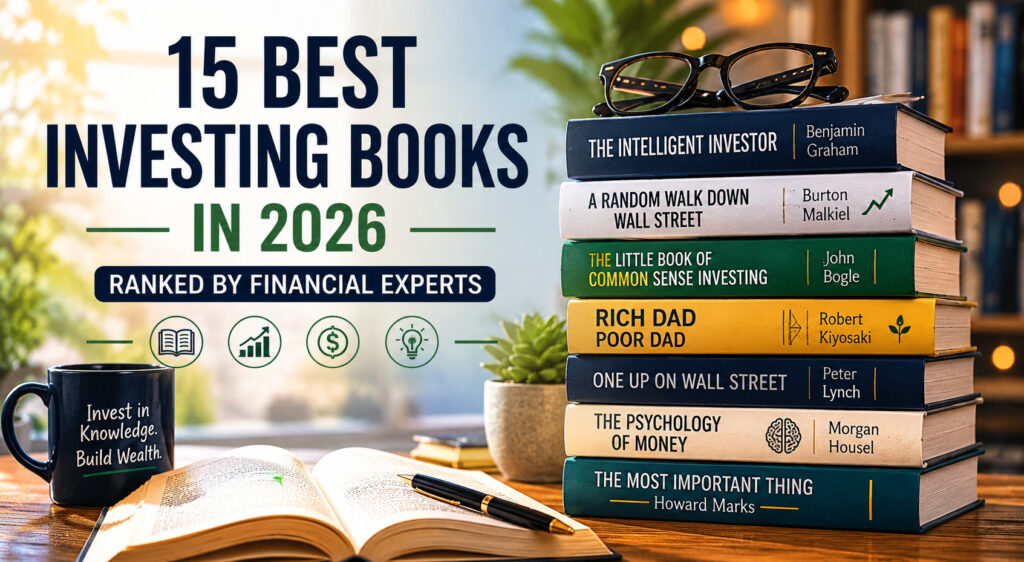
That’s exactly what this guide solves. After reviewing dozens of titles, we’ve selected the 15 best investing books for every experience level — from complete beginners who’ve never bought a stock, to seasoned investors looking to sharpen their edge.
Whether you want to understand index funds, master value investing, or fix your money mindset, the right investing books can transform your financial future. There’s one on this list for every type of reader.
Why Reading Investing Books Still Matters in 2026
In the age of YouTube shorts and TikTok finance advice, it’s tempting to skip investing books entirely. But here’s the truth: the best investors in the world are obsessive readers. Warren Buffett reads 500 pages a day. Charlie Munger built his entire worldview through investing books and business biographies.
A great investing book compresses decades of real-world experience into a few hours of reading. Unlike trending videos that come and go, the books on this list have survived multiple market crashes, recessions, and bull runs. They’re not just relevant — they’re timeless.
Quick Comparison: Best Investing Books 2026
| Book | Author | Level | Best For |
|---|---|---|---|
| The Psychology of Money | Morgan Housel | Beginner | Money mindset |
| The Little Book of Common Sense Investing | John Bogle | Beginner | Index fund strategy |
| The Intelligent Investor | Benjamin Graham | Intermediate | Value investing |
| A Random Walk Down Wall Street | Burton Malkiel | Beginner–Intermediate | Market theory |
| Rich Dad Poor Dad | Robert Kiyosaki | Beginner | Financial mindset |
| One Up On Wall Street | Peter Lynch | Intermediate | Stock picking |
| The Millionaire Next Door | Thomas Stanley | Beginner | Wealth habits |
| Common Stocks and Uncommon Profits | Philip Fisher | Intermediate | Growth investing |
| I Will Teach You to Be Rich | Ramit Sethi | Beginner | Personal finance system |
| Think and Grow Rich | Napoleon Hill | Beginner | Wealth psychology |
| The Bogleheads’ Guide to Investing | Larimore, Lindauer, LeBoeuf | Beginner | Long-term passive investing |
| Security Analysis | Graham & Dodd | Advanced | Deep value investing |
| Reminiscences of a Stock Operator | Edwin Lefèvre | Intermediate | Trading psychology |
| The Warren Buffett Way | Robert Hagstrom | Intermediate | Buffett’s framework |
| Your Money or Your Life | Vicki Robin | Beginner | Financial independence |
The 15 Best Investing Books in 2026
1. The Psychology of Money — Morgan Housel
Best for: Understanding why you make bad financial decisions — and how to stop.
If you read only one book from this list, make it this one. Morgan Housel’s The Psychology of Money doesn’t teach you stock formulas or portfolio theory. Instead, it reveals something far more valuable: your behavior is more important than your knowledge when it comes to building wealth.
Through 19 short, punchy chapters, Housel explains how greed, fear, and overconfidence cause even brilliant people to make terrible financial decisions. The chapter on compound interest alone — using Warren Buffett as an example — will change how you think about patience forever.
Key takeaway: Getting wealthy and staying wealthy are two different skills. Most people only practice the first one.
You can find this book on Amazon here.
2. The Little Book of Common Sense Investing — John Bogle
Best for: Beginners who want the simplest, most effective investing strategy.
John Bogle founded Vanguard and invented the index fund. The Vanguard portfolio allocation guide is a great companion resource to this book. In this book, he makes an argument so simple it’s almost uncomfortable: stop trying to beat the market, and just own the market.
Backed by decades of data, Bogle shows that the vast majority of actively managed funds underperform low-cost index funds after fees. His advice: buy a total stock market index fund, keep costs low, and hold forever.
In 2026, with markets more volatile than ever, this message is more relevant than it has ever been.
Key takeaway: The simplest investing strategy — buy index funds and hold — beats 90% of professional fund managers over the long run.
3. The Intelligent Investor — Benjamin Graham
Best for: Understanding value investing and avoiding market speculation.
Warren Buffett has called this the best book on investing ever written. Benjamin Graham, Buffett’s own mentor at Columbia Business School, introduced the concept of value investing — the idea that you should only buy a stock when it’s trading below its true intrinsic value.
The book introduces two iconic characters: the defensive investor (patient, passive, low risk) and the enterprising investor (active, research-driven, higher reward). Graham’s framework for the “margin of safety” is the backbone of virtually every serious investor’s strategy today.
It’s not a light read — but the updated commentary by Jason Zweig makes it far more accessible for modern readers.
Key takeaway: The stock market is there to serve you, not to instruct you. Buy when prices are irrationally low; ignore the noise the rest of the time.
Learn more about Graham’s approach at the CFA Institute’s overview of value investing.
4. A Random Walk Down Wall Street — Burton Malkiel
Best for: Understanding how markets work and why passive investing wins.
First published in 1973 and updated regularly since, Burton Malkiel’s classic argues that stock prices move randomly, making it nearly impossible to consistently outperform the market through stock picking or timing.
He walks through every major investment strategy — technical analysis, fundamental analysis, growth investing — and systematically dismantles the idea that any of them provide a reliable edge. The conclusion: a diversified index fund portfolio beats almost everything else.
Key takeaway: A blindfolded monkey throwing darts at a newspaper could select a portfolio that performs as well as most expert picks.
5. Rich Dad Poor Dad — Robert Kiyosaki
Best for: Beginners who need a mindset shift about money, assets, and financial education.
Love it or debate it — Rich Dad Poor Dad has sold over 40 million copies and introduced millions of people to the concept that your house is not an asset, it’s a liability.
Kiyosaki draws on two father figures: his “poor dad” (highly educated, worked for money) and his “rich dad” (made money work for him through assets). The central lesson is simple: wealthy people acquire assets that generate income; the middle class buys liabilities they think are assets.
Note: this book is best read as a mindset primer, not a practical investment guide. It pairs perfectly with more technical investing books like Bogle or Housel for a complete picture.
6. One Up On Wall Street — Peter Lynch
Best for: Investors who want to learn how to identify winning stocks before Wall Street does.
Peter Lynch managed the Magellan Fund at Fidelity from 1977 to 1990, achieving an average annual return of 29.2%. You can read more about his approach at Fidelity’s investment learning center. In One Up On Wall Street, he argues that ordinary people have a massive advantage over professional investors — because we spot great businesses in our daily lives before analysts do.
Lynch’s approach: invest in what you know, do your homework, and ignore macro predictions. His concept of “10-baggers” (stocks that return 10x your investment) is some of the most memorable and practical advice in investing literature.
Key takeaway: The best investment opportunities are often hiding in plain sight — at your local mall, grocery store, or workplace.
7. I Will Teach You to Be Rich — Ramit Sethi
Best for: Young adults and beginners who want a no-nonsense, step-by-step financial system.
Ramit Sethi cuts through the financial advice noise with a brutally practical 6-week program. He covers automating your finances, choosing the right accounts, investing in index funds, and spending guilt-free on the things that matter to you.
What sets this book apart is its tone: Sethi speaks like a smart friend, not a finance professor. He’s blunt about the fact that most “savings advice” is useless, and that the real wins come from a few big decisions made correctly — not obsessing over daily lattes.
You can explore Sethi’s current content at iwillteachyoutoberich.com.
8. The Millionaire Next Door — Thomas J. Stanley & William D. Danko
Best for: Understanding the real habits and lifestyles of wealthy Americans.
Based on decades of research into wealthy Americans, Stanley and Danko reveal a shocking truth: most millionaires don’t look like millionaires. They drive used cars, live in modest houses, and avoid flashy spending.
The book introduces the concept of “prodigious accumulators of wealth” (PAWs) vs. “under-accumulators of wealth” (UAWs) — and explains exactly what separates the two groups. Spoiler: it’s not income. It’s behavior.
9. Common Stocks and Uncommon Profits — Philip Fisher
Best for: Intermediate investors who want to evaluate growth companies like a professional.
While Graham focused on buying cheap stocks, Philip Fisher pioneered the concept of buying exceptional businesses at fair prices — and holding them for years. Warren Buffett has said he is “85% Graham, 15% Fisher,” but the older he gets, the more Fisher-like his thinking becomes.
Fisher’s famous “15 points” checklist for evaluating a company — covering management quality, R&D, profit margins, and competitive position — remains the gold standard for growth stock analysis in 2026.
10. The Bogleheads’ Guide to Investing
Best for: Beginners who want a complete, practical roadmap to long-term financial independence.
Written by three members of the legendary Bogleheads community (the fan base of John Bogle), this book is the most comprehensive beginner investing guide on this list. It covers everything: asset allocation, tax-advantaged accounts, estate planning, insurance, and retirement planning — all explained in plain English.
If The Little Book of Common Sense Investing is the philosophy, this book is the instruction manual. Together they form two of the most actionable investing books available for passive investors.
11. Reminiscences of a Stock Operator — Edwin Lefèvre
Best for: Understanding the psychological traps of trading and speculation.
Published in 1923 and based on the life of legendary trader Jesse Livermore, this book reads like a novel — but contains more wisdom about market psychology than most modern finance textbooks. It explores how emotions like greed, hope, and impatience destroy traders, and why the market always finds a way to punish arrogance.
A classic used by professional traders for over a century, and one of the most psychologically rich investing books ever written.
12. Security Analysis — Benjamin Graham & David Dodd
Best for: Advanced investors who want to go deep on fundamental analysis.
This is the academic foundation of value investing — a 700-page masterpiece first published in 1934. If The Intelligent Investor is the philosophy, Security Analysis is the technical manual. Graham and Dodd walk through how to read balance sheets, assess earnings power, and evaluate bonds and equities with surgical precision.
Not for beginners — but among the most essential advanced investing books for anyone who wants to analyze securities like a professional.
13. The Warren Buffett Way — Robert Hagstrom
Best for: Investors who admire Buffett and want to understand his actual decision framework.
Rather than a biography, Hagstrom deconstructs exactly how Buffett evaluates businesses — from Coca-Cola to GEICO to Apple. He covers the four pillars of Buffett’s investing principles: business tenets, management tenets, financial tenets, and market tenets.
If you’ve ever read Buffett’s annual letters and wanted a guide to decode them, this is it. Learn more about Buffett’s annual letters directly at Berkshire Hathaway’s official website.
14. Your Money or Your Life — Vicki Robin & Joe Dominguez
Best for: People pursuing financial independence or early retirement (FIRE movement).
This book asks a question most people never consider: how much of your life energy are you trading for money? By tracking every dollar earned and spent in terms of “life hours,” Robin and Dominguez give you a radically new way to think about work, spending, and wealth.
It’s the foundational text of the FIRE (Financial Independence, Retire Early) movement, and still one of the most transformative personal finance books ever written.
15. Think and Grow Rich — Napoleon Hill
Best for: Developing the mindset and discipline required to build long-term wealth.
Written in 1937 after Hill spent 20 years studying the wealthiest Americans of his era (including Andrew Carnegie, Henry Ford, and Thomas Edison), this book identifies 13 principles of wealth creation rooted in purpose, belief, and persistence.
It’s not an investing manual — it’s a mindset foundation. Best read alongside a practical guide like Bogle or Sethi.
How to Choose the Right Investing Book for Your Level
Complete Beginners
If you’ve never invested before, the best investing books to start with are: The Psychology of Money to fix your mindset, then read I Will Teach You to Be Rich for a practical action plan. Add The Little Book of Common Sense Investing to understand why index funds beat active management.
Intermediate Investors
Once you have the basics, graduate to The Intelligent Investor and One Up On Wall Street. These will teach you how to evaluate individual stocks and build conviction in your positions.
Advanced Investors
If you’re already experienced and want to go deeper, Security Analysis, Common Stocks and Uncommon Profits, and The Warren Buffett Way will challenge your thinking and sharpen your analytical edge.
Frequently Asked Questions
What is the best investing book for absolute beginners in 2026?
The best investing book for absolute beginners in 2026 is The Psychology of Money by Morgan Housel. It’s short, engaging, and teaches the behavioral foundations of wealth before you worry about which stocks to buy. Follow it up with The Little Book of Common Sense Investing for your first practical strategy.
Is The Intelligent Investor still relevant in 2026?
Absolutely. While some of the specific examples are dated, the core principles — margin of safety, Mr. Market metaphor, and the distinction between investing and speculation — are as relevant as ever. Use the Jason Zweig commentary edition for modern context.
How many investing books should I read before I start investing?
You don’t need to read all 15 investing books on this list before you start. Read 2–3 foundational books (we recommend Housel + Bogle + Sethi), open a brokerage account, and start investing in index funds. Learning by doing is essential — books alone won’t make you a great investor.
What investing books does Warren Buffett recommend?
Warren Buffett most frequently recommends The Intelligent Investor by Benjamin Graham (which he calls the best investing book ever written), Security Analysis (also by Graham), and Common Stocks and Uncommon Profits by Philip Fisher. He also recommends his own annual letters, available free at Berkshire Hathaway’s website.
Are investing books better than YouTube for learning?
Both have their place, but investing books offer a depth and rigor that short-form video rarely matches. A good book like The Intelligent Investor took Graham decades to develop — you can’t compress that into a 10-minute video. Use YouTube to supplement your reading, not replace it.
5 Common Mistakes Beginners Make With Investing Books
Reading investing books is only half the battle. Most beginners make the same avoidable mistakes that slow their progress — or stop them entirely. Here’s what to watch out for:
1. Reading Without Acting
The most common mistake: finishing 5 investing books and still not having opened a brokerage account. Knowledge without action is worthless. After reading Sethi’s I Will Teach You to Be Rich, open your account the same week. Set a rule: every book must lead to one concrete action.
2. Starting With the Wrong Book
Starting with Security Analysis or The Intelligent Investor as a total beginner is like learning to drive in a Formula 1 car. Begin with The Psychology of Money or I Will Teach You to Be Rich — books written specifically for people with no prior investing knowledge.
3. Treating Every Book as Gospel
Kiyosaki says your house is a liability. Most financial planners disagree. Graham’s valuation methods are hard to apply to modern tech companies. The best approach: read multiple investing books, identify what the top investors agree on, and think critically about the rest.
4. Skipping the Audiobook Option
If reading feels slow, don’t skip the material — switch formats. The Psychology of Money, Rich Dad Poor Dad, and I Will Teach You to Be Rich are all available as audiobooks on Audible. You can get through one investing book per week during your commute alone.
5. Reading but Not Revisiting
The best investing books — especially The Intelligent Investor — reward re-reading at different stages of your investing journey. What confuses you at 25 will make complete sense at 35, when you have real money in the market and lived experience of volatility.
What to Do After Reading Your First Investing Books
Finished your first one or two investing books? Here’s your exact action plan:
- Open a brokerage account — Fidelity, Schwab, or Vanguard for US investors. Free to open, takes 10 minutes.
- Set up automatic contributions — Even $50/month invested consistently beats a one-time $5,000 investment made at the wrong time.
- Buy your first index fund — A total US stock market fund (like VTI) or an S&P 500 fund (like VOO) is the starting point recommended by Bogle, Buffett, and virtually every investing book on this list.
- Max your tax-advantaged accounts first — 401(k) up to employer match, then Roth IRA. The Bogleheads’ Guide covers this in detail.
- Keep reading — Aim for one new investing book every 6–8 weeks. Track what you learn and what action each book triggered.
The investors who build lasting wealth aren’t the ones who read the most — they’re the ones who read, act, and stay consistent. These investing books give you the map. It’s up to you to start walking.
Final Verdict: The Best Investing Books to Read in 2026
Building wealth in 2026 doesn’t require a finance degree — it requires the right knowledge and the discipline to act on it. The best investing books on this list give you both. No matter your starting point, these investing books will give you a lasting edge.
Here’s the fastest path forward based on your level:
- Beginner: The Psychology of Money → I Will Teach You to Be Rich → The Little Book of Common Sense Investing
- Intermediate: The Intelligent Investor → One Up On Wall Street → Common Stocks and Uncommon Profits
- Advanced: Security Analysis → The Warren Buffett Way → Reminiscences of a Stock Operator
Start reading. Start investing. The best time to begin was yesterday — the second best time is now.
Looking for more resources? Browse our guides on InvestClarify.com to continue your investing education.