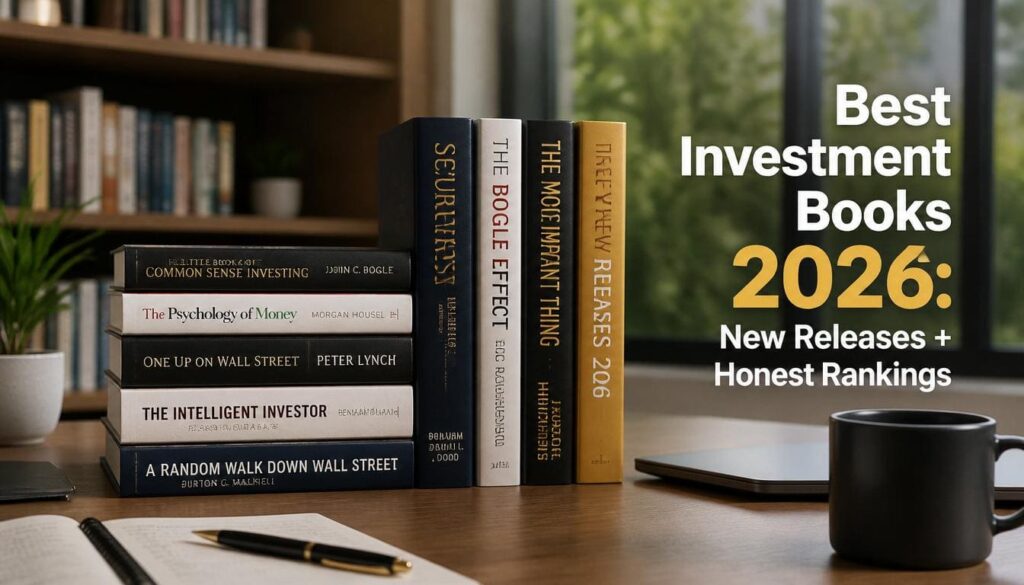
The pattern with “best investment books 2026” searches is consistent and frustrating. The top results serve you the same ten books from 1949 to 2020 with a new year in the headline. Nobody covers what actually came out in 2025 and 2026. Nobody contextualizes the timeless classics for this specific market environment. And nobody tells you that several books on every list — Principles by Dalio, The Bond King by Childs — are not investment books in any useful sense for an individual investor.
This guide does what the others don’t. Part one covers the investment books genuinely published in 2025–2026, including two titles virtually no other list mentions. Part two covers the timeless classics — honestly ranked, with specific context for why they matter in the 2026 investment environment. Part three tells you which books to skip and why.
Table of Contents
Best investment books actually published in 2025–2026
These are the investment books that came out in the past 12–18 months. The Stock Trader’s Almanac — one of the most respected annual investment publications in the US — named its best investment books of the year for 2026 after a five-year hiatus. That list, combined with our own reading, forms the foundation of this section.

1. How Not to Invest by Barry Ritholtz (2024–2026) — Stock Trader’s Almanac #1 pick
Published: 2024 | Best for: Every investor at every level who wants a comprehensive map of how investments fail — behavioral, numerical, and structural.
Ritholtz, founder of Ritholtz Wealth Management and one of the most widely read financial commentators in the US, spent his career watching intelligent people make the same categories of mistake in different market environments. This book is the definitive catalog of those mistakes.
The Stock Trader’s Almanac named it the #1 best investment book of 2026, describing it as a guide that “illustrates how to avoid unforced errors, recognize fallacious data, and break bad habits that undermine investment success.” The book is organized around the three categories of investment error: bad ideas (popular strategies that don’t work), bad numbers (data that misleads), and bad behaviors (psychological patterns that destroy returns). Each section is documented with specific historical examples.
What makes it particularly valuable in the 2026 environment: many of the bad ideas it documents — AI investment mania, momentum chasing, narrative-driven speculation — are precisely what dominated market psychology in 2024–2025. The book reads like it was written for this specific moment.
The honest critique: it’s a “what to avoid” book, not a “what to do” book. Pair it with JL Collins or Bogle for the positive case alongside the negative one.
Verdict: The most important new investment book of 2024–2026. Read it before making any changes to your portfolio this year.
2. Your Perfect Portfolio by Cullen Roche (January 2026) — the genuinely new 2026 release
Published: January 6, 2026 | Best for: Investors who are ready to move beyond “just buy a total market index fund” and build a portfolio genuinely suited to their own risk tolerance, time horizon, and life circumstances.
Cullen Roche is a renowned financial strategist with two decades of experience building investment firms and advising clients. Morgan Housel has said: “I can count on one hand the number of people whose views on the economy and portfolio construction I pay attention to. Cullen Roche is one of them.”
Your Perfect Portfolio argues that there is no universally optimal investment portfolio — there is only the portfolio that is optimal for you, given your specific situation. The book walks through the process of identifying your actual risk tolerance (not the theoretical one you think you have), your real time horizon, your income stability, and your behavioral tendencies — and then building an allocation that you will actually stick with when markets turn volatile.
This is the most practically useful genuinely new investment book of 2026 for anyone who has the basics down and is ready to take portfolio construction seriously. It’s absent from virtually every other “best investment books 2026” list because it was published in January 2026 and most lists were assembled before or shortly after that date without reading the new releases.
Verdict: Essential reading for investors ready to move beyond a single-fund portfolio. The most important genuinely new investment book of 2026.
3. The Art of Execution 2 by Lee Freeman-Shor & Clare Flynn Levy (March 2026) — for active investors
Published: March 3, 2026 | Best for: Active investors and portfolio managers who want to understand what separates the best professional investors from the rest — and how to apply those lessons.
Freeman-Shor’s original The Art of Execution was praised by serious investment practitioners for its data-driven analysis of how professional investors behave when positions move against them. This follow-up draws on exclusive access to detailed trade data and in-depth interviews with top professional investors to examine what the best actually do differently from everyone else — not by getting it right all the time, but by managing their mistakes more effectively.
Annie Duke, author of Thinking in Bets, called it essential for “every serious investor — established or aspiring.” Less accessible than the other new releases on this list; it rewards investors who already have a real investment process and want to refine it rather than beginners building from scratch.
Verdict: Recommended for intermediate and advanced investors with real portfolio management experience. Not a starting point — a refinement tool.
4. Same as Ever by Morgan Housel (2023) — the most relevant recent release for 2026
Published: October 2023 | Best for: Investors trying to make rational sense of a 2026 market that feels unprecedented.
Published in 2023 but more relevant to 2026 than when it came out. Housel’s framework — focus on what never changes rather than trying to predict what will — is precisely what investors need in a market dominated by AI speculation, geopolitical uncertainty, and rate volatility. His chapter on how narratives drive markets reads like it was written specifically about 2024–2025. It wasn’t. That’s the point.
Timeless investment books: why they matter specifically in 2026
These books weren’t published in 2026. But each is more relevant to the 2026 investment environment than most books that were. Here’s why — the specific context that other lists never provide.
The Simple Path to Wealth by JL Collins — why 2026 specifically
After two years of AI-driven market concentration, rising valuations, and persistent narratives about why this time is different — Collins’ book is the most important antidote available. His argument that the simple approach (total market index fund, stay invested, keep costs minimal) has survived every previous period of market euphoria and panic is directly relevant to a 2026 environment where that simplicity is under constant challenge from financial media, fintech products, and social media trading culture.
A Random Walk Down Wall Street by Burton Malkiel — why 2026 specifically
In 2026, S&P 500 concentration in mega-cap tech stocks has reached historic levels. The debate about whether passive index investing amplifies market distortions — a legitimate academic discussion — has been weaponized by active managers to argue that index funds are now dangerous. Malkiel’s evidence-based response to this argument, updated in the 13th edition, is the most rigorous rebuttal available. Read it to understand why the concentration concern, while real, doesn’t change the case for passive investing.
The Intelligent Investor by Benjamin Graham (Zweig 2024 edition) — why 2026 specifically
The October 2024 edition includes Jason Zweig’s updated commentary on AI-driven market valuations, passive investing’s dominance, and the 2022 bond market collapse. Graham’s central concepts — intrinsic value, margin of safety, the distinction between investment and speculation — apply directly to a 2026 market where many AI-adjacent stocks trade at valuations that require decades of perfect execution to justify. Read the 2024 edition specifically; the Zweig commentary makes the 1949 text directly relevant to current conditions.
The Psychology of Money by Morgan Housel — why 2026 specifically
The behavioral patterns Housel describes — recency bias, narrative investing, tail-driven returns, the urge to act when doing nothing is optimal — were operating at maximum intensity in the 2024–2025 AI investment cycle. Reading this book in 2026, with that specific experience fresh, gives every chapter additional resonance. If you read it before 2024 and felt like you understood it, read it again. The market of the last two years is the most vivid illustration of its core arguments since the book was published.
The Four Pillars of Investing by William Bernstein — why 2026 specifically
The 2022–2024 period — the worst bond market in modern history followed by a recovery — has forced many investors to reconsider their bond allocation assumptions. Bernstein’s treatment of asset allocation, the role of bonds at different life stages, and the importance of international diversification is the most thorough response to the questions that period raised. His analysis of why diversification helps even when it underperforms temporarily is directly relevant to investors who abandoned diversification during the AI bull run.

Investment books on every 2026 list you can skip
Principles by Ray Dalio — not an investment book
Dalio’s book is a management and life philosophy book describing the principles he uses to run Bridgewater Associates. It is not an investment book. It contains almost no actionable investment guidance for individual investors. Including it on investment book lists — as GOBankingRates does — reflects the conflation of “written by a famous investor” with “useful for investors.” Dalio’s actual investment writing — his essays on the debt cycle, the changing world order, and the 10-year template — are available free on LinkedIn. Read those instead if you want his investment thinking.
The Bond King by Mary Childs — engaging biography, wrong category
Childs’ biography of Bill Gross is well-researched and genuinely interesting. It tells the story of how one person built the world’s largest bond fund and then lost almost everything. It is not an investment instruction manual. Understanding that Bill Gross was brilliant and then made catastrophic ego-driven decisions does not give you an investment framework to apply. Inspiring and worth reading for its narrative value — but not an investment book.
Rich Dad Poor Dad — skip
Still appearing on investment book lists in 2026. Still not an investment book in any rigorous sense. The one useful idea — assets generate income, liabilities consume it — is delivered alongside vague advice, a fictional mentor, and upselling toward paid seminars. Skip it. If you want the mindset shift it claims to offer, read Housel’s Psychology of Money instead — it delivers the same insight with evidence and without the upsell.
Reading order for best investment books 2026
| Stage | Book | Published | Why now |
|---|---|---|---|
| Foundation | The Simple Path to Wealth — Collins | 2016 | Counterweight to 2026 AI hype |
| Foundation | The Psychology of Money — Housel | 2020 | More relevant after 2024–2025 AI mania |
| New release | How Not to Invest — Ritholtz | 2024 | STA #1 pick, documents 2024–2025 mistakes |
| New release | Same as Ever — Housel | 2023 | Framework for navigating novel-feeling markets |
| Portfolio | Your Perfect Portfolio — Roche | Jan 2026 | True 2026 release; best new portfolio book |
| Theory | A Random Walk Down Wall Street — Malkiel | Updated 2023 | Responds to passive investing concentration debate |
| Theory | The Four Pillars — Bernstein | Updated | Asset allocation after 2022–2024 bond volatility |
| Advanced | The Intelligent Investor — Graham/Zweig | Oct 2024 ed. | 2024 edition specifically addresses AI valuations |
| Advanced | The Art of Execution 2 — Freeman-Shor | Mar 2026 | True 2026 release; for active portfolio managers |
What other best investment books 2026 lists get wrong
Ritholtz.com: excellent content, too brief for the reader
The Stock Trader’s Almanac 2026 best investment books list, reported on Ritholtz.com, is the most credible primary source in this SERP. It actually evaluated books published in 2024–2025 by experienced practitioners. The problem: the writeup is very brief, providing almost no context about why each book was chosen or how they relate to each other. A reader learns that How Not to Invest is #1 but doesn’t learn why it matters specifically in 2026 or what to read alongside it. We’ve built on this foundation rather than ignored it.
PopVortex: Apple Books bestseller chart, not editorial curation
PopVortex tracks real-time Apple Books bestseller charts. It’s an accurate data source for what’s selling — not a curated reading guide. It happened to surface Your Perfect Portfolio and The Art of Execution 2 simply because those books were selling on Apple Books when the query was made. Without context, descriptions, or reading order guidance, a raw bestseller chart is noise rather than signal for a reader trying to decide what to read.
MyInvestAcademy: “updated monthly” but actually static
The site claims its list is updated monthly. The content — a comparison table of books from 1949 to 2020 with no books from 2023, 2024, or 2026 — does not support that claim. The “updated monthly” label is a credibility signal rather than an accurate description. Not a single genuinely new release appears in the list despite the current date being June 2026.
GOBankingRates/AOL: personal finance mixed with investment, Principles included
GOBankingRates’ investment book list includes Principles by Ray Dalio (a management philosophy book), Get Good With Money by Tiffany Aliche (a personal finance and budgeting guide), and A Beginner’s Guide to the Stock Market alongside The Intelligent Investor — books that serve completely different audiences. The list exists to capture affiliate clicks across multiple financial search queries, not to help a specific reader make a reading decision.
Read next on InvestClarify
- Best investment books: 15 picks organized by goal
- Best investing books: the definitive ranked list by level
- Investing books 2026: our full updated rankings
- How to start investing: the complete beginner’s guide
- Best high-yield investments in 2026
FAQ: Best investment books 2026
Disclaimer: This article is for educational and informational purposes only. It does not constitute financial advice. Investing involves risk, including the potential loss of principal. Always consult a qualified financial advisor before making investment decisions.