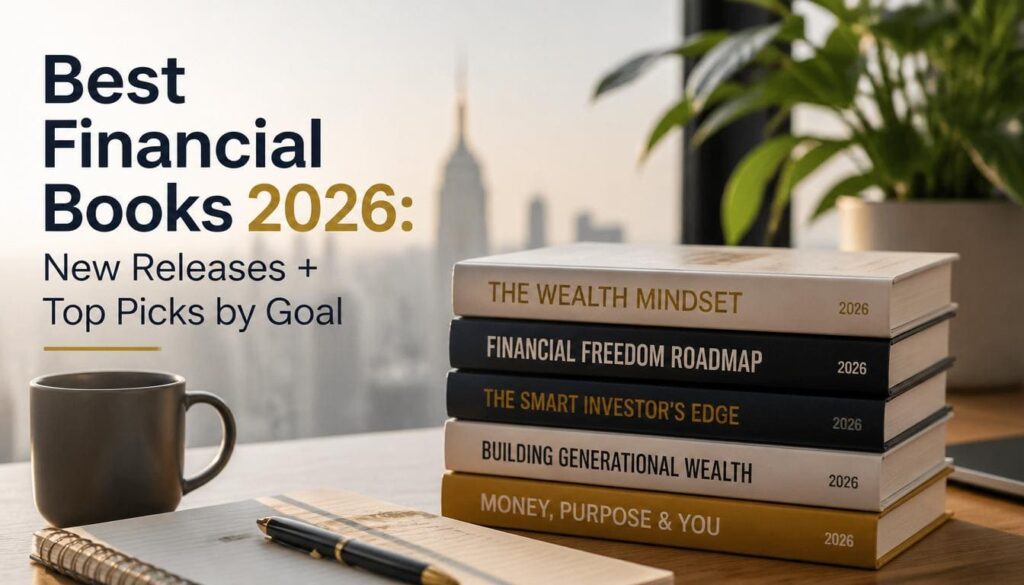
Here is the problem with every “best financial books 2026” list: they all answer a different question than the one you’re asking. CNBC gives you a budgeting guide for people trying to get out of debt. Abacum gives you a CFO leadership reading list. An Indian lifestyle magazine gives you ESG investing books for European crowdfunding platforms. None of them tell you what a US individual investor should actually read in 2026 to manage their money better and build real wealth.
This guide fixes that. It starts with the genuinely new financial books published in 2025–2026 that no other list covers. Then it organizes the timeless classics by what you’re actually trying to achieve. If you want to manage your money better, build long-term wealth, understand markets, or think more clearly about financial decisions — each section starts with the right book for that goal.
Table of Contents
- New financial books published in 2025–2026 worth reading
- Best financial books 2026 for personal money management
- Best financial books 2026 for building long-term wealth
- Best financial books 2026 for your money mindset
- Famous financial books on every 2026 list you can skip
- What other best financial books 2026 lists get wrong
- FAQ: Best financial books 2026
New financial books published in 2025–2026 worth reading
This is the section nobody else writes. Most “best financial books 2026” lists don’t include a single book published in 2025 or 2026. They take the same titles from 2023 and 2024 lists, update the headline, and publish. Here are the books that actually came out recently and are genuinely worth your time.

1. The Art of Spending Money by Morgan Housel (2025–2026) — the standout new release
Published: Late 2025 / January 2026 | Best for: Anyone who has figured out how to earn and save money but struggles with spending it in ways that actually improve their life.
Morgan Housel’s third book completes a trilogy that has become the most important body of financial writing in a generation. The Psychology of Money (2020) addressed how we think about money. Same as Ever (2023) addressed what never changes about human financial behavior. The Art of Spending Money addresses the question both previous books left unanswered: once you have money, how do you actually use it to build a better life?
The book’s central argument is that most people make predictable spending errors in both directions. They spend on things that impress others but don’t actually improve their lives — status spending, lifestyle inflation, keeping up with people they don’t even like. Or they save compulsively out of anxiety, denying themselves spending that would genuinely increase their wellbeing. Housel argues that the highest return on investment money can provide is independence, and that most status-driven spending is essentially renting other people’s approval at compound interest.
Published by Penguin Random House, the book sold 8 million copies globally in its first months. It is the most significant genuinely new financial book of 2026, and it’s the one that other “best financial books 2026” lists consistently fail to mention.
The honest critique: it’s a mindset and philosophy book, not a tactical guide. It won’t give you a budget template or a spending percentage rule. If you want those, Ramit Sethi’s book handles that side. Read Housel for the psychological framework, Sethi for the implementation.
Verdict: The best new financial book of 2026. Read it after The Psychology of Money — the two together give you the most complete picture of how to think about money available in any format.
2. How Not to Invest by Barry Ritholtz (2024) — still the best recent release for investors
Published: 2024 | Best for: Investors at any level who want to understand the full taxonomy of investing mistakes before making them.
Ritholtz, founder of Ritholtz Wealth Management, spent his career watching intelligent people make the same financial mistakes in different market environments. This book catalogs every major category: behavioral errors, timing mistakes, fee traps, narrative-driven investing, confirmation bias, and more. Named one of the best investment books of the year by the Stock Trader’s Almanac 2026.
The approach — organized around what not to do rather than prescriptive advice — is more honest than most investing books. Most mistakes have a predictable shape. Learning to recognize that shape before you make the mistake is worth more than most positive strategies.
Verdict: Strongly recommended for any investor in 2026. Pair with JL Collins for the complete picture of what to do and what to avoid.
3. Same as Ever by Morgan Housel (2023) — still essential in 2026
Published: October 2023 | Best for: Investors trying to make sense of a market environment that feels unprecedented but is largely familiar.
The 2026 market — AI investment mania, rate uncertainty, geopolitical disruption, concentration in mega-cap tech — looks novel on the surface. Housel’s book gives you the framework to recognize it as a familiar pattern in new clothes. His central argument: instead of predicting what will change (which nobody does reliably), focus on what never changes — human nature, greed and fear cycles, the tendency to extrapolate recent trends, the compounding effect of consistent behavior. Published in 2023 but more relevant in 2026 than when it came out.
Best financial books 2026 for personal money management
These books are for readers whose primary goal is managing their money better — building an emergency fund, paying off debt, automating their finances, and establishing the habits that make investing possible. If you’re not there yet, start here before moving to investing books.
4. I Will Teach You to Be Rich by Ramit Sethi — the system builder
Sethi’s six-week program tells you exactly which bank accounts to open, how to automate your savings and investments, how to handle the 401(k) vs Roth IRA decision, and how to negotiate bills and salary. For readers in their 20s and 30s who need to build the complete financial infrastructure from scratch, it’s the most practical financial book available. The honest critique: it’s thin on investing theory. Use it to build the system, then graduate to Collins or Malkiel.
5. The Art of Spending Money by Morgan Housel — the philosophical complement
Where Sethi tells you how to set up your financial system, Housel addresses why most people still feel dissatisfied with their financial lives even after doing everything right. His book is about the psychology of spending — why we chase things that don’t actually improve our wellbeing, why independence is the highest ROI money can provide, and how to align your spending with what actually makes your life better. Read Sethi for the tactical layer, Housel for the philosophical one.
6. Die with Zero by Bill Perkins — the underread counterargument
Most financial books tell you to save more. Perkins argues that excessive saving is itself a financial mistake. His central claim: dying with millions in unspent savings is not financial success — it’s a failure to convert money into the experiences and relationships that actually constitute a good life. The book is deliberately provocative and not universally applicable, but it corrects an underappreciated error that many disciplined savers make. A useful counterweight to the obsessive accumulation mindset that dominates personal finance literature.
Best financial books 2026 for building long-term wealth
These are the books for readers whose primary goal is growing their money over time through investing. For a deeper dive into this category, see our dedicated guide on the best investing books ranked by level.
7. The Simple Path to Wealth by JL Collins — the essential starting point
Collins’ book delivers the complete passive investing framework in one readable volume: own a low-cost total market index fund, keep your savings rate high, stay invested through downturns. Written as letters to his daughter, it assumes no prior knowledge and wastes no words. If you implement this book’s advice, you are already executing a strategy that outperforms most professional fund managers over any 10-year period. Read this before anything else in the investing category.
8. The Little Book of Common Sense Investing by John C. Bogle — the intellectual case
Bogle founded Vanguard and the first index fund available to individual investors. His argument is pure arithmetic: in aggregate, all investors receive the market return before costs and below-market returns after costs. The only rational response is to minimize costs through index funds. Short, morally passionate, and backed by decades of data. Read alongside Collins for the complete case for passive investing.
9. Just Keep Buying by Nick Maggiulli — the data-first modern approach
Maggiulli takes conventional personal finance wisdom and runs it through actual data. His finding that lump-sum investing beats dollar-cost averaging two-thirds of the time is counterintuitive but evidence-based. So is his analysis of when it actually makes sense to pay off debt versus invest. One of the best data-driven financial books published in the last five years — and one that most “best financial books 2026” lists miss entirely.
Best financial books 2026 for your money mindset
10. The Psychology of Money by Morgan Housel — still the most important financial mindset book
Published in 2020 and still the most impactful financial book of the last decade. Housel’s nineteen chapters address why intelligent people consistently make bad financial decisions, why staying invested matters more than finding the best investments, and why financial success is determined more by behavior than by technical knowledge. The 2026 market environment — AI mania, rate volatility, narrative-driven investing — makes every chapter more relevant than when it was written. Mandatory reading at every level.
11. Thinking, Fast and Slow by Daniel Kahneman — the cognitive science foundation
Kahneman’s Nobel Prize-winning research explains why even intelligent, informed people make systematically bad financial decisions. Loss aversion, overconfidence, anchoring, the availability heuristic — each is explained with research that shows these aren’t character flaws but predictable features of human cognition. Once you’ve read Kahneman, you start noticing these errors in your own thinking in real time. Barry Ritholtz, founder of Ritholtz Wealth Management, calls it the first book he recommends to anyone who asks about investing.

Famous financial books on every 2026 list you can skip
Rich Dad Poor Dad — skip
Kiyosaki’s book contains one useful mental model and 300 pages of vague advice, a fictional mentor, and upselling toward paid seminars. CNBC includes it in their “best personal finance books 2026” list labeled “best for challenging the norm.” It challenges norms, yes — including the norm of providing accurate information. The mindset shift it offers is available more accurately in Housel’s work. Skip it.
Think and Grow Rich — not a financial book
Napoleon Hill’s 1937 motivational classic appears in CNBC’s “best financial books 2026” list. It is not a financial book. It is a self-help book about positive thinking, written during the Great Depression, based on interviews whose accuracy has never been verified. If you want mindset books grounded in actual evidence, read Kahneman or Housel.
How to Win Friends and Influence People — very wrong category
Greenbush Financial includes Dale Carnegie’s 1936 interpersonal skills book on their “must-read financial books 2026” list. Carnegie’s book is genuinely useful for professional development and leadership. It is not a financial book. Including it reveals that the list was padded with recognizable titles rather than curated for content relevance.
Blue Ocean Strategy — also wrong category
A business strategy book about creating uncontested market space appears on Greenbush Financial’s “financial books 2026” list alongside budgeting guides. Blue Ocean Strategy is a good business book. It is not a personal finance or investing book. Its presence on this list says everything about that list’s editorial standards.
What other best financial books 2026 lists get wrong
CNBC Select: personal finance only, no investing, questionable inclusions
CNBC’s “Best Personal Finance Books of 2026” is actually a reasonable personal finance list — but it ranks for financial books broadly and doesn’t cover investing at all. More problematically, it includes Think and Grow Rich (labeled “best classic”) and Rich Dad Poor Dad (labeled “best for challenging the norm”) without any honest assessment of their limitations. A reader who follows this list will mix genuinely useful books with titles that contain inaccurate financial advice.
Abacum: CFO reading list, wrong audience entirely
Abacum is a financial planning and analysis software company. Their “Top 10 Finance Books to Read in 2026” is a list for corporate finance leaders and CFOs — not for individual investors or personal finance readers. It includes books about FP&A strategy, corporate financial management, and business leadership. Every page has a “book a demo” CTA for their software product. If you’re a CFO, this list has value. If you’re an individual trying to manage your money or build wealth, it’s completely mismatched to your needs.
Storizen: Indian lifestyle magazine, ESG-heavy, no true 2026 investing books
Storizen is primarily a lifestyle publication covering horoscopes, food, and travel. Their “9 Best Finance Books to Read in 2026” is the only list that mentions Housel’s The Art of Spending Money — credit for that. But most of their other selections are niche ESG and sustainable investing titles with limited relevance to the mainstream US individual investor. The list exists to build their books category traffic, not to serve a specific financial reader.
Greenbush Financial: wealth management firm padding a list for SEO
A wealth management advisory includes Dale Carnegie and Blue Ocean Strategy on their “must-read financial books” list. These are recognizable titles that generate clicks. They are not financial books. The inclusion reveals a list built for search engine visibility rather than genuine reader utility — a common pattern among financial advisory firms that produce content to attract clients.
The universal 2026 problem: nobody covers The Art of Spending Money
Morgan Housel’s third book is the most significant genuinely new financial book of 2026, from an author whose previous two books sold more than 11 million copies combined. It is absent from almost every “best financial books 2026” list. The reason: covering a new release requires reading a new release. Most list-based content is assembled from existing sources and descriptions, not from reading the actual books. That gap is exactly why this guide exists.
Read next on InvestClarify
- Best investing books: the definitive ranked list by level
- Best investing books 2026: new releases and rankings
- How to start investing: the complete beginner’s guide
- Best high-yield investments in 2026
- How to invest with confidence: mindset and strategy
FAQ: Best financial books 2026
Disclaimer: This article is for educational and informational purposes only. It does not constitute financial advice. Investing involves risk, including the potential loss of principal. Always consult a qualified financial advisor before making investment decisions.