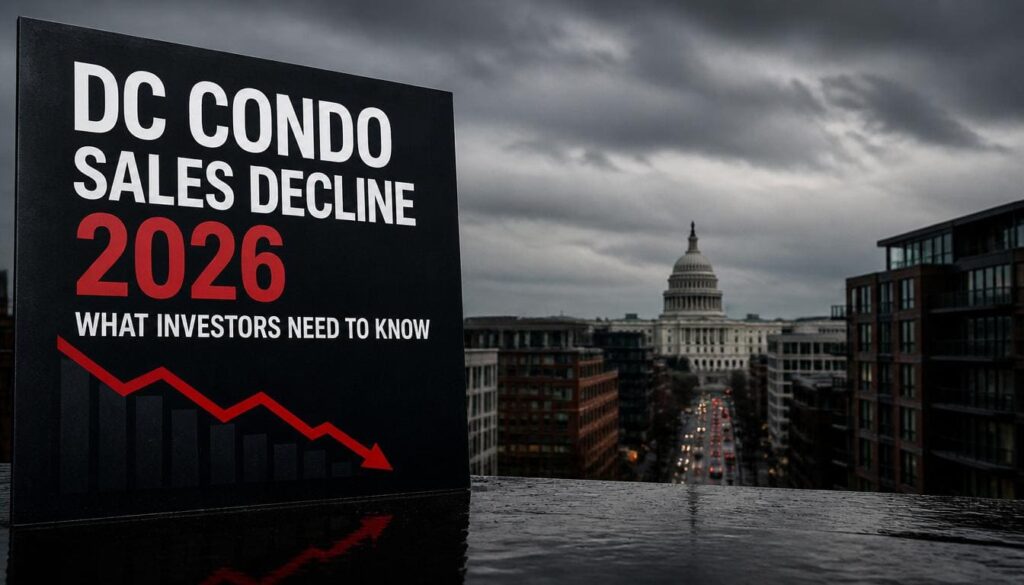
Washington D.C. condo sales have fallen to their lowest level in a decade. According to Axios D.C., reporting on Bright MLS data as of April 2026, sales volume is at a 10-year low while the number of new condo rentals is at a 10-year high. Owners who can’t sell are becoming reluctant landlords instead.
Most of the coverage of this story is written for sellers or buyers navigating the local market. This guide is written for investors — people who either own a DC condo as an investment, are considering buying one at current depressed prices, or want to understand what this specific market downturn signals about urban real estate investing more broadly. Those are different questions, and they deserve different answers.
Table of Contents
- The data: how bad is the DC condo sales decline?
- What is driving the decline: 5 compounding factors
- The reluctant landlord phenomenon: what it means for the rental market
- If you own a DC condo: your options assessed honestly
- If you’re considering buying: is this a buying opportunity?
- What DC condos signal about urban real estate investing broadly
- What other DC condo coverage gets wrong for investors
- FAQ: DC condo sales decline 2026
The data: how bad is the DC condo sales decline?
The numbers are worse than most coverage suggests, and they’ve been getting worse for a long time. Here is what the data actually shows, drawn from Bright MLS and local market analyses current as of June 2026.

Sales volume: down 22% year-over-year
DC condo sales fell 22% year-over-year in January 2026, the most recent period with complete Bright MLS data. This compares to a 3.7% decline in detached single-family home sales over the same period — the condo segment is dramatically underperforming the broader DC housing market. By March 2026, Homes.com data showed condo sales still down 1.5% while single-family sales were up 5.8% and townhome sales were up 9.5%.
Prices: the only DC segment with price declines
Condo prices fell 1.3% year-over-year metro-wide in January 2026 — making condos the only housing segment in the DC area with outright price declines. The broader DC metro median price was up 4.8% over the same period. More strikingly, the average asking price for a DC condo listed for sale in Q1 2026 was 9.4% below Q1 2025 and approximately 9% below the level of ten years ago. In nominal terms, DC condos have produced zero price appreciation over a decade.
Inventory: up 60% on a rolling 90-day basis
Condo active listings rose 20.2% year-over-year to 4,446 in March 2026. On a rolling 90-day average, condo inventory is up nearly 60% — more than double the 29% growth in single-family home inventory. New condo listings were up 29% annually. DC now has 3.91 months of condo supply — the threshold for a buyer’s market is typically considered 4–6 months. DC condos are in buyer’s market territory.
Days on market: up sharply
Listings now sit an average of 43 days on market, up from 32 days a year ago — a 34% increase in time-to-sell. The metro median is 36 days. Condos are taking significantly longer to sell than the broader market average.
Absorption rate: declining 16 consecutive quarters
This is the statistic that contextualizes the trend most clearly. The DC condo absorption rate — the rate at which available inventory is being purchased — has declined year-over-year for 16 consecutive quarters and in 23 of the past 26 quarters, per Eli Residential’s Q1 2026 analysis. This is not a recent event or a pandemic-era blip. The structural weakening of the DC condo market has been underway for over four years.
| Metric | DC Condos (Jan–Mar 2026) | DC Single-Family (same period) |
|---|---|---|
| Sales volume YoY | −22% | −3.7% (Jan) / +5.8% (Mar) |
| Price YoY | −1.3% | +2.1% |
| Inventory YoY | +60% (90-day avg) | +29% |
| Days on market | 43 days (up from 32) | ~25–30 days |
| Months of supply | 3.91 months | <1 month (Fairfax) |
| Absorption rate trend | Declining 16 consecutive quarters | Stable to improving |
What is driving the DC condo sales decline: 5 compounding factors
The DC condo market didn’t weaken because of one thing. It weakened because of five separate headwinds that arrived in sequence and are now compounding each other. Understanding each factor separately helps investors assess which ones are structural (unlikely to reverse) and which are cyclical (may improve).
1. The pandemic work-from-home shift (structural)
During COVID, buyers fled urban condos for suburban homes with more space — they no longer needed proximity to downtown DC offices. Many of those buyers haven’t returned. The remote work normalization has permanently reduced the premium on central urban location for a significant portion of the professional workforce. This is a structural change, not a temporary one. The condo buildings that suffered most are those where the primary value proposition was walkability and commute proximity rather than neighborhood quality or building amenity.
2. Federal workforce layoffs and relocations (cyclical but uncertain)
The federal government workforce reduction that began in 2025 produced a specific and significant inventory effect: laid-off or relocated federal employees listed their condos, adding supply to a market that was already weak. This is a demand destruction event and a supply addition event happening simultaneously — a particularly difficult combination for prices and sales velocity. Whether this reverses depends on federal hiring policy, which is political and therefore unpredictable.
3. Rising HOA fees and condo association scrutiny (structural)
After the Surfside condominium collapse in Miami in 2021, regulators and lenders dramatically increased scrutiny of condo association financial health and reserve fund adequacy. This has produced two effects: HOA fees have risen sharply in many DC buildings as associations fund required reserves, and mortgage lending on condos with inadequate reserve funds has tightened. Both effects reduce the pool of qualified buyers and increase carrying costs for owners. This is a structural shift in the condo market nationally, not specific to DC — and it will not reverse.
4. Higher mortgage rates on an already-expensive asset class (cyclical)
DC condo prices, even after the recent declines, remain expensive in absolute terms. At elevated mortgage rates — which have eased from 2025 peaks but remain above historical norms — the monthly carrying cost of a DC condo frequently exceeds the cost of renting a comparable apartment. When buying is more expensive than renting month-to-month, marginal buyers choose to rent. This is a cyclical factor: if rates decline meaningfully, some of this demand could return.
5. Oversupply psychology and listing-price anchoring (behavioral)
In a falling market, sellers anchor to the prices comparable units achieved in previous years and resist pricing to current market realities. This produces a dynamic where listings sit for 43+ days and eventually sell at lower prices anyway — but not before the extended market time itself signals weakness to subsequent buyers. As Morgan Knull of RE/MAX Gateway told the Washingtonian in April 2026: “Sellers are listing at prices based on comps from a different market climate.” The behavioral loop of overpricing → extended days on market → price reduction → buyer skepticism is a self-reinforcing headwind.
The reluctant landlord phenomenon: what it means for rental market investors
The most significant new dynamic in the DC condo market is the conversion of would-be sellers into reluctant landlords. Axios DC reported on June 2, 2026 that the number of new DC condo rentals was at its highest level in a decade — simultaneously with sales at their lowest level in a decade. This is not a coincidence; it’s the same inventory moving between markets.
What this means for rental market investors: supply of rental condos in DC is rising sharply. Units that owners couldn’t sell are now competing for the same renters that purpose-built apartment buildings are targeting. This typically produces downward pressure on rental rates in the near term, or at minimum slower growth than an undersupplied rental market would produce. An investor considering a DC condo as a rental property should model rental income conservatively — the supply environment for rentals in 2026 is more competitive than it has been in years.
If you own a DC condo: your options assessed honestly
If you currently own a DC condo — as a primary residence, investment, or inherited property — here is an honest assessment of your options in the current market.
Option 1: Sell now, priced correctly
Selling in the current market is possible — but only if you price for where the market is, not where it was. The agents seeing success are those who price “significantly enough below the old comps to be the best value in a sea of listings,” per Dweck of Compass, quoted in the Washingtonian. Sellers who price at 2022 levels and then gradually reduce are losing weeks of market time and leverage in the process. If you need to sell, price aggressively from day one.
Option 2: Hold and wait for market improvement
This is only a rational strategy if you can comfortably carry the property — HOA fees, mortgage if applicable, insurance — without financial strain for an extended period. The structural factors driving the decline (remote work, HOA fee increases, lender scrutiny) are not resolving quickly. A meaningful cyclical recovery requires lower mortgage rates and a shift in buyer sentiment that isn’t visible in current data. Holding without a specific catalyst thesis is a passive bet on an uncertain timeline.
Option 3: Convert to rental
This is what many DC condo owners are doing by default. It can be a rational strategy if your carrying costs are covered by rental income and if you’re prepared to be a landlord for an extended period. The critical caveat: rental supply is rising sharply as more owners make the same decision. Get realistic rental income estimates for your specific building and location — not metro-wide averages — before committing to this path. And understand that being a landlord carries its own costs: vacancy periods, repairs, property management if you don’t self-manage, and DC’s tenant-friendly regulatory environment.
If you’re considering buying a DC condo: is this a buying opportunity?
The contrarian question is worth examining seriously: DC condo prices are down 9% in nominal terms from ten years ago. Inventory is elevated. Sellers are motivated. Is this the buying opportunity that patient real estate investors wait for?
The honest answer is: maybe, but with important conditions.
The case for buying now
- Prices are down in nominal terms from a decade ago — a genuine rarity in major urban markets
- Negotiating leverage is at its highest in years — closing cost credits, inspection contingencies, price reductions are all more available
- Inventory provides genuine choice — buyers can afford to be selective about building quality and HOA financial health
- If mortgage rates decline over the next 2–3 years, refinancing could substantially reduce carrying costs and attract more buyers to the market
- DC’s long-term fundamentals — government employment anchor, university presence, established infrastructure — remain intact
The case for caution
- The absorption rate has been declining for 16 consecutive quarters — there’s no obvious near-term catalyst for reversal
- HOA fees are rising structurally, not cyclically — they will not come down
- Rental supply is increasing, limiting your exit option if you can’t sell
- Federal workforce uncertainty remains — a significant secondary wave of employee departures could add more inventory
- Prices in nominal terms are flat over a decade but down in real (inflation-adjusted) terms — the opportunity cost of capital matters
The conclusion: if you’re buying as a long-term primary residence and have carefully evaluated the HOA financial health of the specific building, the current market offers genuine value relative to recent years. If you’re buying as a short-to-medium-term investment with an exit thesis of selling in 2–4 years, the current data does not support that thesis. The market has not found its floor.

What DC condos signal about urban real estate investing broadly
The DC condo market is not an isolated anomaly. It is one of the clearest case studies available for a structural shift affecting urban condo markets in multiple major cities.
The combination of factors at work in DC — post-pandemic remote work normalization, rising HOA fees driven by regulatory changes, elevated interest rates on already-expensive urban assets, and single-industry employment concentration — is visible in varying degrees in San Francisco, Chicago, New York, and other major markets where condo supply and carrying costs have outpaced buyer demand.
The broader investment lesson: urban condo investing carries risks that suburban single-family investing does not. HOA fees and special assessments are not under your control. Local employment concentration matters — DC’s heavy federal government dependence created specific vulnerability to federal workforce changes that a more diversified employment base would not have. And the liquidity of a condo investment — your ability to sell quickly at a reasonable price — deteriorates faster than other real estate categories when market conditions turn.
For investors building diversified wealth, real estate exposure through REITs — rather than direct condo ownership — avoids many of these concentration and liquidity risks. Our guide on how to get started in real estate investing covers both direct and indirect approaches with their respective risk profiles.
For investors whose primary wealth-building strategy is broad index fund investing with real estate as a secondary component, the current DC condo situation is a useful reminder of why diversification across asset types matters. See our guide on how to start investing and the discussion of high-yield investments for the broader context.
What other DC condo sales decline coverage gets wrong for investors
Axios DC: excellent journalism, zero investment perspective
Axios’ June 2 article is the best journalistic treatment of this story — it broke the “decade low” framing and the “reluctant landlord” phenomenon clearly. What it doesn’t do is address what any of this means for someone who owns a DC condo as an investment or is considering buying one. The article ends without an investor-relevant conclusion. Good news reporting isn’t the same as investment analysis.
Washingtonian and local agent sites: seller/buyer guides with obvious incentives
The Washingtonian article on how to market your condo in the current DC market contains useful tactical advice for sellers. It is written by and for people transacting in the DC market — which means the framing is always toward completing a transaction. Real estate agents whose income depends on transactions have an inherent interest in encouraging transactions. That doesn’t make their data wrong, but it shapes what questions they ask and which conclusions they draw. An investor-focused analysis asks different questions: should you transact at all? What’s the opportunity cost of the alternatives?
Market prediction articles: false precision
Several sites publish DC housing market forecasts with projected price changes of exactly 0.7–1% or sales volume increases of exactly 8–10%. These numbers have a precision that the underlying data does not support. DC condo market dynamics in 2026 involve structural factors (HOA regulatory changes, remote work normalization), cyclical factors (interest rates, federal employment), and unpredictable factors (political decisions about federal workforce). Projections with two significant figures in this environment are false precision. Any honest forecast acknowledges a wide range of outcomes.
Related InvestClarify guides
- How to get started in real estate investing: REITs, direct ownership, and more
- Best high-yield investments in 2026: ranked by risk and return
- Early retirement through dividend investing
- How to invest $10,000 in 2026
- How to invest with confidence: mindset and strategy
FAQ: DC condo sales decline 2026
Disclaimer: This article is for educational and informational purposes only. It does not constitute financial, legal, or real estate advice. Real estate investing involves risk, including the potential loss of principal. Market conditions change rapidly. Always consult qualified financial and real estate advisors before making investment decisions specific to your situation.