Here is a problem nobody talks about: every “best investing books 2024” list is identical to the “best investing books 2023” list. Same titles. Same descriptions. Same order. The Intelligent Investor at number one, written in 1949. One Up on Wall Street at number three, written in 1989. Nobody added anything published in 2024. Nobody explained what actually changed about the investing landscape that year. The list got a new headline and a publish date, and that was it.
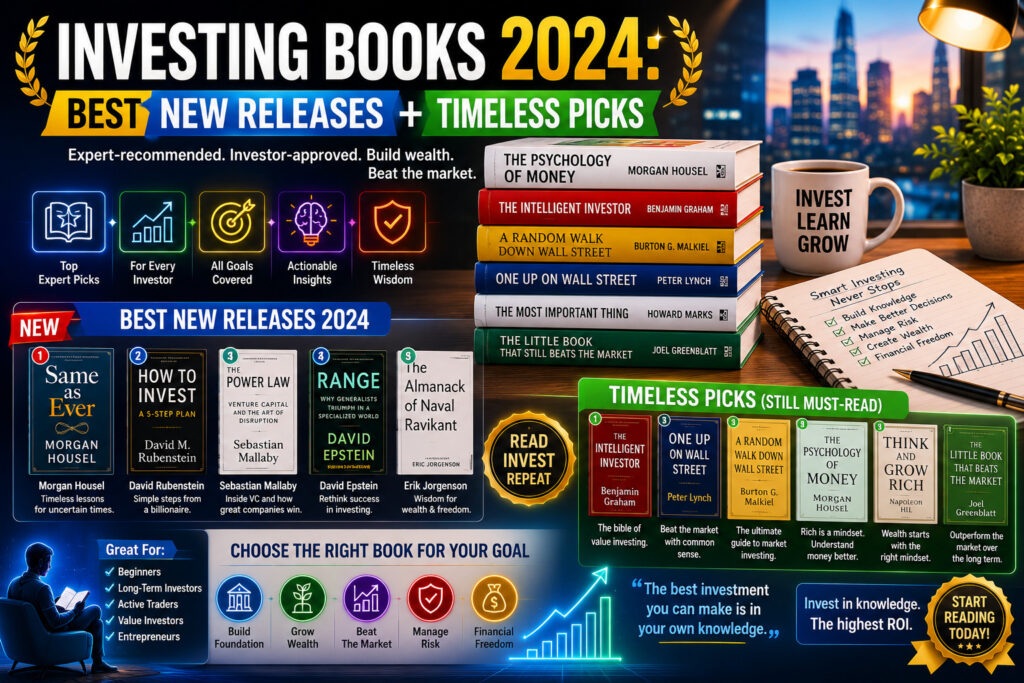
This guide does what those lists don’t. Part one covers the genuinely new investing books published in 2023–2024 that nobody else is talking about. Part two covers the timeless classics — honestly ranked, with context for why they matter in 2024 specifically, and which ones you can skip. If you search “investing books 2024,” this is the only guide that answers the question you’re actually asking.
Table of Contents
New investing books published in 2023–2024 that are actually worth reading
These are the books that came out in 2023 and 2024 that other lists ignore — because covering new releases requires reading new releases, and most listicle sites don’t do that work. The Financial Times Best Books of 2024 selections informed several of these picks alongside our own reading.

1. Same as Ever by Morgan Housel (2023) — the follow-up that delivers
Published: October 2023 | Best for: Anyone who read The Psychology of Money and wants more of the same quality of thinking.
Morgan Housel’s follow-up to his breakout hit is organized around a single insight: instead of trying to predict what will change — which nobody can do reliably — focus on identifying what never changes. Human nature. Greed and fear cycles. The tendency to extrapolate recent trends. Overconfidence in complexity. The compounding effect of small, consistent actions.
For investors, this framework is more useful than it sounds. The 2024 market environment — AI euphoria, rate uncertainty, concentration in mega-cap tech — looks novel on the surface. Housel’s book gives you the tools to recognize it as a familiar pattern wearing new clothes. The chapter on how narratives drive markets is particularly sharp.
The honest critique: if you haven’t read The Psychology of Money, start there. Same as Ever is a companion, not a standalone introduction. The two together form the best behavioral finance reading pair available.
Verdict: Read this in 2024 if you already have the basics down and want to sharpen your long-term thinking. It’s fast (under 250 pages) and dense with insight per page.
2. The Missing Billionaires by Victor Haghani & James White (2023) — the risk management book nobody talks about
Published: September 2023 | Best for: Investors who want a rigorous, evidence-based framework for making better financial decisions under uncertainty.
Victor Haghani is a founding partner of Long-Term Capital Management — the hedge fund whose spectacular 1998 collapse became a case study in how brilliant people can make catastrophic financial decisions. The Missing Billionaires asks a fascinating question: why, given the extraordinary wealth created by financial markets over the past century, aren’t there far more billionaires? The answer, Haghani and White argue, is that most people systematically bet too much — or too little — relative to their actual edge and financial position.
The book introduces a practical framework for sizing financial decisions correctly using expected utility theory. It sounds technical but is written accessibly, with clear examples for individual investors. The core insight — that both over-betting and under-betting are costly mistakes, and that most people make one of these errors consistently — is one of the most practically useful ideas in modern investing.
The Economist called it one of the best finance books of 2023. It appeared on almost none of the “best investing books 2024” lists because it requires real engagement to explain well. That omission is your opportunity to read something genuinely overlooked.
Verdict: Demanding but rewarding. Best suited for investors with a few years of experience who want to think more rigorously about position sizing, risk, and financial decision-making.
3. How Not to Invest by Barry Ritholtz (2024) — the mistake catalogue
Published: 2024 | Best for: Investors who learn better from what not to do than from prescriptive advice.
Barry Ritholtz is the founder of Ritholtz Wealth Management and one of the most widely read financial commentators in the US. His 2024 book takes a different approach to investing education: instead of telling you what to do, it systematically catalogs every major category of investing mistake — behavioral errors, market timing myths, fee traps, overconfidence, narrative-driven investing — with real examples of how each one destroys wealth.
The book was named one of the best investment books of the year by the Stock Trader’s Almanac 2026. Its approach is both entertaining and sobering: by the time you’ve finished, you’ve built a comprehensive mental model of what investor failure actually looks like, which makes it much easier to recognize in your own behavior in real time.
The honest critique: it’s primarily a “what to avoid” book rather than a “what to do” book. Pair it with JL Collins or Bogle for a complete picture of both the negative and positive case for passive investing.
Verdict: One of the best investing books actually published in 2024. Highly readable and immediately applicable. Recommended for any investor at any level.
4. The Intelligent Investor — Updated Edition by Benjamin Graham & Jason Zweig (October 2024)
Published: October 2024 (new edition) | Best for: Investors ready to read Graham with updated context for 2024 markets.
The third edition of the Zweig-revised Graham classic was released in October 2024, making this the most significant genuinely new version of an investing classic to appear that year. Zweig’s updated commentary addresses AI-driven market concentration, passive investing’s dominance, the 2022 bond market collapse, and other developments that post-date earlier editions. If you’re going to read Graham — and at some point you should — this is the edition to read.
The honest critique: Graham’s original text is unchanged and was written in 1949 for a professional audience. The Zweig commentary is what makes it accessible. Read the commentary first, then return to Graham’s chapters. Don’t try to read it straight through like a novel.
Verdict: The only genuinely new edition of a classic in 2024. If you’ve been putting off reading Graham, the 2024 edition is the right version to finally pick up.
Timeless investing books: why they still matter in 2024
These books were not published in 2024. But they are genuinely worth reading in 2024 — for specific reasons that most lists don’t bother to explain. Here’s why each one belongs on your 2024 reading list.
5. The Simple Path to Wealth by JL Collins — why 2024 specifically
After two years of rate hikes, a bond market collapse, AI-driven stock concentration, and persistent inflation, many investors entered 2024 second-guessing their index fund strategies. Collins’ book is the antidote: a clear-eyed explanation of why the simple approach — own a total market index fund, keep your savings rate high, stay the course — has worked through every previous period of uncertainty and will work through this one too. The 2024 market volatility makes this book more relevant, not less.
6. The Psychology of Money by Morgan Housel — why 2024 specifically
The AI investment narrative that dominated 2024 — NVIDIA, Microsoft, the Magnificent Seven — is a textbook example of the behavioral patterns Housel describes: recency bias, narrative investing, tail-driven returns. His chapter “When You’ll Believe Anything” reads like it was written about 2024 specifically. It wasn’t. That’s the point. The patterns are timeless.
7. A Random Walk Down Wall Street by Burton Malkiel — why 2024 specifically
In 2024, S&P 500 concentration in the top 10 stocks reached historic levels, prompting widespread debate about whether passive index investing was itself becoming a systemic risk. Malkiel’s evidence-based case for why passive still beats active — even in concentrated markets — is the most rigorous response to those concerns. Read the most recent edition for his updated view on this specific question.
8. The Little Book of Common Sense Investing by John C. Bogle
Bogle passed away in 2019, but his argument — that costs are the only thing individual investors can control, and minimizing them through index funds is the most reliable path to wealth — has never been more supported by data than it is in 2024. The SPIVA report from S&P Dow Jones consistently shows that 80–90% of active funds underperform their benchmark over 10-year periods. Bogle predicted this decades ago. The 2024 data proves him right again.
9. The Four Pillars of Investing by William Bernstein
The 2024 investing environment — rising rates, uncertain inflation, geopolitical risk, stock market concentration — makes asset allocation more important than it has been in a decade. Bernstein’s book is still the most thorough guide to building a diversified portfolio that can survive multiple market environments. His treatment of international diversification and bond allocation is particularly relevant given the 2022–2024 fixed income volatility.

Books on every 2024 investing list you can safely skip
Nobody else tells you this. Here are the titles that appear on every “best investing books 2024” list that don’t deserve to be there.
Rich Dad Poor Dad — skip
Robert Kiyosaki’s book has sold tens of millions of copies. It contains some useful mental models about assets and liabilities. It also contains factually inaccurate investment advice, a fictional “rich dad” whose existence has been repeatedly questioned, and a consistent push toward Kiyosaki’s own courses. The mindset shift it offers can be found more accurately in Housel’s work. Skip it.
Think and Grow Rich — not an investing book
Napoleon Hill’s 1937 motivational book appears on investing lists because the word “rich” is in the title. It is a self-help book, not an investing book. Its interviews with wealthy industrialists have never been independently verified. If you want evidence-based behavioral finance, read Kahneman or Housel instead.
Secrets of the Millionaire Mind — skip
T. Harv Eker’s book is primarily a vehicle to sell his seminars. Multiple investigative reports have documented the gap between the book’s promises and the actual outcomes of his paid programs. Not an investing book in any substantive sense.
Power Your Profits — wrong category entirely
Susie Carder’s book is about scaling a business from $10,000 to $10,000,000 in revenue. It appears on City Lifestyle’s “best investment books 2024” list. It is not an investing book. Including it reveals that the list was assembled for affiliate clicks, not editorial curation.
Reading order for investing books 2024
| Book | Author | Published | Read when |
|---|---|---|---|
| The Simple Path to Wealth | JL Collins | 2016 | First — always |
| The Psychology of Money | Morgan Housel | 2020 | Second |
| Same as Ever | Morgan Housel | 2023 | After Psychology of Money |
| How Not to Invest | Barry Ritholtz | 2024 | Any level, any time |
| A Random Walk Down Wall Street | Burton Malkiel | 1973/updated | After Collins |
| The Little Book of Common Sense Investing | John C. Bogle | 2007/updated | Alongside Malkiel |
| The Four Pillars of Investing | William Bernstein | 2002/updated | When building portfolio |
| The Missing Billionaires | Haghani & White | 2023 | Intermediate/advanced |
| The Intelligent Investor (2024 ed.) | Graham/Zweig | 2024 update | After foundational reads |
If you’re still building your core foundation, start with our full guide on how to start investing in 2026 before diving into books. Our updated 2026 investing books list covers the same classics with more recent context and new releases from 2025–2026.
What other investing books 2024 lists get wrong
I reviewed every major competitor for this keyword. The pattern is striking and consistent.
GOBankingRates: the recycled list problem
GOBankingRates publishes “best investing books” lists for 2023, 2024, and 2025 with nearly identical content. The same titles appear in the same order. The descriptions are copy-pasted between versions. The 2024 list includes Smart Women Finish Rich by David Bach, Get Good with Money by Tiffany Aliche, and The Budgetnista — none of which are investing books. They are personal finance books, and good ones, but they answer a different question than the one the reader is asking.
Moneywise: 12 books, no dates, no new releases
Moneywise’s 2024 list doesn’t include publication dates for any of the books it recommends. This is not an oversight — it’s how you present a list of books written between 1949 and 2020 and call it a “2024” guide. Not one title was published in 2024. Not one explanation mentions why these books are particularly relevant to 2024 market conditions. The year in the headline is a search engine hook, not editorial context.
City Lifestyle: 6 books including a business revenue guide
City Lifestyle’s “6 Best Investment Books for 2024” includes Power Your Profits by Susie Carder — a book about growing a business from $10,000 to $10,000,000 in revenue. It also includes How to Invest: Navigating the Brave New World of Personal Investment without noting that this title focuses heavily on cryptocurrencies and alternative assets, which is a significant context gap for a reader expecting conventional stock and ETF investing guidance.
LinkedIn articles: no editorial standards
Multiple LinkedIn articles appear in the top results for this keyword. One, written in all-caps by a LinkedIn user with no stated financial credentials, begins: “Now I Will Tell You, Which Are the Best Books That Are Good for Investors.” It ranks because LinkedIn has domain authority, not because the content has any editorial value. The books it recommends are the same classics that appear on every other list, with descriptions that appear to be paraphrased from publisher summaries.
The fundamental problem: nobody covers the actual new releases
Search “investing books 2024” and you’ll find zero mentions of Same as Ever by Housel (released October 2023, one of the best-selling finance books of that year), The Missing Billionaires (released September 2023, praised by the Economist), or How Not to Invest by Ritholtz (2024). These books don’t appear because covering them requires reading them. The competing lists don’t do that work.
At InvestClarify, we don’t earn commissions on book recommendations. We read the books. We tell you what’s actually new, what’s worth reading, and what to skip.
Keep building your investing foundation
- How to start investing: the complete beginner’s guide
- Best investing books 2026: updated rankings with new releases
- Best high-yield investments: ranked by risk and return
- How to invest with confidence: mindset and strategy
- Early retirement through dividend investing
FAQ: Investing books 2024
Disclaimer: This article is for educational and informational purposes only. It does not constitute financial advice. Investing involves risk, including the potential loss of principal. Always consult a qualified financial advisor before making investment decisions.