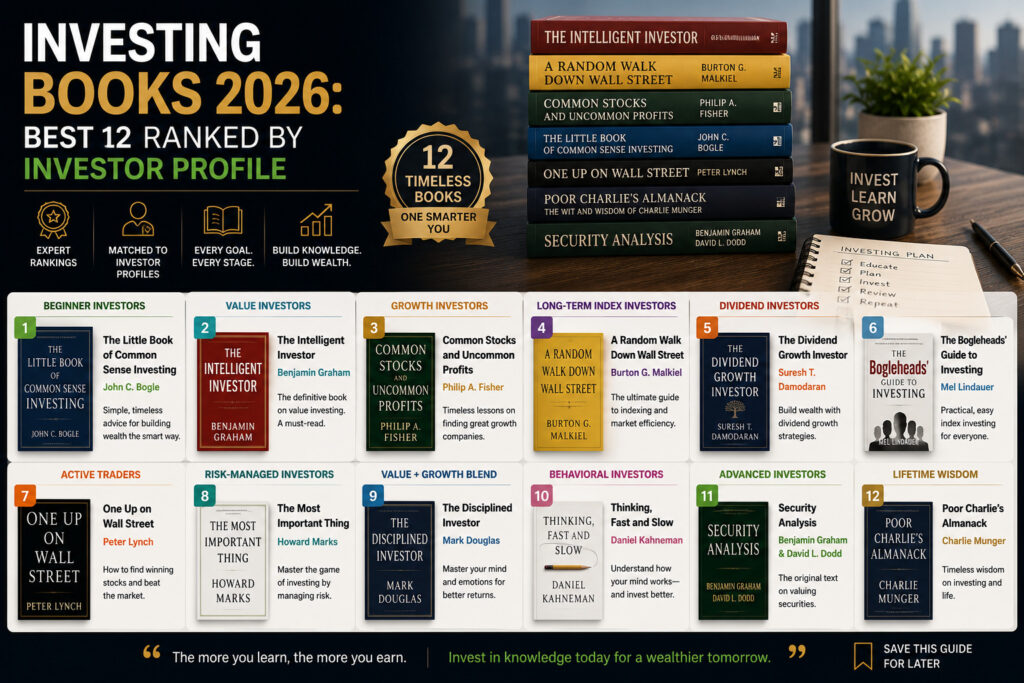
Every “best investing books” list looks the same. The Intelligent Investor is always number one. A Random Walk Down Wall Street is always number two. Rich Dad Poor Dad shows up somewhere, which tells you immediately that nobody on the editorial team read it critically. The list exists to get clicks and sell affiliate links — not to help you figure out which book to read next given where you actually are in your investing journey.
This guide does something different. I’ve organized the best investing books of 2026 by investor profile — where you are right now determines what you should read next. A 25-year-old opening their first brokerage account needs a very different book than a 52-year-old recalibrating their retirement allocation. Treating them as the same reader produces lists that are useless to both.
Table of Contents
- What kind of investor are you? Pick your reading path
- Investing books 2026 for complete beginners
- Best investing books for wealth builders (25–45)
- Best investing mindset books — any level
- Best investing books for advanced investors
- Investing books everyone recommends that you can skip
- What other investing book lists get wrong in 2026
- FAQ: Investing books 2026
What kind of investor are you? Pick your reading path
Before recommending a single investing book, I want to make one thing clear: investing books and personal finance books are not the same category, and most lists mix them up completely. Budgeting, debt payoff, and money mindset books — Ramit Sethi, Dave Ramsey, Tiffany Aliche — are useful, but they’re not investing books. If you’re looking for how to manage your spending or pay off credit card debt, those guides exist and are worth reading. But they are a different genre.
This list is specifically about investing: how to allocate capital, build a portfolio, understand markets, and grow wealth over time. Here are the four profiles and their corresponding reading paths.
| Profile | Description | Start here |
|---|---|---|
| Complete beginner | Never invested before, new to markets | JL Collins → Morgan Housel |
| Wealth builder | Investing regularly, wants to optimize | Malkiel → Bernstein → Graham |
| Mindset gap | Has a strategy but struggles to follow it | Housel → Kahneman → Marks |
| Advanced investor | Experienced, wants deeper frameworks | Graham → Lynch → Marks |

Investing books 2026 for complete beginners
These books assume you know nothing. They are the right place to start if you’ve never invested before or feel like you’re missing foundational knowledge.
1. The Simple Path to Wealth by JL Collins — the best first investing book, full stop
Best for: Anyone who wants the simplest possible framework for building long-term wealth and never needs to think too hard about it again.
JL Collins originally wrote this book as a series of letters to his daughter. That origin shows in the best possible way: it’s direct, warm, and free of the complexity that most financial writing hides behind. The core message is deceptively simple: own VTSAX (Vanguard Total Stock Market Index Fund) or an equivalent low-cost total market fund, keep your savings rate high, and stay the course through inevitable downturns.
What makes it the best beginner investing book is not that it’s dumbed down — it’s not. It’s that Collins explains why the simple approach works with enough depth that you actually believe it, rather than constantly second-guessing yourself. He addresses the stock market’s volatility honestly, explains why most active managers underperform, and gives you the psychological tools to hold through a 40% correction without selling.
The honest critique: it’s US-centric and focused almost entirely on the equity market. It doesn’t address international diversification seriously, and readers outside the US will need to adapt the specific fund recommendations.
Verdict: Read this before any other investing book. If you finish it and implement its advice, you’re already ahead of 90% of retail investors. The rest of this list is refinement.
2. The Psychology of Money by Morgan Housel — the mindset foundation
Best for: Beginners who understand the mechanics of investing but struggle to behave rationally when markets move.
Morgan Housel is the best financial writer alive. This is not hyperbole — his ability to turn complex behavioral finance concepts into clear, human stories is genuinely rare. The Psychology of Money argues that financial success has less to do with intelligence and technical knowledge than with behavior: patience, humility, avoiding catastrophic mistakes, and understanding your own relationship with money and risk.
The chapter “Tails, You Win” alone — explaining that a small number of events drive the majority of investment returns — is worth the price of the book. So is “The Man in the Car Paradox,” which reframes why people pursue wealth in the first place. Each chapter is a standalone essay, which makes it easy to return to specific ideas as your investing experience grows.
The honest critique: it’s a mindset book, not a strategy book. It won’t tell you what to buy or how to allocate your portfolio. Read it alongside a tactical book like Collins or Malkiel.
Verdict: Read this second, immediately after JL Collins. The combination of tactical simplicity (Collins) and behavioral wisdom (Housel) is the most powerful beginner reading foundation available.
3. I Will Teach You to Be Rich by Ramit Sethi — the system book
Best for: Young professionals who need a complete financial system — banking, debt, investing — set up correctly from the start.
Sethi’s book sits on the border between personal finance and investing. It belongs on this list because it does something the other beginner books don’t: it tells you exactly how to set up the infrastructure around your investments. Which bank accounts to use, how to automate contributions, how to handle the 401(k) vs Roth IRA decision, and how to invest your first dollars without overthinking it.
For readers in their 20s or early 30s who need to build the whole system from scratch, it’s genuinely invaluable. The six-week program format makes it actionable in a way that most investing books are not.
The honest critique: the investing advice is solid but thin. Sethi correctly directs you toward index funds and low-cost brokerages, but doesn’t go deep on portfolio construction, asset allocation, or long-term strategy. Use it to build the system, then read Collins for the investing philosophy.
Verdict: Best for readers who haven’t set up their financial infrastructure yet. If your accounts are already set up, skip it and go straight to Collins.
Best investing books 2026 for wealth builders (25–45)
These books are for investors who have the basics down and want to deepen their understanding of how markets work, how to build a durable portfolio, and how to think about asset allocation over a decades-long horizon.
4. A Random Walk Down Wall Street by Burton Malkiel — the index fund case
Best for: Investors who want to understand why passive index investing works — not just that it does, but the theoretical and empirical case behind it.
Malkiel’s central argument — that stock prices follow a “random walk” and cannot be consistently predicted — is one of the most evidence-supported ideas in finance. He walks through every major active management strategy and shows systematically why they fail to beat a diversified index fund over long periods. The data he cites from the S&P SPIVA report (which tracks how many active funds beat their benchmark) has been consistent for decades: the majority of active funds underperform their index over any 10-year period.
Now in its 13th edition, Malkiel also addresses behavioral finance, technical analysis, fundamental analysis, and the rise of ETFs. It’s the most comprehensive intellectual case for passive investing available in book form.
The honest critique: it’s denser than Housel or Collins and rewards slower reading. Some sections on technical analysis and efficient market theory get academic. Skip those sections if they bog you down and focus on the practical chapters.
Verdict: Essential for anyone who has ever been tempted by active stock picking or timing the market. Read it once and you’ll never pay an active management fee again.
5. The Four Pillars of Investing by William Bernstein — the portfolio builder
Best for: Investors who are ready to move beyond “just buy a total market index” and think seriously about asset allocation, diversification, and portfolio construction.
William Bernstein is a neurologist who became one of the most respected voices in investment theory. This book is organized around four pillars: the theory of investing, the history of investing, the psychology of investing, and the business of investing. Together they give you a complete framework for building a portfolio that will survive market downturns, inflation, and your own behavioral tendencies.
The asset allocation chapters are particularly valuable. Bernstein explains how to combine different asset classes — US stocks, international stocks, bonds, REITs — in a way that improves returns relative to risk. His treatment of rebalancing, expected returns, and the role of bonds at different life stages is the clearest available anywhere.
The honest critique: it’s the most demanding read on this list. If you find yourself getting lost, read Collins first to build intuition, then return to Bernstein for the theory.
Verdict: The best book on portfolio construction for individual investors. Read it when you’re ready to think seriously about asset allocation beyond a single fund.
6. The Little Book of Common Sense Investing by John C. Bogle — from the founder of Vanguard
Best for: Investors who want the definitive, concise argument for index fund investing from the person who invented it.
Jack Bogle created Vanguard and the first index mutual fund available to individual investors. This book is his life’s argument distilled: costs are the only thing investors can control, and minimizing them through index funds is the single most reliable path to investment success. The arithmetic he presents — that in aggregate, all investors must receive the market return before costs, and therefore below-market returns after costs — is irrefutable.
Short (under 300 pages), clear, and written with the moral conviction of someone who spent 50 years watching the financial industry extract fees from ordinary savers, this is one of the most important investing books ever written. Warren Buffett has said that a statue of Bogle should be erected in Washington for what he did for individual investors.
Verdict: Read it alongside Malkiel for the complete intellectual case for index investing. Together they form the most persuasive one-two combination in investment literature.
Best investing mindset books 2026 — any experience level
7. Thinking, Fast and Slow by Daniel Kahneman — the behavioral foundation
Best for: Investors who want to understand the cognitive biases that cause even intelligent, informed people to make systematically bad financial decisions.
Kahneman is a Nobel Prize-winning psychologist whose decades of research on human decision-making is the intellectual foundation for everything we know about behavioral finance. This book explains the two systems of thinking — the fast, intuitive, pattern-matching system and the slow, deliberate, analytical system — and shows how the fast system consistently produces predictable errors in judgment.
For investors, the implications are profound. Overconfidence bias, loss aversion, anchoring, availability heuristic — each of these is explained with compelling research and shown to produce costly mistakes in financial decision-making. Once you’ve read Kahneman, you start to notice these errors in your own thinking in real time. That awareness is worth more than almost any tactical insight.
The honest critique: it’s long and some sections are academic. Skip to the chapters most relevant to financial decision-making if you find the psychological research sections slow going.
Verdict: Read this at any stage of your investing journey. The self-awareness it produces compounds over time like interest.
8. The Most Important Thing by Howard Marks — second-level thinking
Best for: Investors who feel confident in the basics and want to develop more sophisticated frameworks for thinking about risk, value, and market cycles.
Howard Marks co-founded Oaktree Capital Management and is famous on Wall Street for his client memos, which Warren Buffett reads as soon as they arrive. This book distills his most important investing concepts into a single volume. The central idea — that successful investing requires “second-level thinking” (thinking about what others are thinking, and why the consensus is wrong) — is one of the most useful frameworks for developing genuine investment insight.
His treatment of risk is the best available: risk is not volatility, it’s the probability of permanent loss. His analysis of market cycles — how they form, how they peak, and why investors consistently misread them — is drawn from decades of real experience managing capital through every major market event since the 1970s.
Verdict: Read this after you have a few years of investing experience. The concepts are straightforward but the wisdom lands differently once you’ve lived through a market correction.
Best investing books 2026 for advanced investors
9. The Intelligent Investor by Benjamin Graham — the value investing foundation
Best for: Investors who want to understand how to evaluate individual stocks and think about intrinsic value.
Graham’s masterwork introduces the concepts that define value investing: intrinsic value, margin of safety, Mr. Market, and the distinction between investment and speculation. Warren Buffett called it “by far the best book about investing ever written.” That endorsement has made it the most-recommended investing book in history — which also means it’s placed at the top of lists by people who haven’t read it and recommend it out of habit.
The honest critique: it’s genuinely difficult. It was written in 1949 for a professional audience. The Jason Zweig revised edition with updated commentary is the only version worth reading. Even then, several chapters require a working knowledge of financial statements. If you’re a complete beginner, Collins and Housel will serve you better for years before you need Graham.
Verdict: Essential — but not first. Place it correctly in your reading order: read it when you’re ready to analyze individual companies, not when you’re building your first index fund portfolio.
10. One Up on Wall Street by Peter Lynch — growth investing made human
Best for: Investors who want to learn how to identify exceptional individual companies using everyday observation and common sense.
Peter Lynch managed the Magellan Fund at Fidelity from 1977 to 1990, producing a 29.2% average annual return — one of the best track records in mutual fund history. His book explains how he did it: by investing in companies he understood, products he used, and businesses with strong fundamentals that Wall Street had overlooked.
Lynch is funny, practical, and unpretentious. He argues that individual investors have a real advantage over professionals: they experience products and services in daily life before Wall Street analysts catch on. His framework for categorizing stocks (stalwarts, fast growers, cyclicals, turnarounds, asset plays) remains one of the most useful organizational tools in growth investing.
The honest critique: Lynch’s approach requires significant time and research. It’s not passive. If you don’t want to analyze individual companies, this book will inspire you but you won’t be able to apply it.
Verdict: Read after Malkiel and Graham. Lynch and Malkiel represent opposing investment philosophies — active stock picking vs passive indexing. Reading both gives you the intellectual tools to make an informed choice about which approach fits your temperament and available time.
11. Common Stocks and Uncommon Profits by Philip Fisher — the qualitative complement to Graham
Best for: Investors who want to evaluate the qualitative dimensions of a business that financial statements don’t capture.
Graham focuses on quantitative analysis — what the numbers say. Fisher focuses on qualitative analysis — what the numbers can’t capture. His “scuttlebutt” method of researching companies by talking to customers, suppliers, competitors, and employees was revolutionary when published in 1958 and remains one of the most effective approaches to company research today.
Warren Buffett has described his own investment philosophy as “85% Graham and 15% Fisher.” Reading both helps you understand the full picture of how Buffett actually evaluates businesses — numbers plus qualitative judgment about management quality, competitive position, and long-term growth potential.
Verdict: Best read alongside or after Graham. The two books are complementary, not redundant.
12. Mastering the Market Cycle by Howard Marks — reading the room
Best for: Experienced investors who want to develop a systematic framework for positioning their portfolio relative to market cycles.
Marks’ second major book focuses specifically on market cycles — how economic cycles, credit cycles, and investor psychology cycles interact to create the boom-and-bust patterns that repeat throughout market history. More importantly, it gives you a practical framework for assessing where we are in the current cycle and adjusting your portfolio’s risk exposure accordingly.
This is not market timing in the traditional sense. Marks is explicit that nobody can predict precisely when markets will turn. What you can do is observe whether markets are priced for greed or fear, and tilt your portfolio accordingly — more defensive when euphoria is widespread, more aggressive when pessimism is extreme.
Verdict: Best for investors managing significant portfolios who want to think more systematically about risk positioning. Read after The Most Important Thing.

Investing books everyone recommends in 2026 that you can skip
Honest curation means telling you what not to read, not just what to read. These books appear on nearly every list and are worth examining critically.
Rich Dad Poor Dad — skip it
Robert Kiyosaki’s book contains some useful reframes about assets and liabilities, but is riddled with factual inaccuracies, vague advice, and a consistent push toward Kiyosaki’s own courses and products. The “rich dad” character is widely believed to be fictional. Multiple financial journalists have documented the gap between what Kiyosaki teaches and what he actually does. The mindset shift it offers can be found more accurately in Housel or Collins. Skip it.
Think and Grow Rich — not an investing book
Napoleon Hill’s 1937 motivational classic appears on investing book lists because it mentions wealth. It is not an investing book. It is a self-help book about the power of positive thinking, written during the Great Depression, based on interviews whose accuracy has never been verified. If you want mindset books, Housel and Kahneman are grounded in actual evidence.
The Total Money Makeover — wrong category
Dave Ramsey’s book is excellent for people who need to get out of debt and build an emergency fund. It is not an investing book. His investing advice — specifically his recommendation to seek out mutual funds with 12% annual returns and his dismissal of index funds — is widely criticized by financial economists as factually incorrect. Read it for the debt payoff framework. Stop before taking his investment advice.
What other investing book lists get wrong in 2026
I reviewed every major ranking for this keyword before writing this guide. Here’s what I found.
CNBC Select & GOBankingRates: personal finance disguised as investing
Both lists include budgeting books, debt payoff books, and money mindset books under the “investing” label. CNBC’s list includes Girls That Invest, The Total Money Makeover, and Get Good with Money — none of which are investing books in any meaningful sense. GOBankingRates recommends Real Estate the Ramsey Way and Tax-Free Wealth alongside Graham. The editorial decision to blur the category exists because broader categories generate more affiliate clicks.
MentorCruise: the first book is for children, the CTA is a paid mentor
MentorCruise’s investing book list opens with Investing for Kids as the number one recommendation. Every book links to Amazon with an affiliate tag. The page ends with repeated calls to “Find an Investing Mentor” through their paid platform. The list exists to generate affiliate revenue and mentor subscriptions, not to help you decide what to read next.
Invesdor: European platform, ESG-heavy, wrong audience for US investors
Invesdor is a crowdinvesting platform based in Europe. Their 2026 investing book list is heavily weighted toward ESG, venture capital, and impact investing — which reflects their platform’s focus, not the needs of a beginner US investor searching for where to start. Half the books they recommend are not available on major US bookselling platforms.
The universal problem: no honest “skip” section
Not one of the competing lists tells you which books to skip. This is because every listing is a potential affiliate click. Rich Dad Poor Dad generates more commission than being told it’s not worth your time. At InvestClarify, we don’t earn commissions on book recommendations. We can tell you what not to read.
Keep building your investing foundation
Books are the foundation. These InvestClarify guides help you put the knowledge into practice:
- How to start investing in 2026: the complete beginner’s guide
- Best high-yield investments in 2026: ranked by risk and return
- Early retirement through dividend investing
- How to invest with confidence: mindset, strategy and portfolio tips
- How to invest in a down market: strategies that work
FAQ: Investing books 2026
Disclaimer: This article is for educational and informational purposes only. It does not constitute financial advice. Investing involves risk, including the potential loss of principal. Always consult a qualified financial advisor before making investment decisions.