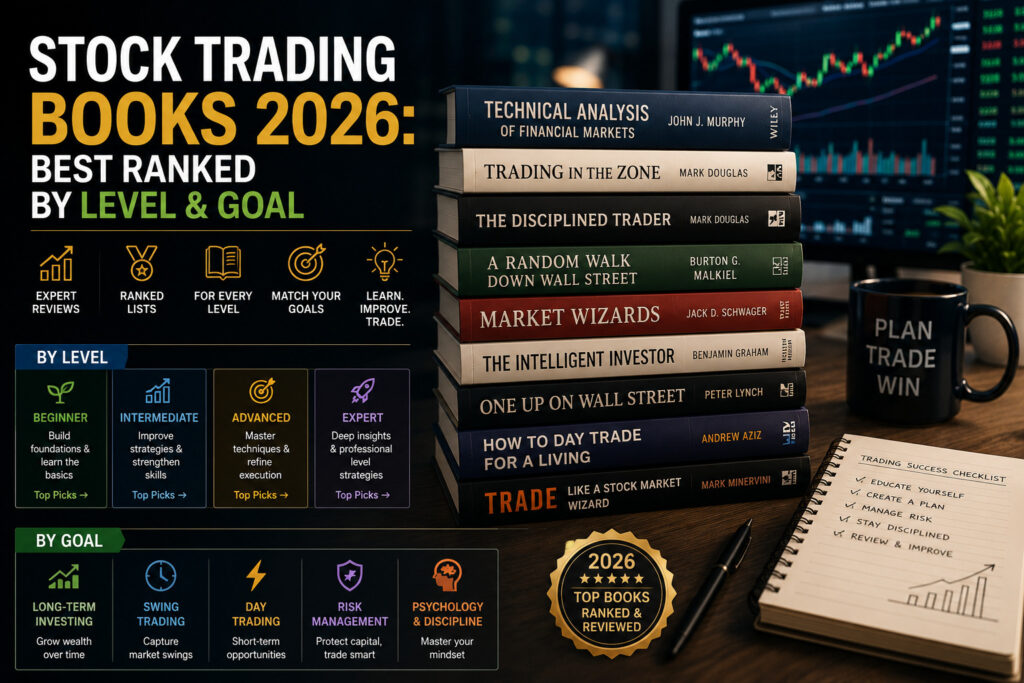
Here’s the problem with most lists of stock trading books: they’re written by brokers trying to get you to open an account, or by content farms recycling the same ten titles year after year. Nobody tells you that half the books on those lists are written for active traders, not long-term investors. Nobody tells you that Trading in the Zone is useless if you haven’t mastered the basics yet. And nobody separates trading from investing — two very different activities that require very different books.
This guide fixes that. I’ve read every stock trading book on this list. I’ll tell you which ones are genuinely worth your time in 2026, who each book is actually for, and which ones you can skip entirely. The reading order matters. Start here.
Table of Contents
Stock trading vs. investing: which books do you actually need?
This is the question every list skips, and it’s the most important one to answer before you read anything. Stock trading and investing are not the same activity. They require different mindsets, different skills, and different books.
Stock trading means actively buying and selling stocks over short periods — days, weeks, or months — with the goal of profiting from price movements. It requires time, discipline, a trading plan, and a strong grasp of technical analysis and risk management. Most active traders underperform a simple index fund over time. According to Investopedia’s research on trading mistakes, the majority of retail traders lose money in their first year. The books that address this head-on are the ones worth reading.
Long-term investing means buying and holding diversified assets — stocks, ETFs, index funds — over years or decades. If this is your goal, most trading books are the wrong place to start. Check out our guide on how to start investing in 2026 and our list of best investing books across all categories instead.
If you want to trade stocks actively — not just hold an index fund — this list is for you. Read it in order.

Best stock trading books 2026 for beginners
Start here if you’ve never traded actively before. These books build the foundation every other book assumes you have.
1. A Beginner’s Guide to the Stock Market by Matthew R. Kratter — the fastest onramp
Best for: Complete beginners who want to understand how the stock market works before touching any other book on this list.
Kratter is a former hedge fund manager who writes with uncommon clarity. This book is short, direct, and covers exactly what its title promises: how the stock market actually works, how stocks are bought and sold, what brokers do, what bid-ask spreads mean, and how to place a basic trade. It doesn’t try to make you rich. It tries to make you competent — which is the right starting point.
The honest critique: it’s thin. Once you understand the basics, you’ll outgrow it quickly. But that’s the point. It’s a runway book, not a destination.
Verdict: Read this first. It takes about three hours and saves you from embarrassing yourself in every conversation and every decision that follows.
2. How to Make Money in Stocks by William J. O’Neil — the CANSLIM framework
Best for: Beginners who want a systematic, rules-based approach to stock selection rather than gut-feel trading.
O’Neil founded Investor’s Business Daily and developed the CANSLIM system — a seven-factor stock selection framework that combines fundamental and technical analysis. The book is data-driven and grounded in decades of research on what the best-performing stocks had in common before they made their big moves.
What makes it stand out: O’Neil doesn’t just describe winners in hindsight. He gives you a replicable checklist. Earnings growth, institutional support, relative strength, market timing — each factor is explained with historical chart examples. It’s one of the few beginner books that actually teaches you what to look for before you buy, not just after.
The honest critique: CANSLIM is a growth-stock strategy. It works best in bull markets. In sideways or bear markets, it produces more false signals. O’Neil doesn’t adequately address this limitation.
Verdict: Read this second. It’s dense but worth it. Take your time with the chart examples.
3. The Intelligent Investor by Benjamin Graham — the value investing bible
Best for: Anyone who wants to understand what a stock is actually worth, not just what it’s trading for today.
Benjamin Graham is the father of value investing and Warren Buffett’s mentor. This book introduces the concept of intrinsic value — the idea that stocks have a fundamental worth independent of their current market price — and the margin of safety principle: only buy when the price is significantly below that value.
It’s not a stock trading book in the active sense. It’s a stock thinking book. It teaches you how to evaluate a business rather than a price chart. That mental model is invaluable even if you end up using it to avoid bad trades rather than find great ones.
The honest critique: it’s dense and was written in 1949. The Jason Zweig revised edition with updated commentary is dramatically more accessible. Read that version, not the original.
Verdict: Essential for long-term context. Read it third, after you understand how trading works mechanically. It will permanently change how you evaluate whether a stock is cheap or expensive.
Best stock trading books 2026 for intermediate traders
These books assume you already understand the basics. They address strategy, technical analysis, and the market mechanics that separate consistent traders from lucky ones.
4. Reminiscences of a Stock Operator by Edwin Lefèvre — the timeless classic
Best for: Anyone who has made their first trades and wants to understand market psychology from the inside.
Written in 1923 and based on the life of legendary trader Jesse Livermore, this is the most-read trading book in history for a reason. It reads like a novel but teaches like a textbook. Livermore’s observations about crowd psychology, market timing, and the emotional traps that destroy traders are as accurate today as they were a century ago.
What you take from this book: the market is driven by human behavior, and human behavior doesn’t change. Greed, fear, hope, and denial create patterns that repeat across every era. Recognizing those patterns in yourself is the beginning of trading discipline.
The honest critique: Livermore himself went bankrupt four times and died broke. The book is a masterclass in market insight combined with a cautionary tale about position sizing and ego. Read it for the wisdom, not as a how-to.
Verdict: Read this after your first real trading losses. It will make more sense then than it does on paper.
5. Market Wizards by Jack D. Schwager — the interview masterclass
Best for: Traders who want to understand what actually separates consistently profitable traders from everyone else.
Schwager spent years interviewing the top traders in the world — futures traders, stock traders, macro investors, options specialists — and compiled their answers into this landmark book. What emerges is striking: despite wildly different strategies, the best traders share a small set of common traits. Strict risk management. Emotional detachment from individual trades. A defined edge they understand and trust. A willingness to cut losses fast.
This is a pattern recognition book, not a strategy book. By the time you’ve read the interviews, you start to see what separates the 5% who make money consistently from the 95% who don’t. It’s one of the most useful books you can read — not because it gives you a system, but because it shows you what a system actually requires.
Verdict: Read this after you have your first trading system, however basic. The interviews land very differently once you have skin in the game.
6. Technical Analysis of the Financial Markets by John J. Murphy — the reference manual
Best for: Traders who want a comprehensive, authoritative reference on chart patterns, indicators, and technical signals.
This is the textbook. Murphy’s 576-page reference covers everything in technical analysis: trend lines, support and resistance, chart patterns (head and shoulders, double tops, flags, pennants), moving averages, RSI, MACD, Bollinger Bands, volume analysis, and more. It’s not a cover-to-cover read — it’s a reference you return to when you need to understand a specific concept or pattern you’re seeing in your charts.
The honest critique: it’s comprehensive to the point of being overwhelming for beginners. Use it as a reference, not as an introduction. Every concept it describes can be found explained more accessibly elsewhere — but nowhere else will you find all of it in one place.
Verdict: Buy it as a reference. Don’t try to read it cover to cover. Search it when you need it.
7. The New Trading for a Living by Dr. Alexander Elder — the complete system
Best for: Traders who want a complete framework covering psychology, strategy, and risk management together in one book.
Elder is a psychiatrist turned trader, and that combination shows. His book is organized around three pillars: trading psychology, market analysis, and money management. He argues — convincingly — that most traders fail not because they lack a strategy but because they lack the psychological discipline to follow one. The technical content (his Triple Screen trading system, impulse system, and Force Index indicator) is solid, but the real value is the framework he builds around risk management and trader psychology.
The 2% rule he introduces — never risk more than 2% of your trading capital on a single trade — is one of the most important concepts in active trading. Simple but almost universally ignored by new traders.
Verdict: One of the best complete trading books available. Read it once you have some trading experience and are ready to build a systematic approach.
Best trading psychology stock trading books 2026
8. Trading in the Zone by Mark Douglas — the psychology essential
Best for: Traders who have a strategy but can’t seem to follow it consistently.
Mark Douglas spent his career as a trading coach watching talented traders blow up their accounts — not because their analysis was wrong, but because their psychology was broken. Trading in the Zone addresses the most common and most destructive mental patterns in active trading: the need to be right on every trade, revenge trading after a loss, cutting winners too early, and holding losers too long.
Douglas introduces the concept of probabilistic thinking — understanding that even a high-quality trading setup has an uncertain outcome on any individual trade, and that your edge only plays out over a large sample of trades. This mental shift is what separates traders who compound wealth from traders who oscillate between winning and losing forever.
The honest critique: the book is repetitive. Douglas makes the same point many times from different angles. Some readers find this valuable for reinforcement. Others find it frustrating. Skim once you feel you’ve absorbed the core message.
Verdict: Read this after you’ve blown up a trading account, or ideally just before. It will explain exactly what happened and how to prevent it from happening again.

Reading order: stock trading books 2026 by goal
| Book | Author | Level | Read when |
|---|---|---|---|
| A Beginner’s Guide to the Stock Market | Matthew R. Kratter | Beginner | First — always |
| How to Make Money in Stocks | William J. O’Neil | Beginner | Second |
| The Intelligent Investor | Benjamin Graham | Beginner/All | Third (Jason Zweig edition) |
| Trading in the Zone | Mark Douglas | All levels | After first real losses |
| Reminiscences of a Stock Operator | Edwin Lefèvre | Intermediate | After first trades |
| Market Wizards | Jack D. Schwager | Intermediate | After first system |
| The New Trading for a Living | Dr. Alexander Elder | Intermediate | When building a system |
| Technical Analysis of the Financial Markets | John J. Murphy | Reference | As needed, not cover to cover |
If you’re a complete beginner
Start with Kratter to understand the mechanics, then move to O’Neil for a rules-based selection framework. Add Graham for valuation context. Keep Murphy’s technical analysis book as a reference. Skip Douglas for now — trading psychology only makes sense once you’ve experienced trading emotions firsthand.
If you’ve been trading for 6–12 months
Start with Douglas immediately — it will explain most of what went wrong. Then read Reminiscences for historical perspective on why markets behave the way they do. Follow with Elder for a complete system framework. Add Market Wizards to understand what the top 5% actually do differently.
If you want long-term investing, not active trading
Skip most of this list. Read Graham’s Intelligent Investor for valuation, then head to our beginner investing guide and our full investing books list for a better-matched reading path. Active trading and passive investing require fundamentally different approaches.
What other stock trading book lists get wrong in 2026
I read every major competitor ranking for this keyword. Here’s what I found — and why it matters for your reading decisions.
XS.com: a forex broker writing content to attract accounts
XS.com is a forex and CFD broker. Their “11 Best Trading Books” article exists for one reason: to rank on Google and convert readers into XS.com account holders. The book descriptions are lifted from publisher summaries. There is no reading order, no distinction between beginners and advanced traders, no honest critique of any title. The list ends with a call to action to open a trading account. If the content was written to help you read better, it would look very different.
StockBrokers.com: 20 books with no honest curation
StockBrokers.com lists 20 books — a number that sounds comprehensive but is really a hedge. With 20 books, you never have to make a difficult editorial judgment about which ones to exclude. The list mixes active trading books with passive investing books without ever acknowledging that these serve completely different readers with different goals. A Random Walk Down Wall Street (buy index funds and hold) sits next to Trading in the Zone (active trading psychology). Those two books recommend opposite strategies. A reader following both at the same time would be paralyzed.
Finowings: Indian market content for a US keyword
Finowings’ article is written primarily for the Indian stock market. It references SEBI regulations, Indian brokerage platforms, and market dynamics specific to the NSE and BSE. If you’re a US investor searching for stock trading books in 2026, this content is mismatched to your needs. The books recommended overlap with universal titles but the context is wrong for a US audience.
TradeReview: 7 quant/algo books for a general audience
TradeReview’s list skews heavily toward quantitative and algorithmic trading — books with Python and R code examples that assume a programming background. Their audience is systematic traders and quants, not the average person searching “stock trading books 2026.” The article also ends with a pitch for their trading journal app. Useful if you’re a quant developer. Wrong list if you’re a retail investor learning to trade actively.
What we do differently at InvestClarify
We don’t sell brokerage accounts. We don’t earn affiliate commissions on book links. We don’t pad lists with 20 titles to avoid making editorial judgments. We separate trading from investing clearly, rank books by experience level, give honest critiques of each title’s limitations, and tell you which ones to skip.
| Competitor | What they do well | Key weakness |
|---|---|---|
| XS.com | Covers popular titles | Forex broker with no editorial independence; no reading order |
| StockBrokers.com | 20 books, decent descriptions | Mixes trading and investing; no honest curation; affiliate-driven |
| Finowings | Good depth on psychology books | Written for Indian market, wrong context for US investors |
| TradeReview | Strong on quant/algo titles | Wrong audience; pitches paid app; too advanced for most readers |
| InvestClarify | Ranked by level, honest critiques, no broker bias | Smaller list (intentional — curation beats padding) |
Build your full investing foundation
Stock trading books are one piece of the puzzle. These InvestClarify guides cover the broader picture:
- How to start investing in 2026: the complete beginner’s guide
- 15 best investing books in 2026 — all categories
- Best high-yield investments in 2026: ranked by risk and return
- Investing in a down market: strategies that work
- How to invest with confidence: mindset, strategy and portfolio tips
FAQ: Stock trading books 2026
Disclaimer: This article is for educational and informational purposes only. It does not constitute financial advice. Stock trading involves substantial risk of loss. Always conduct your own research and consider consulting a qualified financial advisor before trading.