Investment planning is one of the most important topics for US investors in 2026. Whether you’re just starting your financial journey or looking to refine your existing strategy, investment planning helps you build wealth systematically while managing risk. Without a clear plan, even the best investment opportunities can fail to deliver the long-term results you need.
According to a 2025 study by the Federal Reserve, nearly 61% of Americans who lack a formal investment plan feel uncertain about their retirement readiness, compared to just 23% of those with documented financial strategies. In an era of market volatility, rising inflation concerns, and evolving tax policies, having a structured approach to growing your wealth has never been more critical. The difference between financial stress and financial freedom often comes down to the quality of your investment planning process.
What Is Investment Planning?
Investment planning is the comprehensive process of setting financial goals, assessing your current resources, determining appropriate asset allocations, and creating a roadmap to achieve your objectives over time. It involves analyzing your risk tolerance, time horizon, income needs, and tax situation to build a personalized strategy. This disciplined approach transforms random investment decisions into coordinated actions that work together toward your desired outcomes.
For example, a 35-year-old software engineer earning $120,000 annually might use investment planning to balance retirement contributions in a 401(k), save for a home down payment in a high-yield savings account, and invest in index funds for long-term growth. Rather than chasing hot stock tips or reacting emotionally to market swings, this investor follows a predetermined strategy based on specific milestones. The plan adapts as life circumstances change, such as marriage, children, or career transitions, ensuring investments remain aligned with evolving priorities.
Why Investment Planning Matters for US Investors in 2026
The investment landscape in 2026 presents unique challenges and opportunities that make structured planning essential for success. With the S&P 500 experiencing average annual volatility of 18-22% over the past three years and interest rates stabilizing after a period of aggressive Federal Reserve adjustments, investors need clarity more than ever. Additionally, new tax regulations affecting capital gains and retirement accounts require strategic positioning to maximize after-tax returns.
- Protection Against Inflation: Investment planning helps you select assets that historically outpace inflation, which averaged 3.2% annually from 2021-2025. Without investments that generate real returns above inflation, your purchasing power steadily erodes over time.
- Tax Efficiency Optimization: A well-structured plan strategically uses tax-advantaged accounts like IRAs, 401(k)s, and HSAs to minimize your lifetime tax burden. By 2026, investors who maximize these accounts can save 20-35% more than those who ignore tax planning.
- Emotional Discipline During Volatility: Having a documented investment plan reduces panic-selling during market downturns by 67%, according to Vanguard research. When you trust your strategy, you’re less likely to make costly emotional decisions that derail long-term wealth accumulation.
- Retirement Readiness Assurance: With traditional pensions nearly extinct and Social Security replacing only about 40% of pre-retirement income for average earners, personal investment planning is now the primary vehicle for retirement security. Starting early and following a plan can mean the difference between retiring at 65 or working into your 70s.
How to Get Started with Investment Planning: Step-by-Step
Beginning your investment planning journey doesn’t require advanced financial expertise, but it does demand honest self-assessment and commitment to following through on your decisions.
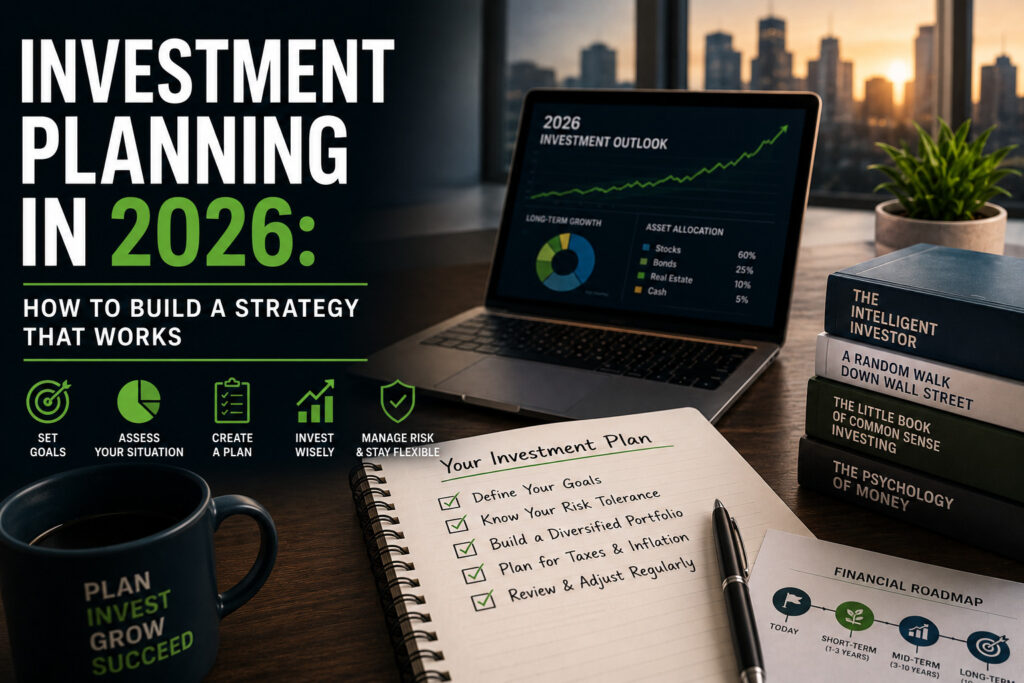
- Step 1: Define Clear Financial Goals: Identify specific objectives with dollar amounts and target dates, such as “$50,000 for a home down payment in 5 years” or “$2 million for retirement in 30 years.” Vague aspirations like “be wealthy someday” don’t provide the clarity needed for effective investment planning.
- Step 2: Assess Your Risk Tolerance and Time Horizon: Complete a risk assessment questionnaire to understand your emotional capacity for market fluctuations and align it with your investment timeline. Someone retiring in 3 years has dramatically different needs than someone with 30 years until retirement, requiring different asset allocation strategies.
- Step 3: Determine Your Asset Allocation: Decide what percentage of your portfolio should be in stocks, bonds, real estate, and cash based on your risk tolerance and timeline. A common starting framework for younger investors is the “120 minus your age” rule for stock allocation, though this should be customized to individual circumstances.
- Step 4: Select Tax-Efficient Account Structures: Maximize contributions to employer-sponsored 401(k) plans (especially to capture any company match), then fund Roth IRAs for tax-free growth, and use taxable brokerage accounts for additional savings. Understanding contribution limits ($23,000 for 401(k) and $7,000 for IRAs in 2026) ensures you optimize tax advantages.
- Step 5: Implement and Automate Your Strategy: Set up automatic contributions from each paycheck to your investment accounts and enable automatic rebalancing to maintain your target asset allocation. Automation removes the friction that causes many people to delay or abandon their investment planning efforts.
- Step 6: Review and Adjust Quarterly: Schedule quarterly reviews to assess performance, rebalance if allocations have drifted more than 5% from targets, and adjust contributions based on income changes. Annual comprehensive reviews should reassess goals, risk tolerance, and overall strategy as your life circumstances evolve.
Investment Planning: Common Mistakes to Avoid
Even well-intentioned investors frequently make predictable errors that undermine their investment planning efforts and reduce long-term returns.
- Mistake 1: Failing to Start Due to Perfectionism: Many beginners wait for the “perfect” market conditions or until they fully understand every investment concept before beginning. The cost of delayed investment planning is enormous—waiting just 5 years to start investing can reduce your retirement savings by 35-40% due to lost compound growth, even if you invest the same total amount.
- Mistake 2: Ignoring Tax Implications: Investing without considering tax consequences can cost you thousands annually through unnecessary capital gains taxes, inefficient account selection, and poor asset location strategies. For example, holding tax-inefficient bonds in taxable accounts while keeping stocks in tax-deferred accounts is backwards for most investors.
- Mistake 3: Emotional Reaction to Market Volatility: Selling investments during market downturns and buying during euphoric peaks is the opposite of effective strategy, yet behavioral research shows 40% of investors do exactly this. Investment planning includes pre-committing to stay the course during inevitable market cycles, recognizing that volatility is the price of admission for long-term returns.
- Mistake 4: Neglecting Regular Rebalancing: Letting your portfolio drift away from target allocations means you’re taking either more or less risk than intended, potentially jeopardizing your goals. A portfolio that started at 70% stocks and 30% bonds can easily drift to 85% stocks during a bull market, exposing you to unexpected losses when corrections occur.
- Mistake 5: Paying Excessive Fees: High expense ratios on actively managed funds, unnecessary advisory fees, and frequent trading costs can consume 1-2% of your portfolio annually, which compounds to a 25-35% reduction in lifetime wealth. Effective investment planning prioritizes low-cost index funds and minimizes turnover.
Avoiding these pitfalls requires education, discipline, and often guidance from qualified financial professionals who follow fiduciary standards.
For more information, visit Investopedia or the official SEC website.
Advanced Investment Planning Strategies for 2026
Once you’ve mastered the basics, several sophisticated techniques can enhance your investment planning outcomes and accelerate wealth accumulation. These approaches require more attention but deliver measurably better results for committed investors. Understanding these strategies helps you evolve from beginner to intermediate investor status.
Tax-loss harvesting involves strategically selling investments at a loss to offset capital gains, potentially saving thousands in taxes annually while maintaining your desired market exposure through similar replacement investments. Geographic diversification beyond US markets captures growth in emerging economies while reducing country-specific risk. Factor-based investing targets specific return drivers like value, momentum, and quality that have historically outperformed market-cap-weighted indexes over long periods.
Asset location optimization places investments in the most tax-efficient account types—for instance, keeping REITs and bonds in tax-deferred accounts while holding stocks in Roth IRAs and municipal bonds in taxable accounts. Dynamic spending strategies for retirees adjust withdrawal rates based on market performance to extend portfolio longevity. These advanced tactics should complement, not replace, your fundamental investment planning framework.
The Role of Professional Guidance in Investment Planning
While self-directed investment planning works well for many investors, professional guidance provides value in specific situations and can prevent costly mistakes. Fee-only financial planners who follow fiduciary standards charge transparent fees and are legally obligated to act in your best interest. Robo-advisors offer algorithm-driven investment planning at low costs, typically 0.25-0.50% annually, making professional management accessible to investors with smaller portfolios.
Consider professional help when facing complex situations like inheritance planning, business sale proceeds, stock option compensation, or approaching retirement with multiple account types requiring coordination. The cost of professional advice often pays for itself through tax savings, behavioral coaching during market stress, and sophisticated strategies you wouldn’t implement independently. However, thoroughly vet any advisor by checking their credentials (CFP, CFA), reviewing their ADV form on the SEC website, and understanding exactly how they’re compensated.
Many successful investors use a hybrid approach—handling routine contributions and rebalancing themselves while consulting professionals for major life transitions and annual strategy reviews. This balanced method maximizes cost efficiency while ensuring expert oversight when stakes are highest. The key is recognizing your knowledge limits and seeking qualified help before making irreversible mistakes.
Investment Planning for Different Life Stages
Effective investment planning adapts to your current life stage, with dramatically different priorities for those in their 20s versus their 60s. Understanding these stage-specific strategies helps you optimize your approach for maximum results. Your investment timeline fundamentally shapes appropriate risk levels and asset selection.
Investors in their 20s and 30s should prioritize aggressive growth through high stock allocations (80-100%), maximize retirement account contributions to capture decades of compound growth, and accept higher volatility as the price of superior long-term returns. Those in their 40s and 50s typically balance growth and stability with 60-80% stock allocations, increase savings rates as income peaks, and begin serious retirement projections to ensure they’re on track. Pre-retirees in their late 50s and 60s gradually reduce risk by shifting to 40-60% stocks, establish income-generating positions, and create withdrawal strategies that minimize taxes and extend portfolio longevity.
Retirees focus on capital preservation and reliable income through dividend stocks, bonds, and systematic withdrawal plans, typically maintaining 30-50% stock exposure to combat inflation over potentially 30+ year retirements. Each transition requires intentional investment planning adjustments rather than passive drift. The specific percentages should be customized to individual circumstances, risk tolerance, and goals rather than following rigid age-based formulas.
Investment Planning Tools and Resources
Modern technology has democratized access to sophisticated investment planning tools that were previously available only to wealthy clients of private banks. Free portfolio analysis tools like Morningstar’s X-Ray show your aggregate asset allocation across all accounts and identify overlap or gaps in your strategy. Retirement calculators from Vanguard, Fidelity, and Charles Schwab project whether your current savings rate will meet your goals, allowing course corrections decades before retirement.
Personal Capital and Empower offer free comprehensive financial dashboards that track net worth, analyze fees, and monitor investment performance across multiple institutions in one interface. Tax-optimization software like Betterment’s TaxMin and Wealthfront’s automatic tax-loss harvesting can add 0.5-1.5% to annual after-tax returns. Spreadsheet templates and goal-tracking apps help maintain accountability to your investment planning commitments.
Educational resources like the Bogleheads forum provide community support from experienced investors who follow evidence-based strategies, while podcasts like “The Money Guy Show” and “ChooseFI” deliver actionable investment planning guidance for self-directed investors. Books remain valuable—”The Simple Path to Wealth” by JL Collins, “A Random Walk Down Wall Street” by Burton Malkiel, and “The Intelligent Investor” by Benjamin Graham provide timeless frameworks. Combining technology tools with quality education creates a powerful foundation for successful do-it-yourself investment planning.
Monitoring and Adjusting Your Investment Planning Strategy
Creating an initial investment plan is just the beginning—ongoing monitoring and strategic adjustments ensure your strategy remains aligned with changing circumstances and markets. Quarterly reviews should verify that automatic contributions are functioning, rebalance any allocations that have drifted beyond your 5% tolerance bands, and assess whether you’re on track to meet short-term goals. These brief check-ins take 30-60 minutes and prevent small issues from becoming major problems.
Annual comprehensive reviews examine bigger-picture questions like whether your risk tolerance has changed, if major life events require strategy modifications, and whether your goals remain realistic given current savings rates and investment returns. This is when you adjust contribution amounts based on raises, redirect money from completed goals to new objectives, and ensure your beneficiary designations remain current. Market performance over the past year should inform tactical adjustments but never trigger wholesale abandonment of your long-term investment planning framework.
Major life events—marriage, divorce, children, inheritance, job changes, health issues—necessitate immediate strategy reviews outside your regular schedule. Each of these can fundamentally alter your financial situation, risk capacity, time horizon, or goals in ways that require portfolio adjustments. Building flexibility into your investment planning approach means viewing your strategy as a living document that evolves with you rather than a static set of rules established once and never questioned.
Frequently Asked Questions About Investment Planning
What is investment planning and how does it work?
Investment planning is the systematic process of defining financial goals, assessing your risk tolerance and time horizon, selecting appropriate investments, and creating an actionable strategy to build wealth over time. It works by transforming vague aspirations into specific objectives with dollar amounts and deadlines, then structuring your savings and asset allocation to achieve those targets efficiently. The process includes regular monitoring and adjustments to keep you on track as markets fluctuate and life circumstances change.
Is investment planning a good option for beginners?
Absolutely—investment planning is essential for beginners because it prevents costly mistakes, provides emotional discipline during market volatility, and establishes good habits early when they have maximum impact through compound growth. Starting with a simple plan using low-cost index funds in tax-advantaged retirement accounts gives beginners a solid foundation they can build upon as knowledge increases. The alternative—investing randomly without a plan—almost always produces inferior results and higher stress.
How much money do I need to start with investment planning?
You can begin investment planning with any amount, even $50-100 monthly, since the planning process itself costs nothing and most brokerages now offer commission-free trading with no account minimums. The important factor is starting immediately to capture maximum compound growth time, not waiting until you have some arbitrary “enough” amount. Many employers’ 401(k) plans accept contributions as low as 1% of salary, and apps like Acorns or Robinhood allow fractional share investing with tiny initial deposits.
What are the risks of investment planning?
The primary risk of investment planning is creating an overly aggressive strategy that doesn’t match your true risk tolerance, leading to panic-selling during inevitable market downturns. Other risks include following a plan too rigidly without adjusting for major life changes, underestimating how much you need to save, and selecting inappropriate investments that don’t align with your timeline. However, these risks are far smaller than the virtual certainty of inadequate retirement savings that results from having no investment planning strategy at all.
How often should I update my investment planning strategy?
You should conduct brief quarterly reviews to rebalance portfolios and verify automatic contributions, comprehensive annual reviews to assess progress toward goals and adjust for changed circumstances, and immediate reviews following major life events like marriage, children, inheritance, or job changes. Market volatility alone rarely justifies strategy changes unless it reveals that your risk tolerance was miscalibrated. The balance between consistency and flexibility is crucial—update when circumstances genuinely