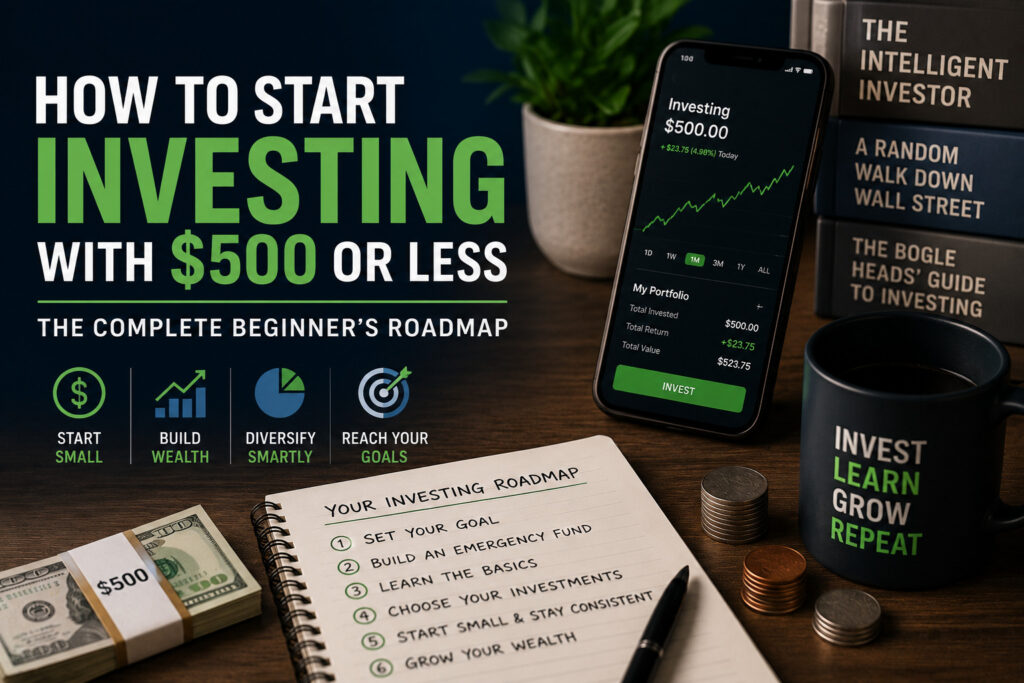
How to Start Investing with $500 or Less — The Complete Beginner’s Roadmap

You don’t need a fortune to start building one. Here’s how to invest with $500 or less.
Before You Invest: 3 Things to Do First
Before you put a single dollar into the market, there are three financial fundamentals you need to check off. Skipping these is one of the most common and costly mistakes new investors make.
① Build a Small Emergency Fund
An emergency fund is cash set aside for unexpected expenses — a car repair, a medical bill, a sudden job loss. Ideally you want 3–6 months of living expenses in a high-yield savings account (HYSA). But before you can invest your $500 comfortably, you need at least a starter emergency fund of $500–$1,000 separate from your investment money.
Why does this matter? Because if you invest your last $500 and an emergency strikes next month, you’ll be forced to sell your investments — possibly at a loss — to cover the cost. The emergency fund is your buffer that keeps your investments untouched.
② Pay Off High-Interest Debt First
The stock market has historically returned around 7–10% per year on average. But if you’re carrying credit card debt at 20% interest, investing instead of paying it off is mathematically irrational — you’re earning less than you’re losing.
③ Define Your Goal and Time Horizon
Why are you investing this $500? Your answer shapes every decision that follows:
- Retirement (20+ years away): You can take on more risk — more stocks, fewer bonds.
- Buying a home in 3–5 years: Keep it conservative — bonds, CDs, or a high-yield savings account for money you’ll need soon.
- Building long-term wealth: Broad-market ETFs are your best friend.
- Generating passive income: Dividend ETFs or bond ETFs may suit you.
What Can $500 Actually Do for You?
Skeptical that $500 makes a real difference? The math of compound interest tells a different story. Here’s what a single $500 investment grows to at a 7% average annual return (a conservative estimate for a diversified stock portfolio):
| Time Horizon | $500 One-Time Investment | $500 + $100/month |
|---|---|---|
| 5 years | $701 | $7,760 |
| 10 years | $984 | $18,130 |
| 20 years | $1,967 | $54,040 |
| 30 years | $3,869 | $122,710 |
The real power comes from consistency. Adding just $100 per month on top of your initial $500 turns a modest start into over $122,000 after 30 years — without any market-beating strategy, just steady contributions to a boring index fund.
Step 1 — Choose the Right Account
One of the most impactful decisions you’ll make when figuring out how to start investing with $500 is choosing the right account type. The account you use determines your tax treatment — and over decades, that can mean tens of thousands of dollars in difference.
Tax-Advantaged Accounts (Start Here)
| Account Type | Country | Tax Benefit | 2026 Annual Limit |
|---|---|---|---|
| Roth IRA | 🇺🇸 USA | Grow & withdraw tax-free in retirement | $7,000 |
| Traditional IRA | 🇺🇸 USA | Contributions may be tax-deductible | $7,000 |
| 401(k) | 🇺🇸 USA | Pre-tax contributions + employer match | $23,500 |
| ISA | 🇬🇧 UK | All gains & income tax-free | £20,000 |
| PEA | 🇫🇷 France | Tax-exempt after 5 years | €150,000 (lifetime) |
| TFSA | 🇨🇦 Canada | All gains & withdrawals tax-free | $7,000 CAD |
Taxable Brokerage Account
If you’ve maxed your tax-advantaged options (or you’re investing for a goal before retirement age), a standard brokerage account works fine. You’ll pay capital gains tax on profits, but there are no contribution limits and no withdrawal restrictions.
Step 2 — Pick a Brokerage
With your account type decided, you need a platform to hold it. Here are the most beginner-friendly brokerages to consider when starting to invest with $500:
| Brokerage | Best For | Min. Deposit | Fractional Shares | Region |
|---|---|---|---|---|
| Fidelity | Overall best for beginners | $0 | ✅ Yes | 🇺🇸 |
| Charles Schwab | Research & education | $0 | ✅ Yes | 🇺🇸 |
| Interactive Brokers | International investors | $0 | ✅ Yes | 🌍 |
| Trade Republic | European mobile-first investing | €1 | ✅ Yes | 🇪🇺 |
| Wealthsimple | Canadian investors | $0 | ✅ Yes | 🇨🇦 |
Step 3 — Choose Your Investments
Now the part most beginners find overwhelming: what should you actually buy? The good news is that for most people starting out, the answer is straightforward.
Option A: Broad-Market Index ETFs (Best for Most Beginners)
A single broad-market ETF gives you instant exposure to hundreds or thousands of companies. It’s diversified by default, costs almost nothing to hold, and has a long track record of solid long-term returns. This is the foundation of the world’s most successful long-term investment strategy — the kind Warren Buffett recommends for the average person.
| ETF | Ticker | Covers | Expense Ratio |
|---|---|---|---|
| Vanguard S&P 500 ETF | VOO | 500 largest U.S. companies | 0.03% |
| Vanguard Total World ETF | VT | 9,000+ global stocks in one fund | 0.07% |
| iShares Core MSCI World ETF | IWDA | Developed markets worldwide | 0.20% |
| Vanguard FTSE All-World ETF | VWCE | Global stocks (EU-listed, EUR) | 0.22% |
Option B: Robo-Advisors (Best for Hands-Off Beginners)
A robo-advisor is an automated investment platform that builds and manages a diversified portfolio for you based on your risk tolerance and goals. Popular options include Betterment, Wealthfront (USA), and Scalable Capital (Europe). They typically charge 0.25% per year — still very low — and require zero investing knowledge to get started.
Option C: Individual Stocks (Only as a Small Portion)
With $500, putting everything into one or two individual stocks is very risky. If you want stock-picking exposure, limit it to 10–20% of your portfolio maximum (“satellite” allocation), and keep the core in diversified ETFs.
✅ ETF / Index Fund
- Instant diversification
- Very low fees (0.03–0.25%)
- No research required
- Proven long-term track record
⚠️ Individual Stocks
- Concentrated risk
- Requires deep research
- Most stock pickers underperform
- Emotional volatility
Step 4 — How to Allocate Your $500
Here are three sample portfolios for different investor profiles — all built with $500 and all available at zero-commission brokerages with fractional shares:
🟢 Portfolio 1: The Simple Starter (Aggressive Growth)
Ideal for: 20–35 year olds with a 20+ year horizon who can tolerate volatility.
| Investment | Allocation | Amount |
|---|---|---|
| VOO (S&P 500 ETF) | 80% | $400 |
| VXUS (International ETF) | 20% | $100 |
🟡 Portfolio 2: The Balanced Beginner (Moderate)
Ideal for: Investors with a 10–20 year horizon who want some stability.
| Investment | Allocation | Amount |
|---|---|---|
| VTI (Total U.S. Market ETF) | 60% | $300 |
| VXUS (International ETF) | 20% | $100 |
| BND (U.S. Bond ETF) | 20% | $100 |
🔵 Portfolio 3: The Global One-Fund Solution
Ideal for: Complete beginners who want simplicity above everything else.
| Investment | Allocation | Amount |
|---|---|---|
| VT (Vanguard Total World ETF) | 100% | $500 |

Three simple portfolio options for investors starting with $500.
Step 5 — Automate and Keep Investing
Making your first $500 investment is a milestone. But the real wealth-building machine is what comes next: automated, regular contributions. This strategy is called Dollar-Cost Averaging (DCA).
What Is Dollar-Cost Averaging?
Dollar-cost averaging means investing a fixed amount at regular intervals — say, $100 every month — regardless of whether the market is up or down. When prices are high, your $100 buys fewer shares. When prices are low, it buys more. Over time, this averages out your cost per share and removes the stress of trying to “time the market.”
How to Set Up Automatic Investing
Most brokerages allow you to schedule automatic investments on a weekly, biweekly, or monthly basis. The setup takes about five minutes and removes the emotional component of investing entirely. You don’t have to remember, you don’t have to decide — it just happens.
- Log in to your brokerage account.
- Find the “Automatic Investment” or “Recurring Investment” feature.
- Select your ETF, your amount, and your frequency.
- Link your bank account and confirm.
- Done — your portfolio grows on autopilot.
Common Mistakes Beginners Make (and How to Avoid Them)
Knowing how to start investing with $500 is only half the equation. Knowing what not to do is equally important. Here are the most common pitfalls:
Trying to Time the Market
Waiting for “the right moment” to invest is one of the costliest habits in personal finance. Studies show that missing just the 10 best trading days over a 20-year period cuts your total return nearly in half. Invest now, then keep investing.
Checking Your Portfolio Every Day
Daily price swings are noise. Long-term returns are the signal. Obsessively monitoring your portfolio leads to emotional decisions — buying high when excitement peaks, selling low when fear kicks in. Check your portfolio quarterly, not daily.
Chasing Last Year’s Top Performers
The fund that returned 40% last year is not guaranteed to do it again — in fact, research shows last year’s winners frequently underperform the following year. Stick to your diversified core portfolio and resist the urge to rotate into whatever is hot.
Ignoring Fees
A 1% annual fee sounds harmless. On a $500 starting investment growing at 7% for 30 years, the difference between a 0.05% ETF and a 1.05% fund is over $2,800 in lost returns. Always check the expense ratio before buying any fund.
Not Investing at All
The single biggest mistake? Waiting until you have “more money” to invest. Every year you delay, you lose a year of compounding. $500 today is worth far more than $500 five years from now — in ways that compound interest makes mathematically undeniable.
Ready to Take Your First Step?
Get InvestClarify’s free weekly newsletter — plain-English guides on building wealth, one smart decision at a time.
Frequently Asked Questions
Can I really start investing with just $500?
Absolutely. Many brokerages offer zero-minimum accounts and fractional shares, so you can start with as little as $1. With $500, you can build a properly diversified portfolio using low-cost ETFs and still have enough to cover any transaction costs comfortably.
What is the best investment for a beginner with $500?
For most beginners, a broad-market index ETF — such as the Vanguard Total World ETF (VT) or the Vanguard S&P 500 ETF (VOO) — is the ideal starting point. It offers instant diversification, extremely low fees, and a strong historical track record.
Should I pay off debt before investing?
It depends on the interest rate. High-interest debt (above 7–8%, such as credit cards) should generally be eliminated first. Low-interest debt (like a mortgage) can coexist with an investing plan. When in doubt, split your savings: use half to pay down debt, half to invest.
How much can $500 grow over time?
At a 7% average annual return, $500 becomes roughly $1,967 after 20 years and $3,869 after 30 years — purely through compounding. Add $100 per month and those numbers jump to $54,040 and $122,710 respectively. Starting early is the most powerful lever you have.
Is $500 enough to open a brokerage account?
Yes. Most major brokerages — including Fidelity, Charles Schwab, and Interactive Brokers — have no minimum deposit requirement. You can open an account and invest your first $500 the same day, entirely online.
How often should I invest after my first $500?
Consistency matters more than amount. Setting up a recurring automatic investment — even $25 or $50 per month — builds powerful long-term habits and takes advantage of dollar-cost averaging. Increase the amount whenever your income allows.
Conclusion: Start Small, Think Long
Learning how to start investing with $500 is one of the highest-return skills you can develop. Not because $500 alone will make you rich, but because starting — even small — builds the habits, the knowledge, and the account infrastructure that you’ll scale over the rest of your financial life.
Here’s your action plan, condensed to five steps:
- Build a starter emergency fund ($500–$1,000) and eliminate high-interest debt first.
- Open a tax-advantaged account (Roth IRA, ISA, PEA, or 401k) — or a standard brokerage account if those aren’t available to you.
- Choose a zero-commission brokerage with fractional shares and no account fees.
- Invest your $500 in one simple, diversified ETF — VT, VOO, or VWCE are excellent starting points.
- Automate monthly contributions, however small, and ignore short-term market noise.
The market will go up. The market will go down. The investors who win are the ones who stay the course, keep contributing, and let time do the heavy lifting. Your $500 is not just $500 — it’s the first brick in a building that could last decades.
At InvestClarify, we’re here for every step. Explore our related guides below and subscribe to our newsletter for weekly insights delivered in plain English.
Disclaimer: The content on this page is for educational purposes only and does not constitute financial advice. Past performance is not a guarantee of future results. Always consult a qualified financial advisor before making investment decisions. Investing involves risk, including the possible loss of principal.