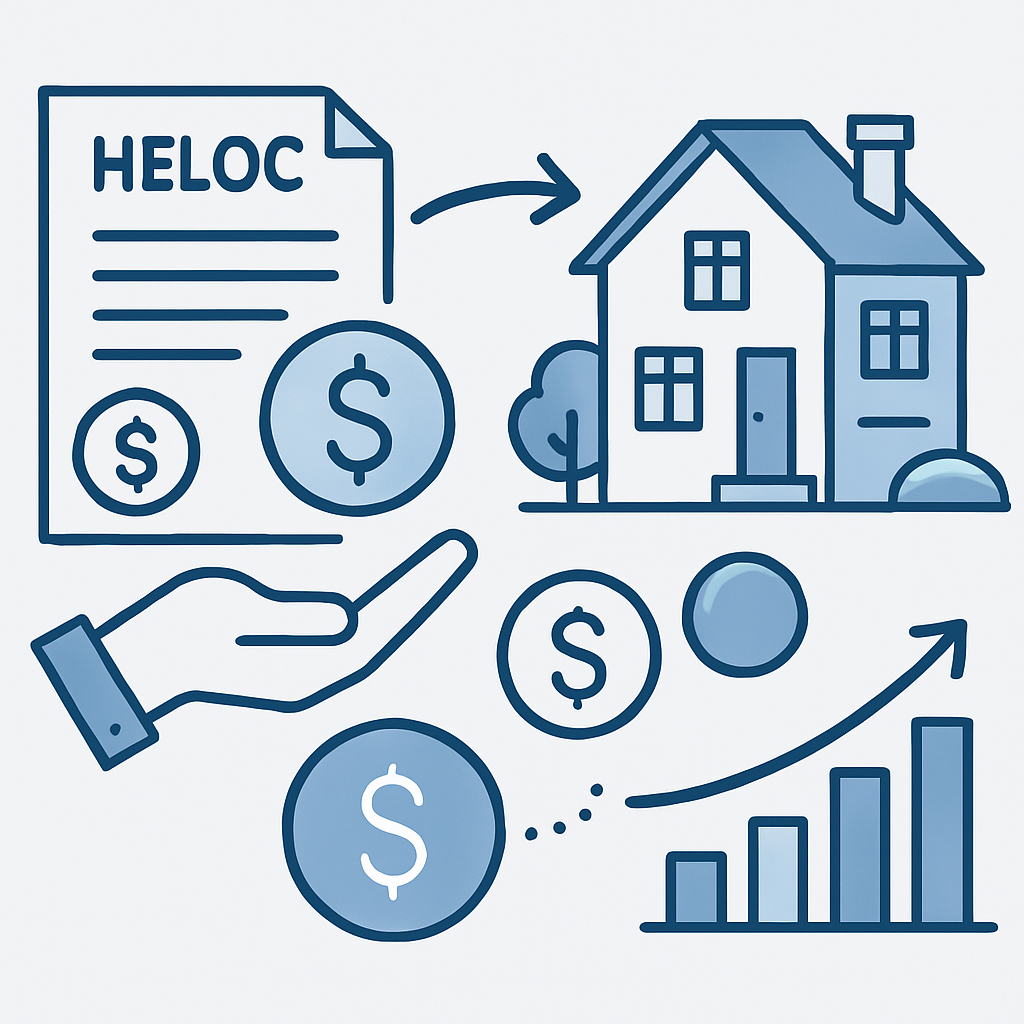
HELOC on investment property is one of the most important topics for US investors in 2026. Many real estate investors sit on significant equity but struggle to access it without selling their properties. A HELOC on investment property can unlock that capital, helping you fund renovations, acquire new properties, or consolidate debt while maintaining ownership of your cash-flowing assets.
With interest rates stabilizing in 2026 and real estate prices remaining elevated across most US markets, savvy investors are looking for creative financing strategies to scale their portfolios. According to recent industry data, approximately 68% of investment property owners have at least 30% equity in their properties, representing billions in untapped capital. Understanding how to leverage that equity responsibly through a HELOC can be the difference between stagnant growth and exponential portfolio expansion.
What Is HELOC on Investment Property?
A HELOC on investment property is a revolving line of credit secured by the equity in a rental property or other non-owner-occupied real estate asset. Similar to a credit card, you can borrow against the available credit limit, repay it, and borrow again during the draw period, which typically lasts 5-10 years. The property itself serves as collateral, meaning the lender can foreclose if you default on payments.
Unlike a traditional mortgage or home equity loan that provides a lump sum, a HELOC offers flexibility to draw funds only when needed. For example, an investor with a rental property worth $400,000 and an outstanding mortgage of $200,000 might qualify for a HELOC of $80,000 to $120,000, depending on the lender’s loan-to-value requirements. This credit line can then fund property improvements, cover unexpected repairs, or serve as a down payment on additional investment properties.
Why HELOC on Investment Property Matters for US Investors in 2026
The strategic use of a HELOC on investment property has become increasingly relevant as traditional lending has tightened and cash-flow optimization has become essential for portfolio growth. Current data shows that investors who strategically leverage equity grow their portfolios 3.2 times faster than those relying solely on saved capital. Furthermore, with average HELOC rates on investment properties ranging from 7.5% to 10.5% in 2026, the cost of capital remains competitive compared to alternative financing methods like hard money loans or cash-out refinancing.
- Liquidity Without Liquidation: You can access substantial capital without selling your investment property and triggering capital gains taxes. This preserves your monthly rental income while giving you funds to deploy elsewhere in your investment strategy.
- Portfolio Velocity: Using equity from one property to fund down payments on others creates a compounding effect that accelerates portfolio growth. Many successful investors use this “snowball” strategy to acquire 5-10 properties within just a few years.
- Interest-Only Draw Periods: During the initial draw period, most HELOCs require only interest payments, keeping monthly obligations low while you deploy the capital for revenue-generating purposes. This cash flow advantage is particularly valuable for investors managing multiple properties simultaneously.
- Tax Advantages: When HELOC funds are used for property improvements or to acquire additional investment real estate, the interest may be tax-deductible as a business expense. Always consult with a tax professional, but this potential deduction can significantly reduce your effective borrowing cost.
How to Get Started with HELOC on Investment Property: Step-by-Step
Securing a HELOC on investment property requires more documentation and higher standards than a HELOC on your primary residence, but the process follows a predictable pattern.
- Step 1: Assess Your Equity Position: Calculate your current loan-to-value ratio by dividing your mortgage balance by the property’s current market value. Most lenders will allow you to borrow up to 75-80% LTV on investment properties, meaning you need at least 20-25% equity to qualify for a meaningful HELOC.
- Step 2: Document Your Cash Flow: Gather at least 12-24 months of rental income documentation, including lease agreements, bank statements showing deposit history, and Schedule E from your tax returns. Lenders want proof that the property generates positive cash flow sufficient to cover the existing mortgage plus the new HELOC payments.
- Step 3: Shop Multiple Lenders: Not all financial institutions offer HELOCs on investment properties, and terms vary dramatically between those that do. Contact at least 3-5 lenders including community banks, credit unions, and specialty investment property lenders to compare interest rates, fees, draw periods, and LTV limits.
- Step 4: Complete the Application and Appraisal Process: Submit your application with all required documentation including personal financial statements, credit reports, property insurance, and existing loan information. The lender will order an appraisal to verify the property’s value, which typically costs $400-600 and takes 1-3 weeks to complete.
HELOC on Investment Property: Common Mistakes to Avoid
Even experienced investors make critical errors when pursuing a HELOC on investment property, often resulting in declined applications, unfavorable terms, or financial strain down the road.
- Mistake 1: Underestimating Qualification Requirements: Investment property HELOCs require higher credit scores (typically 680-720 minimum), lower debt-to-income ratios, and more cash reserves than primary residence HELOCs. Many investors apply without adequate preparation and damage their credit with multiple hard inquiries when they get rejected.
- Mistake 2: Overleveraging Without Cash Reserves: Drawing the maximum available credit without maintaining 6-12 months of reserves for both properties creates dangerous vulnerability to vacancies, repairs, or economic downturns. The properties securing your HELOCs are at risk if you cannot make payments during temporary income disruptions.
- Mistake 3: Ignoring Variable Rate Risk: Nearly all HELOCs carry variable interest rates tied to the prime rate, meaning your payment can increase significantly if rates rise. Failing to stress-test your cash flow against a 2-3% rate increase has caused many investors to face payment shock and potential default.
Before finalizing any HELOC agreement, carefully review all terms including prepayment penalties, annual fees, early closure fees, and rate adjustment caps to avoid unexpected costs.
For more information, visit Investopedia or the official SEC website.
Frequently Asked Questions About HELOC on Investment Property
What is HELOC on investment property and how does it work?
A HELOC on investment property is a revolving credit line secured by equity in a rental or non-owner-occupied property that allows you to borrow, repay, and re-borrow funds during a draw period. You only pay interest on the amount you actually draw, and the property serves as collateral. After the draw period ends (typically 5-10 years), you enter a repayment period where you can no longer draw funds and must repay both principal and interest.
Is HELOC on investment property a good option for beginners?
For true beginners with limited real estate experience, a HELOC on investment property may not be the best starting point since it requires existing equity in an investment property. However, if you already own one rental property with substantial equity and strong cash flow, a HELOC can be an excellent tool to fund your second or third acquisition. The key is ensuring you have adequate reserves and understand the risks of leveraging investment real estate.
How much money do I need to start with HELOC on investment property?
You don’t need upfront cash to obtain a HELOC, but you do need significant equity in an existing investment property—typically at least 20-25% after accounting for the new credit line. Most lenders also require 6-12 months of cash reserves covering all property payments, strong credit (680+ score), and demonstrated rental income history. The actual credit line you receive will depend on the property value and the lender’s maximum LTV, typically resulting in credit lines ranging from $50,000 to $500,000 or more.
What are the risks of HELOC on investment property?
The primary risks include foreclosure if you cannot make payments, variable interest rate increases that strain cash flow, and overleveraging that leaves you vulnerable to market downturns or extended vacancies. Unlike primary residence HELOCs, investment property HELOCs typically offer less favorable terms and higher rates, compounding these risks. Additionally, using HELOC funds for non-appreciating purposes or poor investments can leave you with debt but no offsetting asset value increase.
Lender Requirements for HELOC on Investment Property
Understanding what lenders look for when evaluating a HELOC on investment property application helps you prepare properly and increase your approval odds. Investment property lending carries higher risk for financial institutions, resulting in stricter qualification standards than primary residence HELOCs. Most lenders evaluate five core criteria when determining eligibility and terms.
Credit score requirements typically start at 680 for investment property HELOCs, though many lenders prefer scores above 720 for the best rates and terms. Your credit history should demonstrate responsible debt management with no recent late payments, collections, or bankruptcies. Lenders also examine your debt-to-income ratio, generally requiring it to stay below 43-45% after including the new HELOC payment in calculations.
Property performance documentation is equally critical, with lenders requiring Schedule E forms from your tax returns showing rental income and expenses. They calculate a debt service coverage ratio (DSCR) to ensure rental income exceeds all property-related expenses by at least 1.15 to 1.25 times. Properties with negative cash flow or barely break-even performance typically won’t qualify for a HELOC regardless of your personal financial strength.
Loan-to-value limits on investment properties are more conservative than primary residences, with most lenders capping combined LTV at 75-80%. This means if your property is worth $500,000, your existing mortgage plus the new HELOC cannot exceed $375,000-$400,000. Some portfolio lenders may go slightly higher for exceptionally qualified borrowers, but 80% LTV represents the practical ceiling for investment property HELOCs.
Strategic Uses for HELOC on Investment Property Capital
Once approved for a HELOC on investment property, deploying the capital strategically determines whether the leverage enhances or undermines your financial position. The most successful real estate investors use HELOC funds for specific purposes that generate returns exceeding the borrowing cost. Random spending or lifestyle expenses represent the fastest path to destructive debt accumulation.
Acquiring additional rental properties stands as the most common strategic use, with investors using HELOC funds for down payments on 2-4 properties simultaneously. This approach accelerates portfolio growth dramatically compared to saving for each down payment sequentially. For example, a $100,000 HELOC could fund down payments on four properties at $25,000 each, potentially adding $4,000-$6,000 in monthly rental income while the HELOC interest might only cost $700-900 monthly.
Value-add renovations on existing properties represent another high-return use of HELOC capital. Upgrading kitchens, bathrooms, or adding square footage can increase property values by $2-3 for every dollar invested while also supporting higher rents. Using a HELOC for these improvements provides flexible funding without the complexity and costs of construction loans, and you only draw funds as renovation expenses occur.
Short-term bridge financing for time-sensitive opportunities allows investors to act quickly when ideal properties become available. Real estate markets favor buyers who can close quickly with cash or minimal financing contingencies. Having HELOC funds available lets you make competitive offers, then refinance the acquired property with permanent financing after closing, repaying the HELOC and restoring your available credit.
Emergency reserves and cash flow stabilization provide peace of mind and financial resilience during challenging periods. While not generating direct returns, having HELOC access prevents forced sales during vacancies or unexpected repairs. Many sophisticated investors maintain untapped HELOC availability specifically for this purpose, never drawing funds unless necessary but appreciating the financial safety net.
HELOC vs. Cash-Out Refinance on Investment Property
Investors often debate whether a HELOC on investment property or a cash-out refinance better serves their capital needs. Both strategies extract equity, but they differ substantially in structure, cost, flexibility, and appropriate use cases. Understanding these differences helps you select the right tool for your specific situation.
A cash-out refinance replaces your existing mortgage with a new, larger loan, providing the difference in cash at closing. You receive a lump sum immediately and make fixed monthly payments on the entire new loan balance regardless of whether you’ve deployed all the funds. This approach works well when you need substantial capital for a specific purpose and current interest rates are favorable compared to your existing mortgage rate.
Conversely, a HELOC on investment property functions as a secondary lien behind your existing mortgage, providing revolving access to capital without disturbing your primary loan. You only pay interest on funds actually drawn, maintaining payment flexibility as you deploy capital. This structure proves superior when you need ongoing access to funds, your existing mortgage has a favorable rate you want to preserve, or you’re uncertain about exact capital requirements.
Cost considerations vary significantly between these options. Cash-out refinances involve closing costs of 2-5% of the new loan amount, potentially $10,000-$25,000 on a $500,000 loan, though you might secure a lower interest rate on the entire balance. HELOCs typically have minimal closing costs ($500-$2,000) but carry higher interest rates (currently 1-3% above cash-out refinance rates) on the drawn balance.
The optimal choice depends on your timeline, capital needs, and existing loan terms. If you need $150,000+ immediately and rates are competitive, cash-out refinancing likely makes sense. If you need flexible access to $50,000-$100,000 over time or want to preserve an existing low-rate mortgage, a HELOC on investment property offers superior flexibility and lower upfront costs.
Tax Implications of HELOC on Investment Property
The tax treatment of a HELOC on investment property differs significantly from primary residence HELOCs, with potentially more favorable deductibility rules for investors. Understanding these distinctions helps you maximize tax benefits while maintaining proper documentation for IRS scrutiny. Always consult with a qualified tax professional regarding your specific situation, as tax laws change and individual circumstances vary.
Interest paid on a HELOC on investment property is generally fully deductible as a business expense when funds are used for property acquisition, improvements, or other investment purposes. The Tax Cuts and Jobs Act of 2017 limited personal residence HELOC deductions, but investment property HELOCs used for business purposes remain deductible without the same restrictions. This deductibility effectively reduces your borrowing cost by your marginal tax rate—if you’re in the 24% federal bracket, a 9% HELOC effectively costs only 6.84% after tax benefits.
Proper documentation and fund segregation are essential for defending these deductions during an audit. Maintain separate accounts for HELOC funds, retain receipts and invoices showing how funds were used, and never commingle investment property HELOC money with personal expenses. The IRS closely examines HELOC interest deductions, and poor record-keeping can result in disallowed deductions, interest, and penalties.
When you use HELOC funds to acquire additional properties, the interest becomes deductible against that property’s rental income on Schedule E. If you use funds for improvements on the original property securing the HELOC, the interest remains deductible against that property’s income. Some investors make the mistake of assuming all HELOC interest is automatically deductible—only interest on funds used for investment purposes qualifies.
Capital improvements funded by a HELOC on investment property add to your cost basis in the property, reducing eventual capital gains taxes when you sell. This creates a double benefit: immediate interest deductibility plus reduced future tax liability. Keep detailed records of all improvements funded through HELOC draws, including invoices, permits, and before/after documentation to substantiate basis increases.
Managing Multiple HELOCs Across Your Portfolio
As your investment portfolio grows, you may accumulate multiple HELOCs across different properties, creating both opportunities and management challenges. Successful investors develop systems to track draws, payments, available credit, and strategic deployment across their HELOC portfolio. Without proper organization, multiple credit