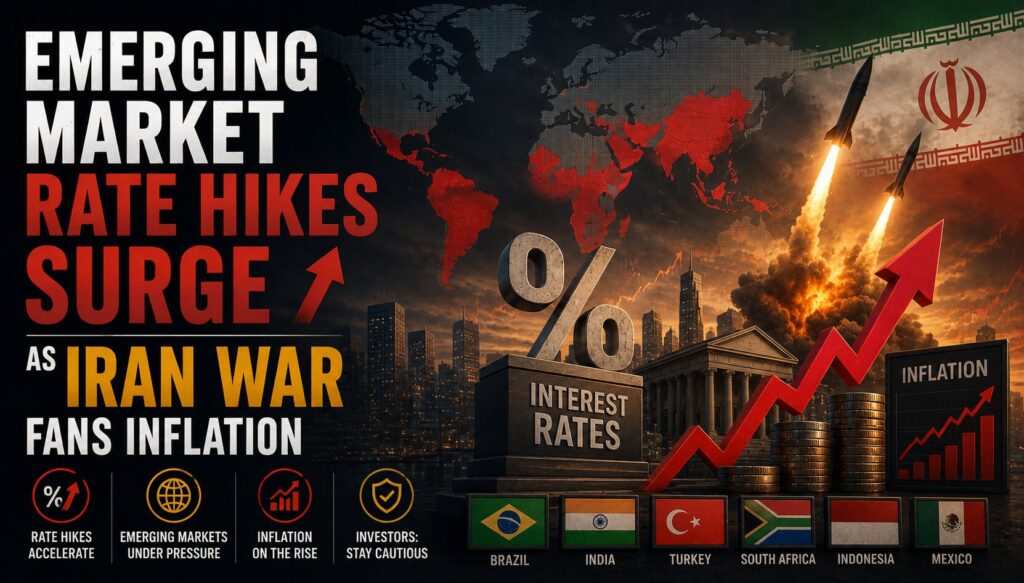
Emerging market rate hikes are reshaping the global investment landscape with urgent speed, and retail investors who ignore this shift risk real portfolio damage. Since fighting erupted in Iran in late February 2026, at least 10 emerging- and frontier-market central banks have raised borrowing costs, including Indonesia, Rwanda, South Africa, and Sri Lanka — all tightening within the past two weeks alone. Developed-world peers, by contrast, remain largely on hold, creating a rare and widening policy divergence that is already moving currency, bond, and equity markets in ways that demand your attention right now.
What You Will Learn
- What Emerging Market Rate Hikes Really Mean for Your Money
- Market Impact: How Emerging Market Rate Hikes Move the Numbers
- By the Numbers: Key Data Investors Need
- Expert Perspectives: What Emerging Market Rate Hike Analysts Are Saying
- Emerging Market Rate Hikes: How to Position Your Portfolio Now
- Key Risks to Watch
What Emerging Market Rate Hikes Really Mean for Your Money
Emerging market rate hikes signal that central banks across the developing world are prioritizing inflation control over growth — a posture with direct consequences for your holdings. When Indonesia’s Bank Indonesia or South Africa’s Reserve Bank raises rates, local bond yields climb, the cost of dollar-denominated corporate debt rises, and equity valuations in those markets compress. For US retail investors holding emerging market ETFs, mutual funds, or ADRs, each new hike erodes near-term price performance even as it signals longer-run monetary discipline. The Iran conflict has injected a fresh oil and commodity price shock that is forcing these banks to act faster than many forecasters anticipated just 90 days ago.
Furthermore, the gap between emerging market tightening and developed-market paralysis is creating a powerful currency dynamic. As EM central banks push rates higher, their currencies receive at least partial support against the US dollar, softening — but not eliminating — the FX headwind that typically punishes dollar-based investors in tighter global conditions. However, that support is uneven: Sri Lanka, still fragile from its 2022 debt crisis, faces far more currency pressure than Indonesia, which carries stronger reserves. Understanding which markets are tightening from a position of strength versus desperation is the single most important distinction investors must make over the next two quarters.
Market Impact: How Emerging Market Rate Hikes Move the Numbers
The ripple effects of synchronized emerging market rate hikes extend well beyond the countries raising rates. Commodity-linked currencies, sovereign debt spreads, and cross-border capital flows all shift simultaneously, and the speed of the current cycle — driven by a geopolitical shock rather than a purely domestic inflation overshoot — makes the moves harder to hedge using standard playbooks. Investors in broad EM index funds are absorbing hits across multiple asset classes at once, while selective country-level exposure is producing sharply divergent outcomes depending on each economy’s energy import profile and reserve cushion.
- Sovereign bond yields rising: EM 10-year yields are climbing 50–150 basis points above pre-conflict levels, pressuring bond fund NAVs directly.
- Equity multiple compression: Higher discount rates shrink price-to-earnings ratios in rate-sensitive EM sectors like real estate, utilities, and consumer credit.
- Currency divergence widening: Commodity-exporting EMs like South Africa gain relative FX stability while energy-importing EMs like Sri Lanka face renewed depreciation pressure.
- Capital outflow risk elevated: Historically, rapid EM tightening cycles triggered by external shocks see 15–25% portfolio outflows from frontier markets within six months.
Meanwhile, developed-market investors should not assume the turbulence stays contained. US multinationals with significant EM revenue exposure — consumer staples, technology hardware, and financial services firms operating in Southeast Asia and Sub-Saharan Africa — are already flagging FX translation losses and tighter consumer credit conditions in their forward guidance. The second-order effects on S&P 500 earnings estimates deserve more attention than they are currently receiving from the mainstream financial press.
By the Numbers: Key Data Investors Need
| Metric | Current | Previous | Impact |
|---|---|---|---|
| EM Central Banks Raising Rates (since Feb 2026) | 10+ | 0 | Broadest synchronized EM tightening since 2022 |
| Indonesia Policy Rate | 6.50% | 6.00% | Rupiah partially stabilized; bank lending costs rise |
| South Africa Repo Rate | 8.50% | 8.00% | Rand supported short-term; mortgage market under pressure |
| Brent Crude (Iran conflict premium) | ~$102/bbl | ~$78/bbl | Core inflation driver forcing EM central bank action |
These figures tell a concentrated story: a $24-per-barrel oil price surge since hostilities began in Iran is the single dominant inflation input forcing central banks from Jakarta to Johannesburg to act. According to Reuters, energy import costs for non-oil-producing frontier markets have increased 28–35% since late February, a supply shock severe enough to push annual CPI projections above central bank comfort bands in every country that has raised rates so far. The rate hike cycle is therefore reactive, not preemptive — a meaningful distinction for timing any re-entry into EM assets.
Expert Perspectives: What Emerging Market Rate Hike Analysts Are Saying
Goldman Sachs and JPMorgan’s EM strategy desks both published revised outlooks in late May 2026, flagging that the current wave of emerging market rate hikes differs from the 2022 post-COVID tightening cycle in one critical way: the inflationary trigger is geopolitical and supply-side, not demand-driven. According to Bloomberg, Goldman’s EM team now projects five additional central banks — including Nigeria, Vietnam, and Egypt — will raise rates before the end of Q3 2026 if the Iran conflict persists beyond 90 days. JPMorgan, meanwhile, has downgraded its broad EM equity outlook to underweight, citing compressed earnings visibility across energy-importing economies.
Moreover, Morgan Stanley’s fixed income analysts argue that the policy divergence between aggressive EM tighteners and a dovish or on-hold Federal Reserve creates a tactical opportunity in select EM local-currency bonds — but only for investors who can absorb near-term FX volatility. As reported by The Wall Street Journal, several large sovereign wealth funds have already started rotating into Indonesian and South African short-duration bonds to capture the carry advantage over US Treasuries. In contrast, retail investors without currency hedging tools are advised to approach unhedged EM bond exposure with significant caution at current spread levels.
Emerging Market Rate Hikes: How to Position Your Portfolio Now
Navigating emerging market rate hikes as a retail investor requires sharper country-level discrimination than broad EM index investing provides. The MSCI Emerging Markets Index mixes commodity exporters, which are relatively insulated, with energy importers, which are structurally vulnerable to this specific shock. Splitting that exposure — overweighting commodity-linked EM economies while underweighting energy-intensive frontier markets — is the most direct way to align your portfolio with the current macro reality. Additionally, reviewing your US large-cap holdings for EM revenue concentration can surface hidden risks that most investors overlook until earnings season reveals them.
- Rebalance broad EM ETFs: Reduce positions in broad EM index funds and increase allocations to commodity-exporting country-specific ETFs such as South Africa or Indonesia.
- Evaluate EM bond duration: Shift EM fixed income exposure toward shorter-duration instruments to limit price sensitivity as rate hike cycles continue.
- Screen US equities for EM revenue risk: Identify S&P 500 holdings where more than 20% of revenue comes from energy-importing EM economies and assess earnings downside.
- Consider a currency-hedged EM allocation: For investors wanting continued EM exposure, currency-hedged ETFs reduce FX translation risk during active tightening cycles without fully exiting the asset class.
For more on this strategy, see our guide to portfolio positioning strategies to understand how to size these adjustments relative to your overall risk tolerance and time horizon.
Key Risks to Watch
- Iran conflict escalation: A widening of hostilities into the Strait of Hormuz would drive oil above $120/barrel, triggering a second, more severe wave of EM rate hikes and sovereign spread blowouts.
- Frontier market debt distress: Sri Lanka, Pakistan, and Egypt carry thin foreign exchange reserves; sustained rate hikes risk tipping these economies toward IMF bailout scenarios and bond default risk.
- Fed policy pivot reversal: Any US inflation resurgence driven by energy pass-through could force the Federal Reserve off its current hold posture, tightening global dollar liquidity and intensifying EM capital outflows simultaneously.
- EM currency crisis contagion: If two or more frontier currencies see disorderly devaluations within the same quarter, investor sentiment toward the entire EM asset class can deteriorate rapidly regardless of individual country fundamentals, as seen in 2018 and 2022.
The Bottom Line: Emerging Market Rate Hike Outlook for Investors
The current wave of emerging market rate hikes is not a temporary blip — it is a policy response to a durable geopolitical inflation shock that central banks in the developing world cannot afford to undershoot. With 10 countries already tightening and analysts at Goldman, JPMorgan, and Morgan Stanley projecting the cycle to widen through Q3 2026, the window for repositioning ahead of further market repricing is narrowing fast. Investors who treat broad EM exposure as a monolithic bet will absorb losses that more selective, country-aware positioning could largely avoid. The data, the analyst consensus, and the rate trajectory all point in the same direction: differentiate or accept the consequences.
Consequently, the next 60 to 90 days represent a critical decision point. If the Iran conflict stabilizes, central banks that over-tightened will reverse quickly, creating a sharp rally in EM bonds and beaten-down equities — a rebound that only positioned investors will fully capture. If hostilities intensify, the tightening cycle deepens and cash preservation in the most vulnerable frontier markets becomes essential. Either scenario rewards preparation over reaction. Track the InvestClarify market analysis hub for real-time updates on EM central bank decisions, sovereign spread movements, and actionable portfolio guidance as this situation evolves. The Iran war has changed the EM investment calculus; your portfolio strategy needs to reflect that reality today, not next quarter.
Frequently Asked Questions
Which emerging market central banks have raised rates since the Iran war began?
At least 10 emerging- and frontier-market central banks have raised rates since fighting began in late February 2026. Indonesia, Rwanda, South Africa, and Sri Lanka all tightened policy within the past two weeks as of early June 2026.
How do emerging market rate hikes affect US investors holding EM ETFs?
Rising EM policy rates compress equity valuations and push bond yields higher, reducing NAVs in EM-focused funds. US investors also face FX translation risk unless their holdings use currency-hedged structures.
What is driving the current wave of emerging market rate hikes?
A roughly $24-per-barrel surge in Brent crude since the Iran conflict began is the primary driver, pushing CPI above central bank targets across energy-importing EM economies. The shock is supply-side and geopolitical rather than demand-driven.
Is now a good time to buy emerging market bonds given the higher yields?
Select EM local-currency short-duration bonds offer compelling carry over US Treasuries, according to Morgan Stanley analysts. However, retail investors without currency hedging tools face significant FX volatility risk that can erode yield advantages quickly.