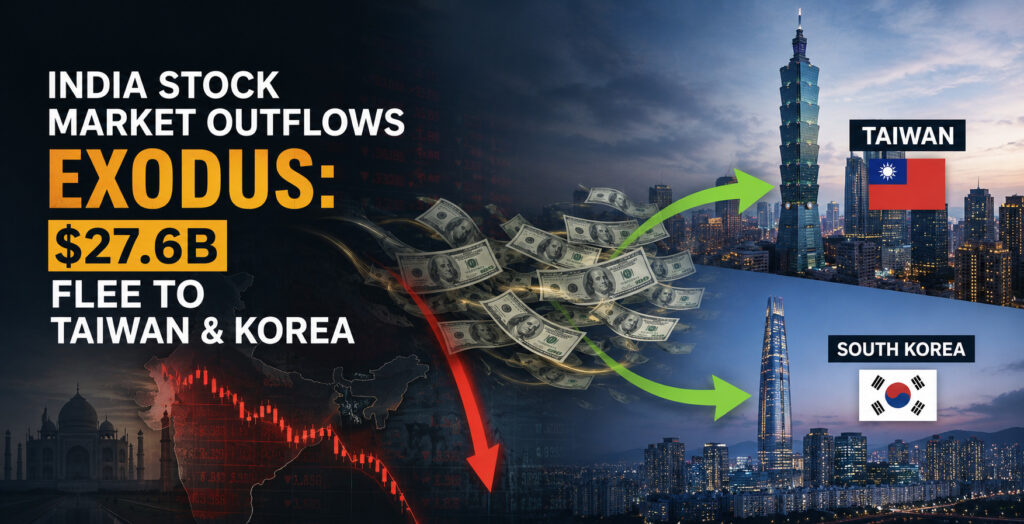

India stock market outflows have exploded to $27.6 billion in just the first five months of 2026 — already dwarfing the full-year 2025 total of $18.9 billion — as foreign investors pivot aggressively toward Taiwan and South Korea. AI-driven rallies in TSMC, Samsung, and SK Hynix have propelled Taiwan past India to claim the world’s fifth-largest equity market ranking, while South Korea shoved India out of sixth. For retail investors watching emerging market allocations, this reshuffling of global capital carries immediate, concrete implications for how portfolios should be positioned right now.
What You Will Learn
- What India Stock Market Outflows Really Mean for Your Money
- Market Impact: How India Stock Market Outflows Move the Numbers
- By the Numbers: Key Data Investors Need
- Expert Perspectives: What India Stock Market Outflows Analysts Are Saying
- India Stock Market Outflows: How to Position Your Portfolio Now
- Key Risks to Watch
What India Stock Market Outflows Really Mean for Your Money
When foreign institutional investors pull $27.6 billion from a single market in five months, the ripple effects reach every retail investor holding an emerging market ETF, an India-focused fund, or any Asia-Pacific allocation. India stock market outflows of this magnitude trigger currency pressure on the rupee, compress equity valuations across sectors from financials to consumer discretionary, and force fund managers to rebalance weightings — often selling positions that retail investors are still holding. This is not a minor rotation; it is a structural reassessment of where global growth capital wants to be.
Furthermore, the beneficiaries of this capital flight tell you exactly what the smart money is chasing. Taiwan’s TSMC and South Korea’s Samsung and SK Hynix are the physical backbone of the global AI infrastructure buildout — supplying the advanced chips that power every major large language model and data center expansion. As AI capital expenditure commitments from hyperscalers like Microsoft, Google, and Amazon continue to compound, semiconductor-heavy markets absorb the inflows that India is losing. Understanding this dynamic is the first step toward making portfolio decisions that align with where institutional money is actually flowing, not where it was flowing two years ago.
Market Impact: How India Stock Market Outflows Move the Numbers
The scale of India stock market outflows in 2026 has already triggered a measurable chain reaction across Asian equity markets. Taiwan’s total market capitalization has overtaken India’s to become the world’s fifth-largest equity market — a ranking that carries weight for index-tracking funds that must adjust their allocations accordingly. South Korea’s market has similarly leapfrogged India into sixth place globally. These are not cosmetic changes; index rebalancing forces billions in passive fund flows to follow the new rankings, amplifying the momentum that active investors have already set in motion.
- Taiwan Market Cap Surge: TSMC’s AI-driven gains pushed Taiwan’s equity market above India’s for the first time, claiming fifth globally.
- South Korea’s Semiconductor Rally: Samsung and SK Hynix HBM memory demand has lifted South Korea past India into sixth place worldwide.
- Rupee Depreciation Pressure: Sustained foreign equity outflows weaken INR demand, eroding dollar-denominated returns for international investors still holding Indian assets.
- Index Rebalancing Cascade: MSCI and FTSE emerging market index adjustments force passive funds to reduce India weightings and increase Taiwan and Korea exposure automatically.
Consequently, retail investors in broad emerging market ETFs are already experiencing this shift whether they intended to or not. Funds benchmarked to MSCI Emerging Markets will mechanically increase their Taiwan and South Korea allocations as these markets grow in relative weight, while India’s share shrinks — a slow but compounding drag on any portfolio that assumed India’s previous trajectory would continue unchanged.
By the Numbers: Key Data Investors Need
| Metric | Current (2026) | Previous | Impact |
|---|---|---|---|
| India Foreign Equity Outflows (YTD) | $27.6 billion | $18.9B full-year 2025 | Rupee pressure; valuation compression across Indian equities |
| Taiwan Global Market Cap Rank | 5th largest | 6th (behind India) | Passive fund rebalancing forces increased Taiwan ETF inflows |
| South Korea Global Market Cap Rank | 6th largest | 7th (behind India) | HBM chip demand drives Samsung and SK Hynix weighting gains |
| India Global Market Cap Rank | 7th (displaced) | 5th (early 2025) | Two-rank drop triggers benchmark weight reductions in EM funds |
According to Reuters, the speed of India’s displacement from fifth to seventh in global market cap rankings is without precedent in the post-2010 emerging market era. The $27.6 billion outflow figure already exceeds full-year 2025 totals by 46%, signaling that institutional conviction behind this rotation is not weakening — and that the gap between India and its Asian competitors may widen further before any reversal takes hold.
Expert Perspectives: What India Stock Market Outflows Analysts Are Saying
Morgan Stanley’s Asia equity strategy team has flagged that India stock market outflows reflect a broader repricing of growth premium across emerging markets. In their view, India traded at elevated valuations through 2024 and early 2025 on the strength of domestic consumption narratives, but the AI investment supercycle has recalibrated what institutional allocators consider a defensible growth premium. Markets with direct semiconductor exposure — Taiwan and South Korea above all — now command the valuation multiples that India’s services-heavy economy previously captured. According to Bloomberg, foreign institutional investors have described the shift as a “structural, multi-year reallocation” rather than a tactical trade.
Meanwhile, Goldman Sachs emerging markets analysts have noted that the AI infrastructure buildout creates a durable demand floor for TSMC’s advanced node production and SK Hynix’s high-bandwidth memory, making the earnings visibility in those names far clearer than in Indian equities facing domestic credit cycle uncertainty. Nomura has separately highlighted that South Korea’s discount to fair value — historically a persistent feature of the market — has begun to compress as global capital recognizes the strategic importance of its semiconductor supply chain. As reported by the Wall Street Journal, several large sovereign wealth funds have formalized overweight positions in Taiwan and South Korea for the first time since 2017, a signal institutional investors rarely ignore.
India Stock Market Outflows: How to Position Your Portfolio Now
India stock market outflows of this scale demand an active response from any investor with Asia-Pacific or emerging market exposure. Sitting still while $27.6 billion in institutional capital reshapes index weights, currency dynamics, and relative valuations is not a neutral position — it is a choice to absorb the consequences passively. The actionable moves below are grounded in where the data currently points, not in speculation about a rebound that has no confirmed catalyst on the near-term horizon.
- Audit Your EM ETF Exposure: Check the current India weighting in any MSCI or FTSE emerging market fund you hold and assess whether it still aligns with your risk tolerance given the ongoing outflow trend.
- Add Targeted Semiconductor Exposure: Consider ETFs focused on Taiwan or South Korean equities — such as those tracking TSMC, Samsung, or the broader Philadelphia Semiconductor Index — to capture the AI infrastructure tailwind directly.
- Hedge Rupee Risk on Existing India Holdings: If you maintain India ADR or direct equity positions, evaluate currency hedging instruments or reduce unhedged INR exposure until outflow momentum stabilizes.
- Monitor MSCI Rebalancing Dates: MSCI index rebalancing events in August and November 2026 will mechanically shift fund flows; positioning ahead of confirmed weight changes can capture short-term momentum.
For more on this strategy, see our guide to portfolio positioning strategies.
Key Risks to Watch
- AI Capex Slowdown: Any pullback in hyperscaler data center spending would directly hit TSMC and SK Hynix earnings, reversing the semiconductor rally that is driving Taiwan and Korea inflows.
- India Policy Response: A Reserve Bank of India rate cut cycle or targeted fiscal stimulus could reignite foreign investor interest and slow or reverse current outflow momentum.
- Geopolitical Taiwan Strait Risk: Escalating US-China tensions over Taiwan represent a tail risk that could rapidly reprice Taiwanese equities regardless of underlying semiconductor fundamentals.
- Global Recession Scenario: A sharper-than-expected US or Chinese economic slowdown would compress all emerging market valuations simultaneously, eliminating the relative advantage currently held by Taiwan and South Korea.
The Bottom Line: India Stock Market Outflows Outlook for Investors
India stock market outflows have crossed a threshold in 2026 that demands serious attention from any investor with emerging market exposure. The $27.6 billion year-to-date figure is not noise — it reflects a calculated, large-scale institutional decision to redirect capital toward the markets most directly positioned to benefit from the AI semiconductor supercycle. Taiwan and South Korea have not simply gotten lucky; they hold irreplaceable positions in the global chip supply chain, and that structural advantage is now being priced into their equity markets with full force. India’s displacement from fifth to seventh in global market cap rankings is the scoreboard, not the story.
Moreover, the forward outlook suggests this rotation has further to run before any mean-reversion sets in. TSMC’s advanced node roadmap, SK Hynix’s dominant position in high-bandwidth memory, and the continued acceleration of AI infrastructure investment by the world’s largest technology companies all point toward sustained inflows into Taiwan and South Korea through at least 2027. India may well recover — its domestic consumption story and demographic tailwinds remain real — but recovery requires a catalyst that is not yet visible in the data. Investors who act on evidence rather than hope will adjust their allocations now. Track every development in this story with InvestClarify market analysis — because in a market moving this fast, timing is everything.
Frequently Asked Questions
Why are foreign investors selling Indian stocks in 2026?
Foreign investors have pulled $27.6 billion from Indian equities year-to-date in 2026, surpassing the full $18.9 billion in outflows for all of 2025. The primary driver is a reallocation toward Taiwan and South Korea, whose semiconductor-heavy markets offer direct exposure to AI infrastructure spending by global tech giants.
How did Taiwan’s stock market surpass India in market cap?
AI-fueled gains in TSMC, which manufactures the advanced chips powering large language models and data centers, drove Taiwan’s total equity market capitalization above India’s in 2026. This promotion to fifth-largest global equity market triggers automatic rebalancing inflows from index-tracking funds worldwide.
Should I reduce my India ETF holdings because of these outflows?
Investors holding broad emerging market ETFs should audit their India weighting, as index rebalancing will mechanically reduce India’s share while increasing Taiwan and South Korea allocations. Targeted review of unhedged rupee exposure and potential rotation into semiconductor-focused ETFs are the two most actionable steps based on current data.
What is driving South Korea’s stock market gains in 2026?
South Korea’s equity market rise is led by Samsung and SK Hynix, both dominant suppliers of high-bandwidth memory chips that are critical to AI model training and inference at scale. Surging HBM demand from hyperscalers has compressed South Korea’s historically persistent valuation discount and driven the market above India into sixth place globally.