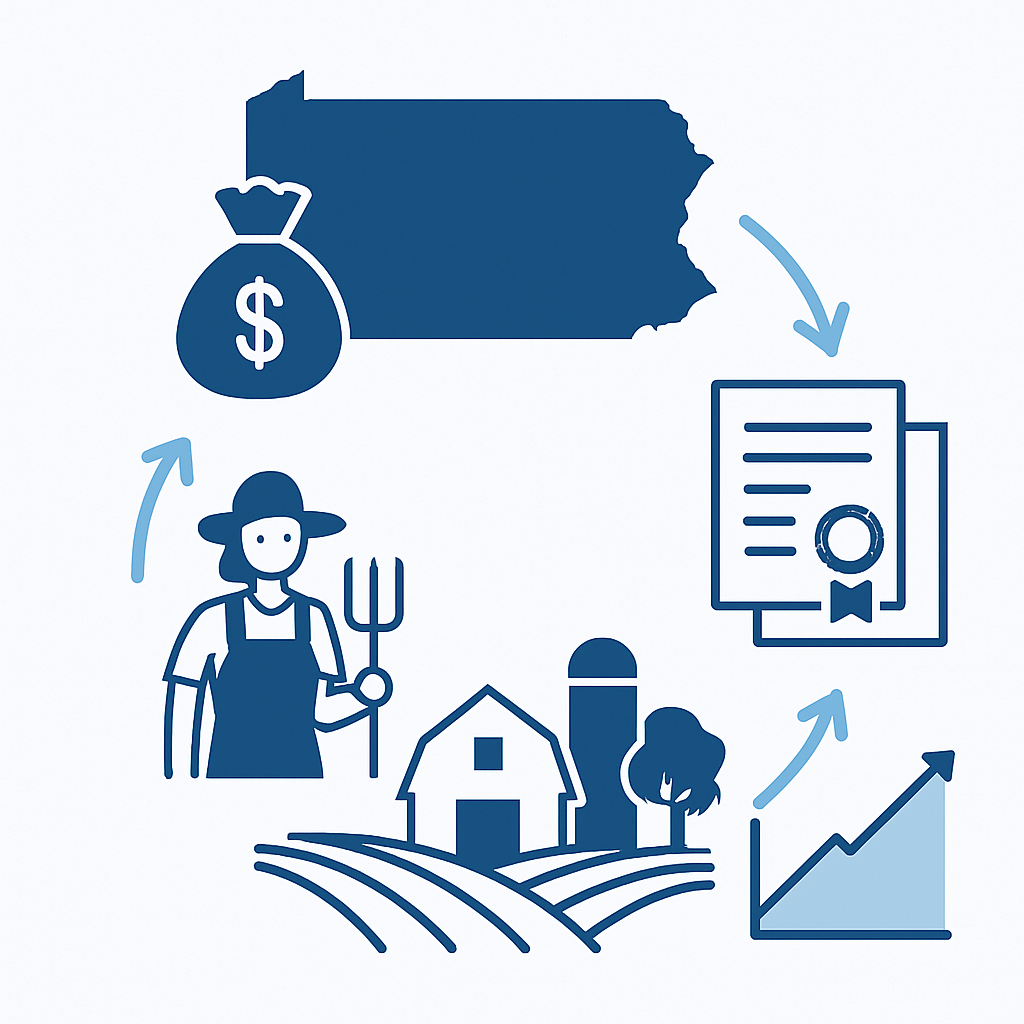
Pennsylvania farmland preservation investments is one of the most important topics for US investors in 2026. If you own agricultural land in Pennsylvania or are considering purchasing farmland in the Keystone State, understanding how the state’s preservation program works can unlock significant financial returns while contributing to conservation efforts. This comprehensive guide breaks down everything you need to know about eligibility, payment structures, and the investment-like benefits of participating in Pennsylvania farmland preservation investments.
Pennsylvania has one of the most robust farmland preservation programs in the United States, having preserved over 595,000 acres across 5,900 farms since the program’s inception in 1988. The state invests millions of dollars annually to purchase agricultural conservation easements from landowners, providing substantial one-time payments that can significantly impact a farm family’s financial position. With development pressure increasing in many Pennsylvania counties and the average age of farmers rising, understanding these preservation opportunities has never been more critical for landowners and investors interested in agricultural real estate.
What Is Pennsylvania Farmland Preservation Investments?
Pennsylvania farmland preservation investments refers to the financial opportunity landowners have when they sell agricultural conservation easements to the state, county, or township through Pennsylvania’s farmland preservation program. The program pays landowners the difference between the land’s fair market value for development and its value for agricultural use, essentially compensating them for agreeing to keep the land in farming permanently. This one-time payment can range from a few thousand dollars per acre to over $10,000 per acre in high-pressure development areas, representing a substantial cash infusion that many landowners treat as a strategic investment return.
For example, a 100-acre farm in Chester County with development value of $15,000 per acre and agricultural value of $8,000 per acre could receive $700,000 through the easement sale ($7,000 difference × 100 acres). The landowner retains full ownership and can continue farming, sell the property, or pass it to heirs, but the land must remain in agricultural use forever. This structure creates a unique investment scenario where landowners essentially monetize their land’s development rights while maintaining operational control and agricultural productivity.
Why Pennsylvania Farmland Preservation Investments Matters for US Investors in 2026
Pennsylvania farmland preservation investments has become increasingly relevant as agricultural land values have appreciated 4.2% annually over the past decade, while development pressure threatens to convert prime farmland to residential and commercial uses. The state allocated $28.5 million for farmland preservation in the 2025-2026 budget, demonstrating continued commitment to the program despite economic pressures. For landowners and agricultural investors, this represents a guaranteed source of capital that can be leveraged for debt reduction, farm improvements, estate planning, or diversification into other investment vehicles.
- Immediate Liquidity Without Asset Sale: Landowners receive substantial cash payments ranging from $200,000 to over $1 million for typical farms while retaining full ownership and operational control. This provides capital access without the tax consequences and emotional difficulty of selling the family farm.
- Property Tax Benefits: Farms with preserved easements often qualify for Clean and Green property tax assessment, reducing annual tax burdens by 50-90% compared to fair market value assessment. This creates ongoing cash flow improvements that compound over decades of farm operation.
- Estate Planning Advantages: Easement sales reduce the estate value for inheritance tax purposes while providing liquid assets to pay taxes, equalize inheritance among heirs, or fund retirement. Pennsylvania’s 4.5% inheritance tax for direct descendants becomes more manageable when easement proceeds are properly allocated.
- Portfolio Diversification Opportunity: The lump-sum easement payment allows farm families to diversify wealth beyond land-intensive agriculture into stocks, bonds, or other investments. This reduces concentration risk while maintaining the agricultural operation that provides steady income and lifestyle benefits.
How to Get Started with Pennsylvania Farmland Preservation Investments: Step-by-Step
Getting started with pennsylvania farmland preservation investments requires understanding your county’s program structure and meeting specific eligibility criteria that vary by jurisdiction.
- Step 1: Verify Eligibility Requirements: Contact your county farmland preservation office to confirm your property meets the minimum requirements, which typically include at least 50 acres in a viable agricultural area with soils capable of supporting commercial farming. Your property must be in an Agricultural Security Area for at least one year and comply with the county’s comprehensive plan designations for agricultural preservation.
- Step 2: Submit Application and Documentation: Complete the county application form and provide deed documentation, soil maps, tax assessment records, and a farm management plan demonstrating active agricultural use. Most counties accept applications during designated enrollment periods, typically once or twice annually, so timing your submission is essential.
- Step 3: Undergo Property Appraisal and Review: The county will commission two independent appraisals to determine fair market value and agricultural value, establishing the easement payment amount. This process typically takes 4-8 months and includes site visits, soil evaluation, and market analysis of comparable sales in your area.
- Step 4: Complete Easement Closing and Receive Payment: Once the State Agricultural Land Preservation Board approves your application and funding is secured, you’ll attend a closing similar to a real estate transaction where the easement deed is recorded. Payment is typically issued within 30-60 days of closing, providing the investment-like return that makes pennsylvania farmland preservation investments attractive to landowners.
Pennsylvania Farmland Preservation Investments: Common Mistakes to Avoid
Many beginners pursuing pennsylvania farmland preservation investments make critical errors that delay approval, reduce payment amounts, or create unintended consequences for their farming operation and financial planning.
- Mistake 1: Failing to Maintain Agricultural Use Documentation: Properties must demonstrate consistent commercial agricultural use, and inadequate record-keeping of farm income, crop production, or livestock operations can disqualify otherwise eligible land. Maintain detailed financial records showing farm revenue exceeds $2,000 annually or that land actively supports agricultural production through lease arrangements with documented farmers.
- Mistake 2: Subdividing Property Before Easement Application: Creating small residential lots or dividing parcels to give land to family members before applying can reduce the eligible acreage and lower the total easement payment. Work with preservation officials and legal counsel before any property divisions to structure transfers that maximize preservation value and maintain program eligibility.
- Mistake 3: Misunderstanding Tax Implications: Easement sale proceeds are generally treated as capital gains rather than ordinary income, but many landowners fail to consult tax professionals before accepting payment. The timing of easement sales, allocation between federal and state transactions, and coordination with other farm income can significantly impact total tax liability and net proceeds.
Working with experienced agricultural attorneys and accountants familiar with conservation easements ensures you structure the transaction to maximize financial benefits while avoiding compliance issues that could jeopardize program participation.
For more information, visit Investopedia or the official SEC website.
Frequently Asked Questions About Pennsylvania Farmland Preservation Investments
What is pennsylvania farmland preservation investments and how does it work?
Pennsylvania farmland preservation investments is the financial opportunity created when landowners sell agricultural conservation easements to government entities, receiving payment equal to the difference between development value and agricultural value. The landowner retains ownership and can continue farming or selling the property, but development rights are permanently extinguished. This creates a one-time cash payment that functions like an investment return while preserving operational flexibility.
Is pennsylvania farmland preservation investments a good option for beginners?
For landowners new to conservation easements, Pennsylvania’s program offers strong financial benefits with relatively straightforward processes managed by experienced county staff. The program has preserved nearly 6,000 farms over 35 years, creating proven systems and support structures. However, beginners should thoroughly understand the permanence of easement restrictions and consult legal and financial advisors before committing, as the decision affects the property forever and impacts estate planning, financing options, and future land use flexibility.
How much money do I need to start with pennsylvania farmland preservation investments?
Landowners don’t need upfront capital to participate in pennsylvania farmland preservation investments, as the program pays you rather than requiring investment. However, you’ll incur costs for legal review ($2,000-$5,000), tax planning consultation ($1,000-$3,000), and survey work if boundary clarification is needed ($2,000-$8,000). These expenses are typically recovered many times over through easement payments, which average $4,000-$8,000 per acre statewide but can exceed $12,000 per acre in southeastern Pennsylvania counties with high development pressure.
What are the risks of pennsylvania farmland preservation investments?
The primary risk is the permanent nature of easement restrictions, which eliminate future flexibility to develop the property for residential, commercial, or industrial uses regardless of changing family circumstances or market conditions. Properties with easements may have reduced resale value to buyers seeking development potential, though this is offset by lower purchase prices for farmers seeking affordable land. Additionally, easement terms restrict subdivision and non-agricultural structures, potentially limiting options for on-farm diversification, agritourism development, or housing additional family members on the property.
Understanding the Financial Structure of Pennsylvania Farmland Preservation Investments
The payment structure for pennsylvania farmland preservation investments varies significantly based on location, with southeastern counties near Philadelphia offering substantially higher per-acre payments than rural northern counties. Chester County, for example, has paid an average of $9,500 per acre over recent years, while northern tier counties average $3,000-$4,000 per acre. This geographic variation reflects development pressure differences, with suburban counties competing against developer prices while rural areas preserve land against agricultural-to-agricultural sales values.
Payment amounts are determined through independent appraisals that analyze comparable sales, zoning allowances, infrastructure access, and market demand in your specific area. The appraisal process examines sales of both development properties and preserved farms to establish credible value ranges. County programs typically use the average of two independent appraisals, providing objectivity and market accuracy while preventing either overvaluation or undervaluation of easement rights.
Funding sources for pennsylvania farmland preservation investments include state appropriations through the Pennsylvania Agricultural Conservation Easement Purchase Program, county funds from bond issues or dedicated millage, and sometimes township contributions for locally significant properties. This multi-level funding structure means payment timing can vary based on budget availability, with some properties approved quickly and others waiting 1-3 years for funding allocation. Understanding your county’s funding cycle and available resources helps set realistic expectations for payment timing.
Tax Considerations for Pennsylvania Farmland Preservation Investments
Federal tax treatment of pennsylvania farmland preservation investments typically classifies easement proceeds as capital gains on the sale of a property interest, qualifying for long-term capital gains rates if you’ve held the property more than one year. For 2026, federal capital gains rates range from 0% to 20% depending on income level, substantially lower than ordinary income rates reaching 37%. This favorable treatment can save landowners $100,000 or more on a $500,000 easement sale compared to ordinary income taxation.
Pennsylvania state income tax applies a flat 3.07% rate to easement proceeds as capital gains income, adding to the federal tax burden but still providing better treatment than ordinary income. Some taxpayers can leverage installment sale treatment by structuring payments over multiple years, spreading tax liability and potentially keeping income within lower federal brackets. However, this requires negotiation with the purchasing entity and isn’t available in all county programs.
Estate tax implications of pennsylvania farmland preservation investments provide significant benefits because the easement reduces property value for inheritance and estate tax purposes. A farm worth $2 million before easement sale might have post-easement value of $1 million, reducing Pennsylvania inheritance tax liability by $45,000 for children inheriting the property. The easement proceeds, if spent or gifted before death, further reduce estate value, though strategic planning is essential to maximize these benefits.
Property tax benefits extend beyond the initial easement sale, as preserved farms typically qualify for Clean and Green preferential assessment, valuing land at agricultural use rather than development potential. This can reduce annual property tax bills by $5,000-$20,000 on a typical preserved farm, creating ongoing cash flow improvements that compound over decades. These tax savings effectively provide an annual return on the preservation decision separate from the initial easement payment.
Investment Strategies After Receiving Pennsylvania Farmland Preservation Investments Payments
Farm families receiving large lump-sum payments from pennsylvania farmland preservation investments face important decisions about deploying this capital to maximize long-term financial security. Financial advisors specializing in agricultural clients recommend allocating easement proceeds across multiple categories based on age, debt levels, and retirement preparedness. A common framework divides payments into debt reduction (30-40%), farm improvements (20-30%), retirement savings (20-30%), and emergency reserves (10-20%).
Debt reduction typically provides the highest guaranteed return, especially for farm mortgages and equipment loans carrying 4-7% interest rates. Eliminating $300,000 in farm debt with 5.5% interest saves $16,500 annually in interest payments, effectively providing a 5.5% tax-free return while improving cash flow and reducing financial stress. This debt elimination also strengthens the farm’s balance sheet for future borrowing needs and creates equity that can support retirement or succession planning.
Farm infrastructure improvements funded by easement proceeds should focus on projects that enhance productivity, reduce labor costs, or improve quality of life without violating easement restrictions. New livestock facilities, grain storage, drainage improvements, and irrigation systems all qualify under easement terms while generating returns through increased production or reduced expenses. These improvements also increase the farm’s value for eventual sale to the next generation or outside buyers seeking turn-key agricultural operations.
Retirement account contributions allow farm families to leverage easement proceeds for long-term wealth building outside the agricultural operation. Maximizing contributions to SEP-IRAs, individual 401(k)s, or traditional/Roth IRAs provides tax advantages and investment growth potential that diversifies family wealth beyond land values. For farmers in their 50s and 60s, dedicating $100,000-$300,000 of easement proceeds to retirement accounts can transform financial security in later years when physical farming becomes challenging.
Pennsylvania Farmland Preservation Investments and Farm Succession Planning
Integrating pennsylvania farmland preservation investments into farm succession planning helps address the common challenge of transitioning farms to the next generation while treating non-farming heirs equitably. When one child wants to continue farming while siblings pursue other careers, easement proceeds provide liquid assets to compensate non-farming heirs without forcing property sale. A family might preserve 200 acres, receive $1 million in easement payments, and use those funds to equalize inheritance among four children while allowing the farming child to purchase the land at reduced agricultural value.
Easement sales before death also reduce estate tax exposure and provide parents with capital to support retirement without selling the farm. Many aging farmers face the dilemma of being land-rich but cash-poor, with substantial farm equity but insufficient retirement income. Preservation easement payments solve this problem by converting illiquid land value into accessible capital while keeping the farm operational and transferable to farming heirs at reduced value.
Timing easement sales relative to farm transfers requires careful planning to optimize tax treatment and family dynamics. Some families preserve land first, then transfer the property to the next generation at reduced value, minimizing gift tax consequences. Others transfer first, allowing the younger generation to receive and manage easement proceeds as their own capital. Both approaches have advantages depending on family circumstances, tax situations, and relationship dynamics.
Comparing Pennsylvania Farmland Preservation Investments to Other States
Pennsylvania’s program ranks among the most generous in the United States, having invested over $1.6 billion in farmland preservation since 1988. Only Maryland and New Jersey have comparable per-acre payment rates in the Mid-Atlantic region, while many Midwestern states have less developed preservation programs with lower payments. This makes pennsylvania farmland preservation investments particularly attractive for landowners fortunate enough to own eligible property in the state.
Maryland’s Agricultural Land Preservation Foundation operates similarly to Pennsylvania’s program but serves a smaller geographic area with more limited funding. New Jersey pays premium rates for preserved farmland, often exceeding Pennsylvania in per-acre payments, but has preserved fewer total acres due to higher costs and more limited agricultural land base. Delaware, Virginia, and West Virginia have preservation programs but generally offer lower per-acre payments than Pennsylvania.
National farmland investors comparing preservation opportunities across states should recognize Pennsylvania’s program as mature, well-funded, and politically supported across Democratic and Republican administrations. This stability provides confidence that the program will continue operating and funding future easement purchases, making Pennsylvania agricultural real estate attractive for long-term