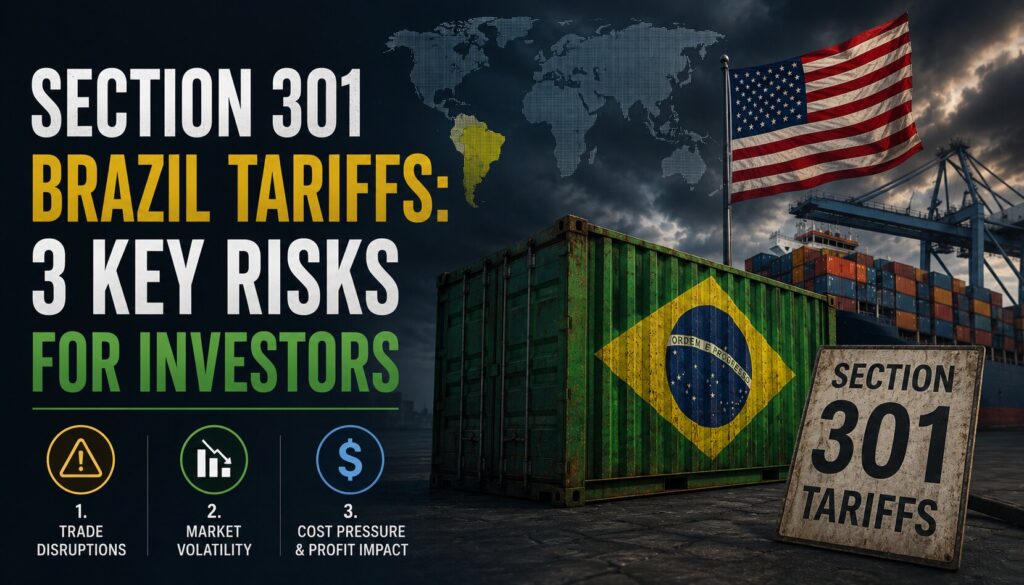

Section 301 Brazil tariffs moved from background noise to front-page risk on June 1, 2026, when the USTR filed a Federal Register notice proposing new trade action against Brazilian imports under the Trade Act of 1974. With public comments due July 1, the clock is ticking for investors holding exposure to Brazilian equities, agricultural exporters, and US companies relying on Brazilian supply chains. This action adds another layer of uncertainty to a global trade environment already upended by sweeping US tariff policy — and it lands at a moment when the legal foundation of that policy is itself under scrutiny after the Supreme Court struck down IEEPA tariffs in February 2026.
What You Will Learn
- What Section 301 Brazil Tariffs Really Mean for Your Money
- Market Impact: How Section 301 Brazil Tariffs Move the Numbers
- By the Numbers: Key Data Investors Need
- Expert Perspectives: What Section 301 Brazil Tariff Analysts Are Saying
- Section 301 Brazil Tariffs: How to Position Your Portfolio Now
- Key Risks to Watch
What Section 301 Brazil Tariffs Really Mean for Your Money
Section 301 of the Trade Act of 1974 grants the USTR sweeping authority to impose tariffs or other trade restrictions when a foreign country’s practices are found to be unreasonable, discriminatory, or burdensome to US commerce. When the USTR targets a major emerging economy like Brazil — the world’s largest exporter of soybeans, beef, and iron ore — the downstream effects run deep. US manufacturers using Brazilian inputs face cost pressure, while Brazilian companies listed on American exchanges through ADRs face margin compression and currency volatility as the real weakens against a tariff-driven dollar.
Furthermore, this action does not arrive in isolation. The USTR has already deployed Section 301 against dozens of trading partners, and the February 2026 Supreme Court ruling invalidating IEEPA-based tariffs has forced the administration to lean harder on statutory tools like Section 301 to maintain trade leverage. For retail investors, that legal pivot matters: Section 301 actions are harder to challenge in court and more durable once implemented. The comment period closing July 1 is the last practical window before these tariffs could become reality — and history shows comment periods rarely reverse USTR momentum.
Market Impact: How Section 301 Brazil Tariffs Move the Numbers
Markets rarely wait for tariffs to be finalized before repricing risk. Since the USTR notice dropped on June 1, traders have already begun adjusting positions across Brazilian ADRs, agricultural commodity futures, and US companies with Brazilian supply-chain exposure. The EWZ — the iShares MSCI Brazil ETF — is a standard barometer, and it tends to drop 3–6% in the weeks following a major US trade action targeting Brazil. Meanwhile, commodities like soybeans and iron ore face dual pressure: tariff uncertainty depresses Brazilian export volumes while a stronger dollar makes dollar-denominated commodities more expensive for other buyers.
- Brazilian ADRs under pressure: Companies like Vale (VALE) and Embraer (ERJ) face direct tariff exposure and investor sentiment headwinds that can accelerate selloffs quickly.
- Agricultural supply chains disrupted: US food processors and animal feed producers that source from Brazil may see input costs rise 5–15% depending on final tariff rates imposed.
- Emerging market contagion risk: A USTR action against Brazil signals continued aggressive trade posture toward EM exporters broadly, pressuring currencies and equity indices from Mexico to Indonesia.
- US dollar strengthening impulse: Trade restrictions that reduce import volumes tend to support the dollar short-term, creating headwinds for any dollar-denominated emerging market debt held by retail investors.
Consequently, investors should treat this not as a single-country event but as a signal about the direction of US trade policy through the rest of 2026. The administration has demonstrated willingness to use every available statutory tool, and Brazil’s size as a commodity exporter means the ripple effects reach far beyond Latin America into global agricultural and metals markets.
By the Numbers: Key Data Investors Need
| Metric | Current | Previous | Impact |
|---|---|---|---|
| USTR Comment Deadline | July 1, 2026 | N/A (new action) | Final window for industry to shape tariff scope |
| EWZ (Brazil ETF) Avg. Tariff-Shock Drop | 3–6% (historical) | Baseline pre-notice | Near-term downside for Brazil equity exposure |
| US–Brazil Trade Volume (goods, 2025) | ~$95 billion | ~$88 billion (2024) | Larger trade base amplifies tariff disruption |
| IEEPA Tariff Status | Struck down (Feb 2026) | Active (pre-ruling) | Shifts legal burden onto Section 301; harder to challenge |
According to Reuters, the February 2026 Supreme Court ruling on IEEPA tariffs fundamentally altered the White House’s trade toolkit, making Section 301 the administration’s preferred instrument for sustained trade pressure. With US–Brazil goods trade topping $95 billion annually, even a moderate tariff rate of 15–25% on targeted categories could redirect billions in trade flows and force portfolio managers to reprice Brazilian asset risk significantly.
Expert Perspectives: What Section 301 Brazil Tariff Analysts Are Saying
Goldman Sachs emerging markets strategists flagged in their June 2026 trade note that Section 301 Brazil tariffs represent a meaningful escalation in Latin American trade risk, estimating that a broad-based tariff of 20% on Brazilian goods could shave 0.4–0.7 percentage points off Brazil’s GDP growth in 2026. Morgan Stanley analysts have echoed that view, noting that Brazilian equities were already trading at a discount to EM peers and that a formal tariff action would likely push foreign institutional outflows above $3 billion in the following quarter. As reported by Bloomberg, currency strategists at Citi expect the Brazilian real to test multi-year lows against the dollar if tariffs are finalized without a negotiated resolution.
Moreover, trade policy specialists at Reed Smith have publicly noted that the legal durability of Section 301 actions — compared with the now-struck-down IEEPA tariffs — makes this round of trade pressure more permanent in character. Unlike executive orders that can be reversed overnight, Section 301 findings require a formal investigation and reversal process that typically spans years. The Wall Street Journal reported in early June 2026 that the administration views Brazil’s digital services tax and agricultural subsidy regime as the primary triggers for this action, suggesting targeted tariffs on technology and food imports rather than a blanket levy — a distinction that matters significantly for sector-specific portfolio positioning.
Section 301 Brazil Tariffs: How to Position Your Portfolio Now
Section 301 Brazil tariffs create both risk and opportunity for disciplined investors who move before the July 1 comment deadline crystallizes the scope of the action. The key is separating companies with deep Brazil supply-chain dependency from those with pricing power sufficient to absorb input cost increases. Broad EM exposure through diversified ETFs may offer a safer vehicle than concentrated single-country Brazil funds during this period of uncertainty, while commodity plays with pricing power — particularly those not dependent on Brazilian export volumes — could benefit from supply disruption dynamics.
- Reduce concentrated Brazil ADR exposure: Trim or hedge positions in VALE, ERJ, and Petrobras (PBR) ahead of July 1 to limit tariff-shock downside risk.
- Evaluate US agricultural supply chains: Screen holdings for companies sourcing soybeans, beef, or iron ore from Brazil and assess their ability to switch suppliers or absorb cost increases.
- Consider EM diversification away from Brazil: Rotate partial Brazil ETF exposure into broader EM funds or into countries not currently targeted by USTR Section 301 actions.
- Monitor the Federal Register and USTR updates: Set alerts for the Federal Register tariff docket — final tariff scope, product exclusions, and implementation timelines will move markets quickly once announced.
For more on this strategy, see our guide to portfolio positioning strategies.
Key Risks to Watch
- Tariff scope expansion: The USTR may broaden the initial proposal beyond digital services and agriculture to include manufactured goods, amplifying supply-chain disruption across US industries.
- Brazilian retaliation: Brazil could impose retaliatory tariffs on US exports — particularly aircraft, technology hardware, and agricultural machinery — hurting American companies with significant Brazilian revenue.
- Legal challenge uncertainty: While Section 301 is more legally durable than IEEPA, ongoing court battles over trade authority mean implementation timelines could shift unpredictably, creating prolonged market uncertainty.
- Emerging market contagion: Aggressive US trade action against Brazil could accelerate capital flight from EM assets broadly, triggering currency crises or sovereign debt stress in more vulnerable economies already under pressure.
The Bottom Line: Section 301 Brazil Tariffs Outlook for Investors
Section 301 Brazil tariffs are not a hypothetical — they are an active USTR proposal with a hard July 1 comment deadline and a legal framework designed for durability. The administration has demonstrated in 2025 and 2026 that trade tools, once deployed, rarely get walked back without significant diplomatic concessions. Brazil is the world’s agricultural powerhouse, and disrupting its export flows to the US creates pricing ripple effects across commodities, currencies, and equities that retail investors cannot afford to ignore. Positioning now, before final tariff rates are announced, gives investors the best chance to manage downside while identifying opportunity in the resulting supply-chain reshuffling.
Meanwhile, the broader tariff landscape remains in legal flux following the Supreme Court’s IEEPA ruling, and any new court challenges to Section 301 authority could introduce sudden policy reversals that whipsaw markets in either direction. Investors who track USTR filings, Federal Register notices, and Congressional trade committee activity will have an information edge in this environment. The second half of 2026 will likely be defined by how aggressively the administration pursues these statutory trade tools — and how trading partners respond. Stay ahead of the curve with InvestClarify market analysis as this situation develops.
Frequently Asked Questions
What are Section 301 Brazil tariffs and why do they matter to investors?
Section 301 Brazil tariffs are trade restrictions the USTR can impose on Brazilian imports when Brazil’s trade practices are deemed unfair or harmful to US commerce. For investors, they matter because they directly affect Brazilian ADRs, US agricultural supply chains, and emerging market sentiment — all of which can move portfolio values significantly.
When will the USTR Section 301 Brazil tariffs take effect?
The USTR set a public comment deadline of July 1, 2026, after which it can finalize the tariff action. Historical Section 301 timelines suggest final tariff rates could be announced and implemented within 30–90 days after the comment period closes, though legal challenges can delay implementation.
Which US stocks are most exposed to Section 301 Brazil tariffs?
US companies most exposed include agricultural processors sourcing from Brazil, manufacturers using Brazilian iron ore or steel, and airlines with significant Brazil routes. On the Brazilian side, ADRs like Vale (VALE), Petrobras (PBR), and Embraer (ERJ) face the most direct tariff and sentiment risk.
How does the Supreme Court’s IEEPA ruling affect the Brazil Section 301 action?
The February 2026 Supreme Court ruling struck down tariffs imposed under IEEPA authority, forcing the administration to rely more heavily on Section 301 for trade pressure. Section 301 actions are harder to reverse legally, meaning these Brazil tariffs — if finalized — are likely to persist longer than previous executive-order-based tariffs.