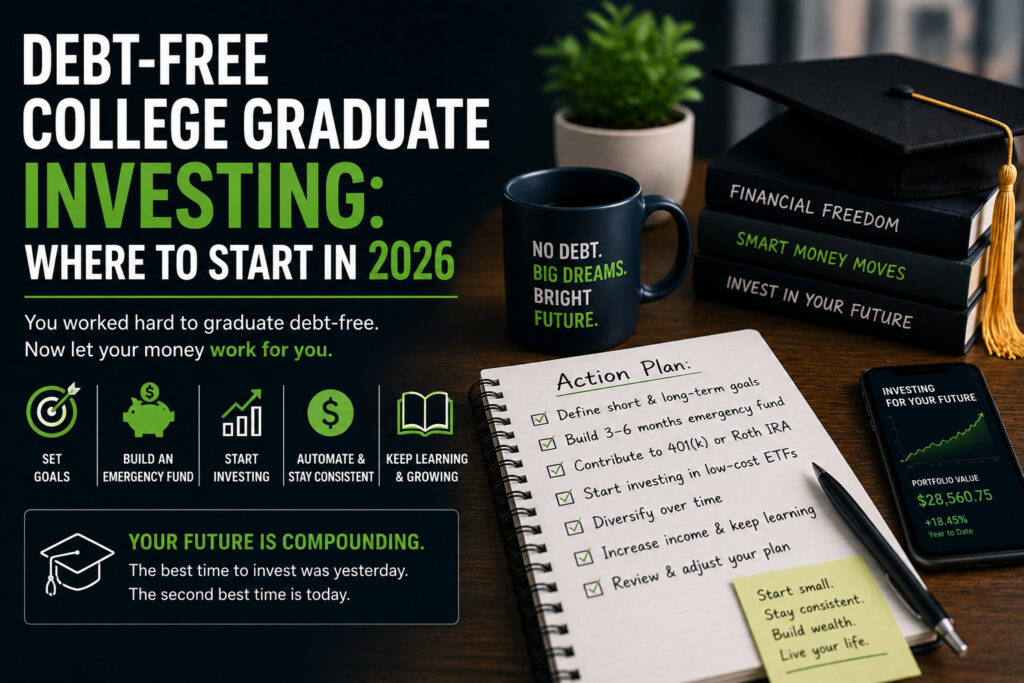
Debt-free college graduate investing is one of the most important topics for US investors in 2026. If you’ve just graduated without student loan debt, you have a rare financial advantage that most of your peers don’t enjoy. This guide will show you exactly how to turn that head start into lasting wealth through smart, beginner-friendly investment strategies.
According to recent data from the Federal Reserve, the average student loan borrower in 2026 carries over $37,000 in debt, with monthly payments exceeding $400. Debt-free graduates can redirect that money straight into wealth-building investments from day one. Starting early with investing creates a compounding advantage that can mean hundreds of thousands of dollars more by retirement, making your first few years after graduation absolutely critical for long-term financial success.
What Is Debt-Free College Graduate Investing?
Debt-free college graduate investing refers to the investment strategies and opportunities available to recent college graduates who enter the workforce without student loan obligations. This unique position allows new graduates to allocate income toward retirement accounts, index funds, and other investment vehicles immediately, rather than spending years paying down educational debt. The fundamental advantage is the ability to harness compound interest from the earliest possible career stage.
For example, a 22-year-old debt-free graduate earning $55,000 annually might invest $500 monthly into a Roth IRA and employer 401(k). Over 40 years with an average 8% annual return, this could grow to over $1.7 million. Meanwhile, a peer with debt might delay investing for 5-10 years while making loan payments, potentially missing out on $500,000 or more in growth due to lost compounding time.
Why Debt-Free College Graduate Investing Matters for US Investors in 2026
The wealth gap between early investors and late starters has never been more pronounced in 2026. With inflation concerns, volatile markets, and uncertain Social Security benefits, starting your investment journey immediately after graduation can mean the difference between comfortable retirement and financial struggle. Data shows that investors who start at age 22 versus age 32 can accumulate nearly double the retirement savings, even when contributing the same total amount over their careers.
- Time Value Advantage: Every year you delay investing costs you exponentially more in lost compound growth. A single $6,000 Roth IRA contribution at age 22 could be worth over $140,000 by age 67 at historical market returns.
- Full Employer Match Capture: Debt-free graduates can immediately maximize employer 401(k) matching, which typically offers 50-100% returns on contributions up to certain limits. Missing this match while paying off debt means leaving free money on the table year after year.
- Risk Tolerance Window: Younger investors can allocate more aggressively to stocks and growth investments since they have decades to recover from market downturns. This higher risk tolerance in your twenties can significantly boost long-term returns compared to conservative strategies required later in life.
- Financial Habit Formation: Starting investments immediately after graduation establishes crucial money management habits during your financial foundation years. These patterns of consistent saving and investing become automatic, making wealth-building effortless rather than a constant struggle.
How to Get Started with Debt-Free College Graduate Investing: Step-by-Step
Getting started with debt-free college graduate investing doesn’t require complex strategies or large sums of money upfront.
- Step 1: Build a Starter Emergency Fund Before investing a single dollar, save $1,000-$2,000 in a high-yield savings account for unexpected expenses. This prevents you from derailing your investment plan by having to sell assets or go into debt when your car breaks down or you face medical bills.
- Step 2: Capture Full Employer 401(k) Match If your employer offers 401(k) matching, contribute at least enough to get the full match, which is typically 3-6% of your salary. This is an immediate 50-100% return on your money, far better than any investment you’ll find elsewhere, making it your absolute first investing priority.
- Step 3: Open and Fund a Roth IRA Open a Roth IRA with a low-cost brokerage like Vanguard, Fidelity, or Schwab and contribute toward the annual limit ($7,000 in 2026 for those under 50). Your contributions grow tax-free forever, and you can withdraw them in retirement without paying taxes, making this ideal for young investors in lower tax brackets.
- Step 4: Invest in Low-Cost Index Funds Within your retirement accounts, invest in broad market index funds like total stock market funds or S&P 500 index funds with expense ratios under 0.10%. These provide instant diversification across hundreds of companies, minimize fees, and historically return 9-10% annually over long periods.
- Step 5: Increase Your Emergency Fund to 3-6 Months Once retirement contributions are established, build your emergency fund to cover 3-6 months of living expenses. This larger cushion protects your investments by ensuring you never need to withdraw them early due to job loss or emergencies, allowing compound growth to work uninterrupted.
- Step 6: Automate and Increase Contributions Annually Set up automatic transfers from each paycheck to your investment accounts, making saving effortless. Commit to increasing your contribution rate by 1-2% whenever you get a raise, ensuring your investment percentage grows with your income.
Debt-Free College Graduate Investing: Common Mistakes to Avoid
Even with the advantage of no student debt, many new graduates make critical errors with debt-free college graduate investing that cost them years of potential growth.
- Mistake 1: Lifestyle Inflation Instead of Investing Many debt-free graduates immediately upgrade their lifestyle with expensive apartments, new cars, and luxury purchases since they lack loan payments. This lifestyle inflation consumes the exact money that should go toward investments, eliminating the debt-free advantage and creating a cycle of living paycheck to paycheck despite good income.
- Mistake 2: Keeping Too Much in Savings Accounts Some conservative graduates keep tens of thousands in regular savings accounts earning minimal interest, fearing market volatility. While emergency funds belong in savings, keeping investment money in accounts earning 1-2% means losing purchasing power to inflation and missing 8-10% average stock market returns over time.
- Mistake 3: Delaying Retirement Contributions Until “Later” New graduates often think they’ll start investing seriously once they earn more money or feel more established in their careers. This delay costs enormous amounts in compound growth, as the first decade of investing contributes disproportionately to total retirement wealth due to the extended time for compounding.
- Mistake 4: Trying to Pick Individual Stocks Excited by their debt-free status and disposable income, some graduates attempt to beat the market through stock picking or cryptocurrency speculation. Statistics show that over 90% of individual investors underperform simple index fund strategies, often losing significant money while learning expensive lessons.
Avoiding these mistakes requires discipline and education about proven investment principles. Start with the fundamentals, automate good habits, and resist the temptation to either overspend your advantage or take unnecessary risks with your capital.
For more information, visit Investopedia or the official SEC website.
Tax Advantages Unique to Debt-Free College Graduate Investing
Debt-free college graduate investing offers specific tax benefits that amplify your wealth-building potential in ways that loan-burdened peers cannot access as easily. Understanding these advantages helps you structure your investments for maximum after-tax returns. Your lower early-career tax bracket combined with immediate investment capacity creates a perfect opportunity for tax-optimized wealth building.
Roth IRA contributions are particularly powerful for recent graduates in the 12% or 22% federal tax brackets. You pay taxes on contributed money now at these low rates, then enjoy completely tax-free growth and withdrawals in retirement when you’ll likely be in higher brackets. Someone contributing $6,000 annually from age 22-32 and never adding another dollar would still have over $400,000 tax-free by age 67, while a traditional IRA would require paying taxes on withdrawals.
Additionally, debt-free graduates can strategically use Health Savings Accounts (HSAs) if they have high-deductible health plans. HSAs offer triple tax advantages: tax-deductible contributions, tax-free growth, and tax-free withdrawals for medical expenses. Many investors use HSAs as “stealth retirement accounts” by paying medical expenses out-of-pocket while young and letting HSA investments grow for decades.
The lack of student loan interest deductions also simplifies your tax situation and removes the perverse incentive some borrowers face to keep debt longer for minor tax benefits. You can focus entirely on tax-advantaged investment growth rather than the complex calculations of whether loan interest deductions outweigh investment returns.
Investment Account Priority for Recent Graduates
Understanding which accounts to fund first maximizes your returns and minimizes taxes throughout your investment journey. This priority system applies specifically to those practicing debt-free college graduate investing and assumes you have no high-interest debt. Following this order ensures you capture the highest-return opportunities before moving to secondary options.
First priority is always employer 401(k) matching contributions, as this provides immediate guaranteed returns of 50-100% that no other investment can match. If your employer matches 50% of contributions up to 6% of salary, that 6% contribution should happen before any other investing. On a $50,000 salary, contributing $3,000 to get $1,500 in matching is an instant 50% return, far exceeding market averages.
Second priority is fully funding a Roth IRA to the annual limit, currently $7,000 for those under 50 in 2026. The tax-free growth makes this account incredibly valuable for young investors who have decades for compounding. Even if you later earn too much to contribute directly to a Roth IRA, these early years of contributions establish a foundation that grows tax-free forever.
Third priority is returning to your 401(k) to contribute beyond the match, ideally reaching 15-20% of gross income in total retirement savings. Many financial advisors recommend this level to ensure comfortable retirement, and debt-free graduates can reach this threshold much earlier than peers with loan obligations. Once you hit this percentage, you’re well ahead of most Americans in retirement preparedness.
Fourth priority includes taxable brokerage accounts for additional investments beyond retirement limits, HSAs if available, and 529 plans if you plan to have children. These accounts lack the tax advantages of retirement accounts but provide flexibility for pre-retirement goals like home down payments or creating passive income streams.
Building Wealth Beyond Retirement Accounts
While retirement accounts form the foundation of debt-free college graduate investing, young investors with no loan payments often have capacity to build wealth in additional ways. These supplementary strategies provide flexibility, earlier access to funds, and diversification beyond traditional retirement investing. The key is balancing these opportunities with maintaining adequate retirement contributions.
Taxable brokerage accounts allow you to invest unlimited amounts in index funds without contribution caps or withdrawal penalties. While you’ll pay capital gains taxes on profits, long-term capital gains rates are favorable at 0%, 15%, or 20% depending on income. These accounts provide access to funds before age 59½ without penalties, making them ideal for medium-term goals like real estate down payments or pre-retirement financial independence.
Real estate investing becomes accessible much sooner for debt-free graduates who can save for down payments rapidly. House hacking, where you rent out rooms in a purchased home to cover mortgage costs, has created wealth for countless young investors. Starting real estate investing in your twenties provides decades for property appreciation and rental income growth.
Some debt-free graduates allocate small portions of their portfolio to alternative investments like peer-to-peer lending, REITs, or carefully researched individual stocks. These should represent no more than 5-10% of total investments, serving as educational opportunities rather than core wealth-building strategies. The majority should always remain in proven index fund approaches.
How Much Should Debt-Free Graduates Invest Monthly?
Determining your investment amount balances aggressive wealth-building with maintaining quality of life and financial security. Debt-free college graduate investing strategies typically recommend saving 20-30% of gross income when possible, though this varies based on living costs and income levels. The absence of loan payments makes these high savings rates achievable where they’d be impossible for debt-burdened peers.
A common framework is the 50/30/20 budget: 50% of after-tax income to needs, 30% to wants, and 20% to savings and investments. However, debt-free graduates can often achieve 30/30/40 or even more aggressive splits, especially while living with roommates or parents early in their careers. Every percentage point above 20% dramatically accelerates your path to financial independence.
Consider this comparison: on a $55,000 salary, investing 15% ($687 monthly) versus 25% ($1,146 monthly) creates a difference of over $500,000 after 30 years at 8% returns. That nine-year gap between reaching $1 million demonstrates how critical high savings rates are in your twenties. The short-term sacrifice of living frugally pays exponential long-term dividends.
Start with whatever percentage captures your full employer match, then increase by 1% every few months until you reach at least 20% total. This gradual approach prevents the shock of suddenly having much less spending money. Many investors find that once investing becomes automatic, they don’t miss the money and actually enjoy watching their net worth grow more than they enjoyed the extra spending.
Frequently Asked Questions About Debt-Free College Graduate Investing
What is debt-free college graduate investing and how does it work?
Debt-free college graduate investing is the practice of immediately directing income toward retirement accounts, index funds, and other investments upon entering the workforce without student loan obligations. It works by taking the money that would otherwise go to loan payments, typically $400-$600 monthly, and investing it in tax-advantaged accounts where compound growth multiplies it over decades. This creates a substantial wealth advantage compared to peers who must delay investing while paying down educational debt.
Is debt-free college graduate investing a good option for beginners?
Yes, debt-free college graduate investing is ideal for beginners because it establishes wealth-building habits early and provides decades for compound growth to work. Simple strategies like index fund investing through Roth IRAs and employer 401(k) plans require minimal knowledge while delivering excellent results. The margin for error is also larger when you start young, as you have time to recover from mistakes and learn through experience without jeopardizing retirement security.
How much money do I need to start with debt-free college graduate investing?
You can start debt-free college graduate investing with as little as $50-$100 per month, though more is better for accelerating wealth building. Many brokerages now offer fractional shares and no minimum investments, removing traditional barriers to entry. The important factor is starting immediately rather than waiting to accumulate a large sum, as consistent small contributions beginning in your early twenties outperform larger contributions that start later due to compound interest dynamics.
What are the risks of debt-free college graduate investing?
The primary risks include market volatility reducing account values in the short term, though this is mitigated by decades of investment horizon for young graduates. Lifestyle inflation can also derail investing plans if graduates increase spending instead of investing their debt-free advantage. Finally, some new investors take excessive risks trying to beat the market through stock picking or cryptocurrency speculation, potentially losing money that should be growing steadily in index funds.
Should I invest or save for a house down payment as a debt-free graduate?
This depends on your timeline and housing market, but generally you should do both by prioritizing retirement accounts for their tax advantages and matching, while simultaneously saving for a down payment in a high-yield savings account. If you plan to buy within 3-5 years, allocate more toward down payment savings after capturing employer match. If homeownership is 5+ years away, maximize retirement contributions now since you can’t go back and recapture those years of tax-advantaged compound growth later.
How does debt-free college graduate investing differ from normal investing?