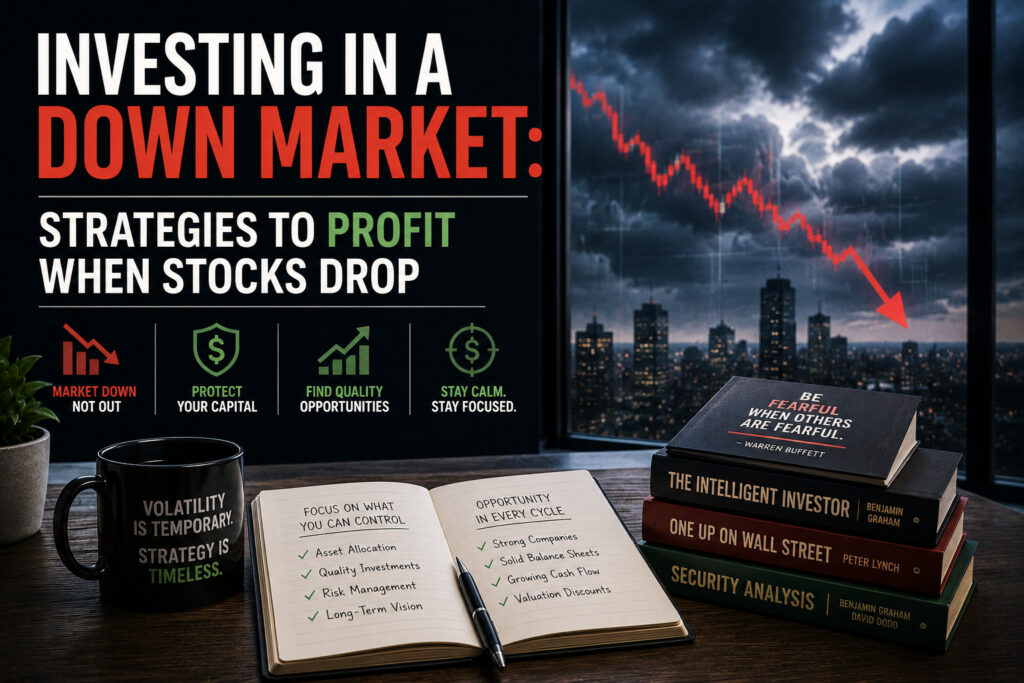
Investing in a down market is one of the most important topics for US investors in 2026. When stocks are falling and portfolios are shrinking, many investors panic and sell at the worst possible time. But savvy investors know that downturns create some of the best opportunities to build long-term wealth if you have the right strategies in place.
Market corrections and bear markets are a normal part of the economic cycle, yet they catch many investors off guard. According to historical data, the S&P 500 experiences a correction of 10% or more approximately once every two years, and a bear market of 20% or more about once every six years. Understanding how to navigate these downturns can mean the difference between retiring comfortably and struggling financially.
What Is Investing in a Down Market?
Investing in a down market refers to the practice of buying stocks, bonds, and other securities during periods when asset prices are declining or depressed. Rather than sitting on the sidelines in cash or selling positions at a loss, strategic investors use downturns as opportunities to acquire quality assets at discounted prices. This approach requires emotional discipline, a long-term perspective, and confidence in the eventual recovery of markets.
For example, during the 2020 COVID-19 market crash, the S&P 500 fell nearly 34% from its February peak to its March low. Investors who bought during that downturn and held their positions saw remarkable gains as the market recovered and reached new all-time highs within months. This illustrates how temporary fear can create lasting opportunities for those willing to invest when others are retreating.
Why Investing in a Down Market Matters for US Investors in 2026
With inflation concerns, geopolitical tensions, and potential interest rate changes affecting markets in 2026, understanding how to navigate volatility is critical. Recent data shows that investors who remained invested during market downturns historically earned average annual returns of 10.7% over 20-year periods, compared to just 6.1% for those who missed the 10 best trading days during recoveries. The ability to stay invested and even add to positions during declines has proven to be one of the most reliable paths to wealth accumulation.
- Lower Entry Prices: Down markets allow you to purchase quality stocks at significant discounts to their intrinsic value, improving your potential for long-term returns. When blue-chip companies trading at premium valuations suddenly become available at 20-30% discounts, your dollar buys more shares and future growth potential.
- Dollar-Cost Averaging Benefits: Continuing to invest regular amounts during downturns means you automatically buy more shares when prices are low and fewer when prices are high. This mechanical approach removes emotion from the equation and can significantly improve your average cost basis over time.
- Dividend Yield Opportunities: As stock prices fall, dividend yields rise for companies that maintain their payouts, providing more income per dollar invested. A stock paying a $2 annual dividend yields 2% at $100 per share but yields 4% at $50 per share, doubling your income return.
- Rebalancing Advantages: Down markets create ideal conditions to rebalance your portfolio back to your target allocation, forcing you to buy low and sell high. This disciplined approach to portfolio management has been shown to add 0.5% to 1% in additional annual returns over time.
How to Get Started with Investing in a Down Market: Step-by-Step
Successfully investing in a down market requires a clear plan and the discipline to execute it when fear is high and uncertainty abounds.
- Step 1: Assess Your Financial Foundation: Before investing during a downturn, ensure you have an emergency fund covering 3-6 months of expenses and no high-interest debt. This financial cushion prevents you from being forced to sell investments at the worst possible time if you face unexpected expenses or job loss.
- Step 2: Determine Your Investment Timeline: Money you’ll need within the next 3-5 years shouldn’t be invested in volatile assets, even at discounted prices. Only invest funds you can afford to leave untouched for at least five years, allowing sufficient time for markets to recover and grow beyond their previous highs.
- Step 3: Choose Your Investment Strategy: Decide whether you’ll use dollar-cost averaging with regular investments, deploy lump sums at specific price levels, or employ a hybrid approach. Each strategy has merit, but the key is committing to your plan before emotions take over during market turbulence.
- Step 4: Select Quality Investments: Focus on established companies with strong balance sheets, consistent cash flows, and competitive advantages that will survive and thrive through economic cycles. Low-cost index funds like the Vanguard S&P 500 ETF (VOO) or the Schwab U.S. Broad Market ETF (SCHB) provide instant diversification and remove the need to pick individual stocks.
Investing in a Down Market: Common Mistakes to Avoid
Many beginners struggle with investing in a down market because they let emotions override logic and abandon proven strategies at critical moments.
- Mistake 1: Trying to Time the Bottom: Waiting for the absolute lowest point before investing means you’ll likely miss the opportunity entirely, as markets don’t ring a bell at bottoms. Research shows that even professional fund managers consistently fail to time market bottoms and tops accurately, so beginners should focus on price ranges rather than perfect timing.
- Mistake 2: Investing Money You Can’t Afford to Lose: Using emergency funds, rent money, or borrowed funds to invest during a downturn can lead to forced selling at losses if you need the cash. Always invest only discretionary funds that you can genuinely afford to see decline further before eventually recovering.
- Mistake 3: Abandoning Your Strategy After Further Declines: Markets often fall further than anyone expects, and selling after your positions decline an additional 10-20% locks in losses and eliminates your recovery potential. The investors who profit most from down markets are those who maintain conviction and continue executing their plan even when positions move against them initially.
Building knowledge through reputable sources helps you develop the confidence to invest during challenging times. Consider reading research reports, market analyses, and historical case studies to understand how previous downturns unfolded and rewarded patient investors.
For more information, visit Investopedia or the official SEC website.
Frequently Asked Questions About Investing in a Down Market
What is investing in a down market and how does it work?
Investing in a down market means purchasing stocks, bonds, ETFs, or other securities when their prices have fallen significantly from recent highs. The strategy works on the principle that quality assets eventually recover their value and grow over time, so buying at temporarily depressed prices improves your long-term returns. This approach requires maintaining a long-term perspective and resisting the emotional urge to sell when everyone else is panicking.
Is investing in a down market a good option for beginners?
Yes, but beginners should start with diversified index funds rather than individual stocks to reduce risk. Dollar-cost averaging with modest amounts allows beginners to build positions gradually without the pressure of timing decisions. The key is having realistic expectations, understanding that further declines are possible, and committing to a multi-year timeline for your investments to recover and grow.
How much money do I need to start with investing in a down market?
Many brokerages now offer fractional shares and have eliminated account minimums, so you can start with as little as $10 to $100. The amount matters less than consistency and percentage of income invested over time. Most financial advisors recommend investing 10-20% of your income, but even starting with $50 or $100 monthly can build substantial wealth over decades through compound growth.
What are the risks of investing in a down market?
The primary risk is that markets can continue falling after you invest, leading to temporary paper losses that test your emotional resolve. Companies you invest in could cut dividends, face bankruptcy, or permanently lose value if economic conditions deteriorate severely. These risks are why diversification through index funds, maintaining an emergency fund, and investing only money you won’t need for 5+ years are critical safeguards.
Conclusion: Is Investing in a Down Market Right for You?
Investing in a down market has historically been one of the most reliable ways to build long-term wealth, but it requires discipline, patience, and a sound strategy. By understanding the principles of buying quality assets at discounted prices, maintaining regular investments through dollar-cost averaging, and avoiding common emotional mistakes, you can position yourself to profit from market volatility rather than fear it. The strategies outlined in this guide provide a framework for turning market downturns into opportunities that accelerate your path to financial independence.
If you are ready to take the next step with investing in a down market, start your investment journey today and build the financial future you deserve.