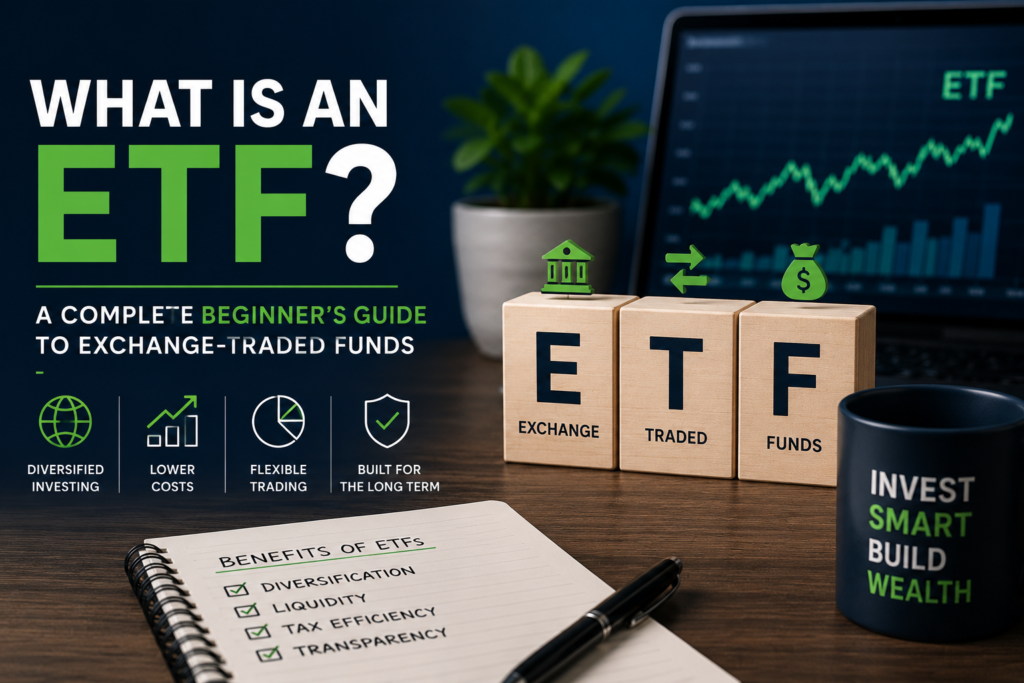
What Is an ETF? A Complete Beginner’s Guide to Exchange-Traded Funds

Understanding Exchange-Traded Funds: the building block of modern investing.
1. What Is an ETF? The Clear Definition
What is an ETF, in the simplest possible terms? The acronym stands for Exchange-Traded Fund. Think of it as a shopping basket filled with many different investments. Instead of buying one share of Apple, one share of Microsoft, and one share of Tesla separately, you buy one ETF share that already holds all three — plus dozens or hundreds more.
The “exchange-traded” part means you can buy and sell ETF shares at any moment during market hours, exactly as you would with a company’s stock. The price fluctuates in real time based on supply and demand and the value of the underlying assets.
ETFs were first introduced in the early 1990s. The very first U.S.-listed ETF — the SPDR S&P 500 ETF (ticker: SPY) — launched in January 1993 and remains one of the most heavily traded securities in the world today. Since then, the ETF industry has grown to over $12 trillion in global assets under management, making ETFs one of the most popular investment vehicles for both retail and institutional investors.
2. How Do ETFs Work?
To understand how an ETF works, you need to know about three key participants: the ETF issuer, authorized participants (APs), and ordinary investors like you.
The Creation / Redemption Mechanism
This is the engine that keeps ETF prices closely aligned with the value of their underlying holdings. Here is how it works:
- An asset manager (issuer) — such as BlackRock, Vanguard, or State Street — designs the ETF and decides what assets it will hold and in what proportions.
- Authorized participants (large financial institutions) buy the underlying basket of securities on the open market and deliver them to the issuer.
- In return, the issuer hands the AP a block of ETF shares, called a creation unit (typically 50,000 shares).
- The AP then sells those shares on a stock exchange where you — the everyday investor — can purchase them.
- If demand pushes the ETF price above its Net Asset Value (NAV), APs create more shares to bring the price back down. If it falls below NAV, they buy ETF shares and redeem them for the underlying assets — pushing the price back up.
This arbitrage mechanism means that what is an ETF price at any given moment will be very close to the fair value of everything it holds — a key feature that makes ETFs efficient and transparent.

The ETF creation/redemption mechanism keeps market price aligned with the fund’s net asset value (NAV).
The Role of the Index
Most ETFs are passively managed: they track a benchmark index such as the S&P 500, the MSCI World, or the Bloomberg U.S. Aggregate Bond Index. The fund simply buys and holds the same securities in the same proportions as the index, making very few trades and keeping costs low.
A smaller number of ETFs are actively managed, where a portfolio manager makes decisions about which securities to include, aiming to beat the market. These tend to have higher fees.
3. Types of ETFs: Which One Is Right for You?
One reason ETFs have become so popular is the sheer variety available. Here is an overview of the most common types:
| ETF Type | What It Holds | Best For |
|---|---|---|
| Stock (Equity) ETF | Shares of companies (e.g., S&P 500 ETF) | Long-term growth seekers |
| Bond (Fixed-Income) ETF | Government or corporate bonds | Income-focused / conservative investors |
| Commodity ETF | Gold, oil, agricultural goods | Inflation hedge / diversification |
| Sector ETF | Stocks in a specific industry (tech, healthcare…) | Thematic / high-conviction bets |
| International ETF | Stocks outside your home country | Global diversification |
| Real Estate ETF (REIT ETF) | Real estate investment trusts | Real estate exposure & dividend income |
| Dividend ETF | High-dividend-paying stocks | Passive income investors |
| Inverse / Leveraged ETF | Derivatives designed to amplify or reverse returns | Advanced traders only |
| ESG ETF | Companies meeting environmental & social criteria | Values-based investors |
4. ETF vs. Mutual Fund: Key Differences
Many beginners ask: if a mutual fund also holds a basket of securities, what is an ETF doing differently? The table below summarizes the critical distinctions:
| Feature | ETF | Mutual Fund |
|---|---|---|
| Trading | Throughout the day on an exchange | Once per day after market close (NAV price) |
| Minimum investment | Price of 1 share (sometimes $1 with fractional) | Often $500–$3,000+ |
| Fees (expense ratio) | Typically 0.03%–0.50% | Typically 0.50%–1.50% (actively managed) |
| Tax efficiency | High (in-kind creation/redemption minimizes taxable events) | Lower (fund must sell assets to meet redemptions) |
| Transparency | Holdings disclosed daily | Holdings typically disclosed quarterly |
| Management style | Mostly passive (index-tracking) | Often actively managed |
For most long-term beginner investors, ETFs win on cost and flexibility. That said, some actively managed mutual funds have delivered strong returns — but consistent outperformance is rare and difficult to predict.
5. ETF vs. Individual Stocks
Buying individual stocks can be rewarding, but it requires significant research and tolerance for concentration risk. Here is how ETFs compare:
- Diversification: One ETF can give you exposure to 500 companies (e.g., S&P 500 ETF) or even thousands. Buying 500 individual stocks would be impractical and expensive.
- Risk: If one company in an ETF collapses, your loss is limited to its small weighting. A single stock that collapses can wipe out your entire position.
- Returns: Some individual stocks can massively outperform an ETF. But the majority of professional stock pickers fail to beat the index over 10 years — a strong argument for ETFs.
- Effort: ETFs require minimal research and maintenance. Stock picking demands continuous monitoring.
Many experienced investors hold both: a core portfolio of broad-market ETFs for stability, plus a small “satellite” allocation to individual stocks they believe in strongly.
6. 7 Major Benefits of Investing in ETFs
Understanding what is an ETF is one thing — but why should you actually invest in one? Here are the seven most compelling reasons:
① Instant Diversification
A single ETF purchase can spread your money across hundreds or thousands of securities, industries, and even countries. Diversification is the closest thing to a “free lunch” in investing — it reduces risk without necessarily reducing expected returns.
② Low Costs
Many index ETFs charge an annual expense ratio below 0.10%. On a $10,000 investment, that’s just $10 per year. Compounded over decades, the difference between a 0.05% ETF and a 1.00% mutual fund can amount to tens of thousands of dollars.
③ Flexibility & Liquidity
You can buy or sell an ETF at any point during market hours. There are no lock-up periods and no waiting until end of day for your price to be set.
④ Transparency
Most ETFs publish their full list of holdings every single trading day. You always know exactly what you own.
⑤ Tax Efficiency
Because of the unique creation/redemption mechanism, ETFs rarely distribute capital gains to shareholders — meaning you typically only pay capital gains tax when you sell, not every time the fund rebalances.
⑥ Accessibility
With fractional shares available at many brokerages, you can invest in premium ETFs with as little as $1. There is virtually no barrier to entry.
⑦ Variety
From U.S. large-cap stocks to emerging market bonds, from gold to clean energy, there is an ETF for almost any investment thesis you can imagine.
7. Risks of ETFs You Must Know
No investment is risk-free, and ETFs are no exception. Here are the key risks every beginner should understand:
- Market Risk: If the market falls, so does your ETF. A broad S&P 500 ETF lost roughly 34% of its value in the COVID crash of March 2020 (though it fully recovered within months).
- Tracking Error: An ETF may not perfectly replicate its benchmark index. Small deviations — called tracking error — can slightly affect your returns.
- Liquidity Risk: Niche or thinly traded ETFs may have wide bid-ask spreads, meaning you could pay more when buying or receive less when selling. Stick to high-volume ETFs as a beginner.
- Currency Risk: International ETFs expose you to exchange rate fluctuations that can impact returns when converted back to your home currency.
- Concentration Risk (Sector ETFs): A technology-sector ETF might hold 30% of its assets in just a handful of mega-cap companies, creating hidden concentration risk.
- Closure Risk: Small ETFs with low assets under management can be shut down. You’ll receive the NAV of your shares, but there may be tax consequences.
8. How to Invest in ETFs: Step-by-Step Guide
Ready to put your knowledge of what is an ETF into practice? Follow these five steps to make your first ETF investment:
- Choose a Brokerage Account. Open an account with a reputable online broker — popular options include Fidelity, Charles Schwab, Interactive Brokers (for EU/international investors), or Trade Republic. Look for zero-commission ETF trading and fractional shares.
- Fund Your Account. Transfer money from your bank account to your brokerage. Most platforms accept bank transfers, and some support instant funding via debit card.
- Research Your ETF. Look up the ETF’s ticker symbol, check its expense ratio, AUM, and top holdings. Resources like ETF.com or the issuer’s own website are reliable starting points.
-
Place Your Order. Search for the ticker (e.g.,
VOOfor Vanguard S&P 500 ETF) and place a limit order (you specify the maximum price you’re willing to pay) rather than a market order to avoid overpaying, especially for less liquid ETFs. - Hold and Review Periodically. ETF investing rewards patience. Review your portfolio every 6–12 months to rebalance if needed, not every day.

A simple five-step process to make your first ETF investment.
9. Popular ETFs for Beginners in 2026
Not sure where to start? Here are some of the most widely held ETFs that are beginner-friendly — well-diversified, liquid, and low-cost. (This is not financial advice; always do your own research.)
| ETF Name | Ticker | What It Tracks | Expense Ratio |
|---|---|---|---|
| Vanguard S&P 500 ETF | VOO | S&P 500 (500 largest U.S. companies) | 0.03% |
| iShares Core MSCI World ETF | IWDA | 1,500+ companies across 23 developed countries | 0.20% |
| Vanguard Total Stock Market ETF | VTI | Entire U.S. stock market (~4,000 stocks) | 0.03% |
| Invesco QQQ Trust | QQQ | NASDAQ-100 (top 100 non-financial tech stocks) | 0.20% |
| iShares Core U.S. Aggregate Bond ETF | AGG | U.S. investment-grade bonds | 0.03% |
| Vanguard FTSE All-World ETF | VWCE | 3,800+ stocks worldwide (popular in Europe) | 0.22% |
Start Investing Smarter with InvestClarify
Get plain-English guides on ETFs, stocks, and personal finance delivered straight to your inbox. No jargon. No fluff.
10. Frequently Asked Questions About ETFs
What is an ETF in simple terms?
An ETF (Exchange-Traded Fund) is a basket of securities — such as stocks, bonds, or commodities — that trades on a stock exchange just like a single share. It allows investors to gain diversified exposure to many assets through one purchase, usually at a low cost.
How much money do I need to start investing in ETFs?
You can start investing in ETFs with as little as the price of one share, which ranges from around $1 to several hundred dollars depending on the fund. Many brokerages also offer fractional shares, so you can begin with literally any amount — even $1.
Are ETFs safer than individual stocks?
ETFs are generally considered less risky than individual stocks because they hold many securities at once, spreading risk through diversification. However, they are still subject to market risk and can lose value during market downturns.
What is the difference between an ETF and a mutual fund?
Both hold a basket of assets, but ETFs trade on an exchange throughout the day like a stock, usually have lower fees, and are more tax-efficient. Mutual funds are priced once per day after market close and often carry higher expense ratios, especially if actively managed.
Do ETFs pay dividends?
Yes. Many ETFs pass the dividend income generated by their underlying securities on to shareholders, usually on a quarterly basis. Some brokerages offer automatic dividend reinvestment (DRIP), compounding your returns over time.
What is an ETF expense ratio?
The expense ratio is the annual fee charged by the ETF provider, expressed as a percentage of your investment. For example, a 0.03% expense ratio on a $10,000 investment costs just $3 per year. It is automatically deducted from the fund’s returns — you never write a check for it.
Conclusion: What Is an ETF and Should You Invest?
So, what is an ETF? It is arguably the most beginner-friendly, cost-efficient, and flexible investment vehicle available to everyday investors today. Whether you are looking to build long-term wealth, generate passive income, hedge against inflation, or simply get started in investing without being overwhelmed, there is almost certainly an ETF designed for your goal.
The key takeaways from this guide:
- An ETF is a basket of securities that trades on a stock exchange like a single stock.
- Most ETFs passively track an index, keeping costs very low.
- ETFs offer diversification, liquidity, transparency, and tax efficiency all in one package.
- There are many types: equity, bond, commodity, sector, international, dividend, and more.
- To invest, open a brokerage account, choose your ETF by ticker, and place your order.
- Understand the risks — market risk, tracking error, and liquidity — before investing.
As with any investment, the best time to start is now — and the second best time is tomorrow. Small, consistent contributions to a diversified ETF portfolio can compound into significant wealth over the long term.
At InvestClarify, our mission is to make financial concepts accessible to everyone. If you found this guide helpful, explore our related articles below and consider subscribing to our newsletter for weekly investing insights.
Disclaimer: The information provided in this article is for educational purposes only and does not constitute financial advice. Always consult a qualified financial advisor before making investment decisions. Investing involves risk, including the possible loss of principal.